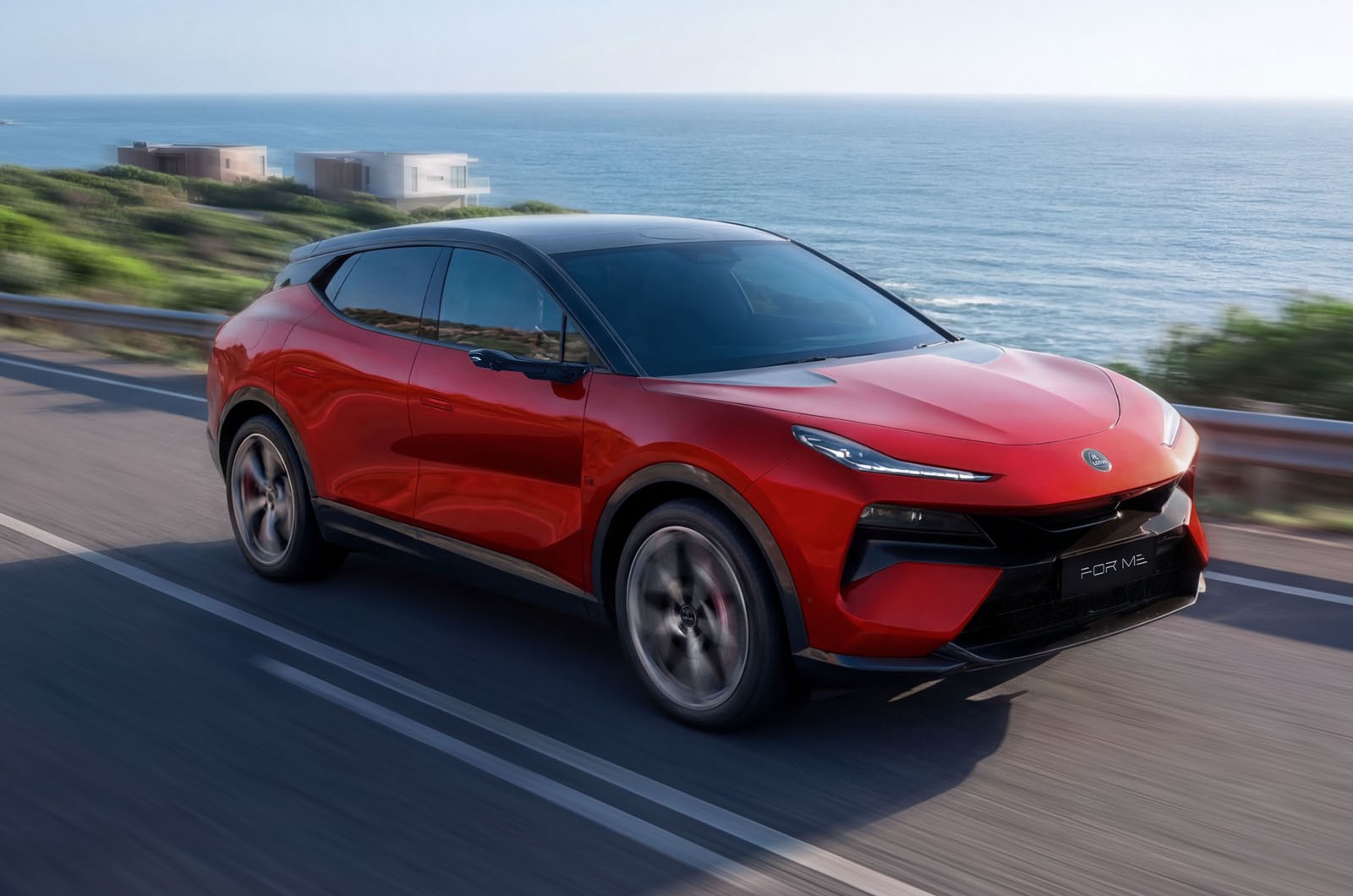
Lotus has reversed course on its all-electric commitment, unveiling a plug-in hybrid (PHEV) version of its Eletre SUV set to arrive in Europe this June. The move marks a significant shift for the Geely-owned brand, catering to a wider customer base hesitant to fully embrace electric vehicles.
Hybrid Power and Performance
The Eletre PHEV, marketed as “For Me” in China and “Eletre X” in Europe, pairs a 2.0-liter turbocharged petrol engine with dual electric motors, generating a combined 939bhp. This surpasses the maximum output of the pure-electric Eletre R by 47bhp, delivering a claimed 0-62mph acceleration in just 3.3 seconds.
The powertrain features a 70kWh battery – smaller than the EV’s 108kWh pack – offering an electric-only range of 217 miles (WLTP cycle). The combined range reaches approximately 750 miles, though this figure is dependent on driving conditions and usage. The battery supports ultra-fast 6C charging, capable of boosting it from 30% to 80% in under eight minutes.
Positioning Against Luxury Rivals
Lotus is directly positioning the Eletre X against high-performance luxury SUVs like the Lamborghini Urus and Ferrari Purosangue. The Urus, now exclusively available as a PHEV with 789bhp, serves as a key benchmark for Lotus. CEO Feng Qingfeng explicitly referenced these competitors at the launch event, signaling Lotus’s ambition to compete at the high end of the market.
Technology and Chassis Refinement
The Eletre X incorporates Lotus’s 6D Digital Dynamic Chassis, equipped with an adaptive 48V anti-roll bar. This technology aims to counter the “boat-like” handling often found in larger SUVs, improving stability and responsiveness. The vehicle’s weight ranges from 2575kg to 2625kg, similar to the all-electric Eletre.
Strategic Shift and Financial Implications
Lotus’s decision to offer a PHEV is driven by slower-than-expected sales of its fully electric models. The company previously pledged to go EV-only by 2028, but shifting market realities forced a pivot. CEO Feng Qingfeng emphasized that PHEVs will boost sales in regions where EV adoption is lagging, such as Italy and Saudi Arabia.
The launch of PHEVs is also expected to improve Lotus’s profitability, as the company reported a $357 million operating loss for the first nine months of 2025. The hybrid model provides an alternative for customers unwilling to make the full transition to electric power.
Lotus’s hybrid strategy is a pragmatic response to market conditions, opening up sales channels previously closed by consumer hesitancy towards EVs. This pivot could be crucial for the brand’s financial turnaround.
Lotus also plans a PHEV version of its Emira sports car, timed to align with the Euro 7 emissions standards in 2027. The underlying “X-hybrid” technology is shared with Lotus sibling Zeekr’s 9X SUV, suggesting potential for future performance upgrades.