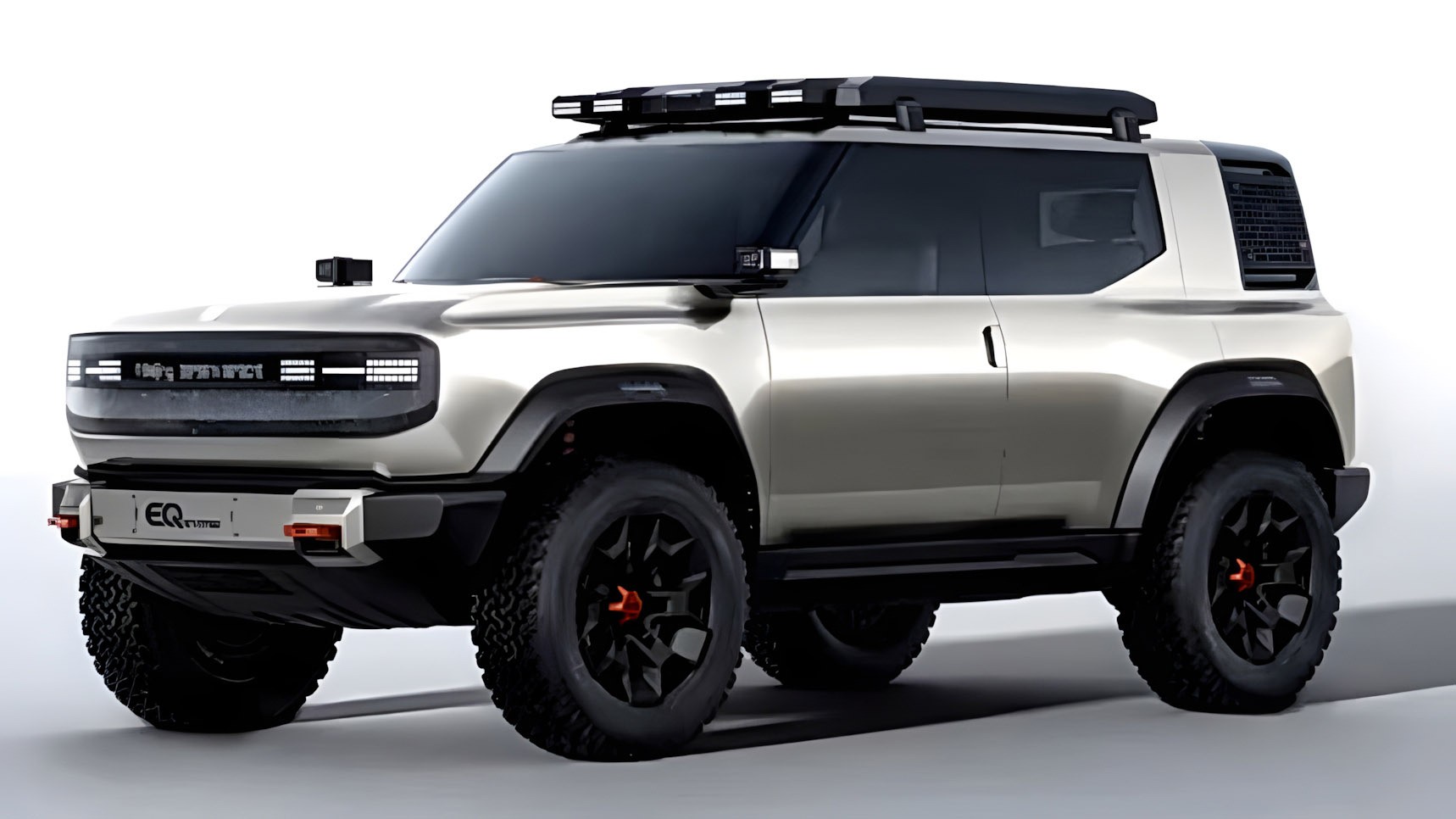
The Beijing Auto Show has unveiled a new contender in the growing “lifestyle off-roader” segment: the Dongfeng EQ-REBORN. While the Chinese automaker presents the concept as a modern tribute to its rugged 1975 EQ240 military vehicle, the design has sparked immediate comparisons—not to vintage military hardware, but to the upcoming Scout Traveler from the American brand Scout Motors.
A Heritage Story or a Design Mirror?
Dongfeng’s marketing narrative focuses on “intelligent light off-roading” and a deep connection to its historical lineage. By invoking the legacy of the EQ240, the brand attempts to ground the EQ-REBORN in a sense of purpose and durability.
However, the visual evidence suggests a different inspiration. The similarities between the EQ-REBORN and the Scout Traveler extend far beyond a simple shared silhouette. Observers have noted several striking parallels:
– The Front Fascia: A distinctively blunt, “bluff” nose.
– Side Profile: Flat, slab-sided bodywork that emphasizes a rugged aesthetic.
– Roofline: A “floating roof” treatment that creates a modern, premium feel.
– Greenhouse: An upright, boxy window arrangement typical of modern adventure vehicles.
While the EQ240 was a utilitarian battlefield tool, the EQ-REBORN leans heavily into the aesthetic of a modern, lifestyle-oriented EV—a direction that aligns almost perfectly with Scout Motors’ current rebranding efforts.
The “Copy-Paste” Trend in Global Automaking
This incident is not an isolated case but rather a reflection of a broader trend within the global automotive industry. Chinese manufacturers have frequently navigated the thin line between being “inspired by” Western designs and direct imitation.
In many instances, the industry sees a pattern where:
1. Concept Testing: Designs are rapidly prototyped to gauge market interest.
2. Speed to Market: Chinese manufacturers often move from concept to production much faster than traditional Western legacy brands.
3. Aesthetic Convergence: As the industry shifts toward electric SUVs, many brands are gravitating toward the same “retro-futurist” design language, leading to frequent visual overlaps.
Uncertainty Surrounding the EQ-REBORN
At this stage, much of what we know about the EQ-REBORN is purely cosmetic. Dongfeng has yet to release concrete technical specifications, such as battery capacity, motor output, or range. Much of the promotional material, including recent video reveals, appears to rely heavily on AI-generated imagery, suggesting the vehicle may still be in the early stages of development rather than being a production-ready model.
The irony of the situation is noted by industry analysts: as Scout Motors works through the complex logistical challenges of launching a new American EV brand, a competitor has already arrived with a design that looks remarkably like the finished product.
The EQ-REBORN highlights a growing tension in the auto industry: as Western brands attempt to revive iconic names, they face immediate competition from manufacturers capable of replicating those same “heritage” aesthetics at high speed.
The EQ-REBORN currently serves as a styling exercise that underscores the rapid, often controversial, pace of design evolution in the Chinese automotive market.