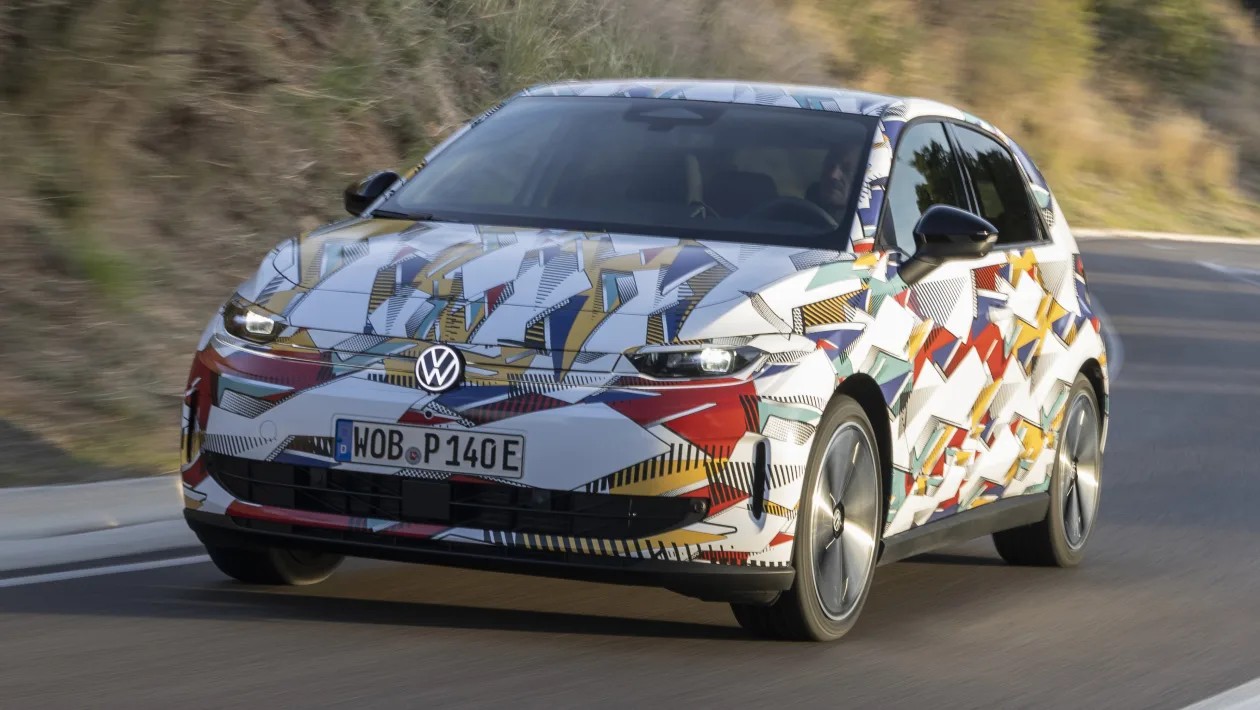
Volkswagen appears to be correcting course with its upcoming ID. Polo, an all-electric supermini that early testing suggests represents a significant leap forward from the brand’s initial electric vehicle (EV) efforts. Engineers and designers behind the project express cautious optimism, acknowledging past shortcomings in quality, driving dynamics, and technology execution in earlier ID models like the ID.3 and ID.4. The ID. Polo is the first in a new era for VW, one driven by a more realistic understanding of customer expectations.
Design and First Impressions
The ID. Polo confidently displays a modern Volkswagen aesthetic, sitting wide and low with 19-inch wheels. Even under camouflage, the design features smooth surfaces and integrated lighting, clearly inspired by the ID.2All concept. The production version remains remarkably close to that concept, which is impressive given the cost and practicality constraints of the supermini segment.
Inside, the cabin feels markedly improved over previous ID products. Visibility is good, with adjustable seating and steering, and the interior features a wider center console with cupholders and smartphone storage. Materials used feel significantly higher quality than those in the current combustion-engine Polo, and recycled fabrics are expected to enhance the cabin’s overall feel.
User Interface Refinements
Volkswagen has addressed usability complaints from earlier models. The digital UI is cleaner and more intuitive, with easier access to safety system controls. Physical climate control buttons are back, replacing the frustrating single-row window switches. The oblong steering wheel is ergonomically improved, and the button layout is more clearly tied to the driver’s information screen. This represents a clear response to customer feedback on interior usability.
Driving Dynamics and Performance
The ID. Polo drives silently and smoothly, even on larger wheels. It shares a similar MEB+ chassis with the Cupra Raval, featuring a front-mounted electric motor and a torsion-bar rear suspension for maximized boot space (437 liters). Two battery options will be available: a 37kWh LFP and a higher-spec 54kWh NMC, offering up to 279 miles of range with 130kW charging capability.
Four power options, up to 207bhp, will be offered, with a 227bhp GTI version planned for the future. The car’s ride quality is surprisingly refined, with a stable rear-axle geometry contributing to settled handling. The brakes have been redeveloped for consistent modulation, blending regenerative and friction braking seamlessly.
The steering is well-weighted and responsive, providing an engaging driving experience without being overly sensitive. The ID. Polo feels grounded and comfortable, a significant improvement over previous MEB-platform vehicles.
A Course Correction for Volkswagen
The ID. Polo isn’t designed to disrupt the market; it’s engineered to be a high-quality, well-executed daily driver. It represents a return to VW’s core competency: building competent, reliable, and well-engineered cars. The success of this model will depend on its pricing in key markets like the UK.
This prototype signals that Volkswagen has learned from past mistakes, prioritizing usability, quality, and driving experience in its next-generation EVs. The ID. Polo isn’t about extravagance; it’s about delivering what customers expect from a Volkswagen.