


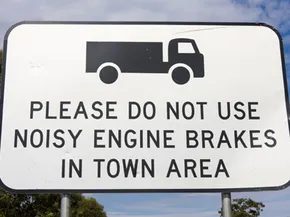
“No Engine Brake.” You see this yellow diamond sign on highway exits or steep downgrades and wonder why a truck driver is being asked to keep their engine quiet. It isn’t about noise pollution alone. It’s about physics. And safety.
That sign warns against using the compression brake system. Often called an engine retarding device, this mechanism changes how a diesel engine operates to slow the vehicle without grinding down traditional friction brakes. For heavy haulers descending mountain passes, it is a lifesaver. Without it, they might not stop in time.
How Compression Brakes Actually Work
To understand the noise, you have to look inside the cylinder. A standard four-stroke diesel engine cycles through intake, compression, power, and exhaust. In normal operation, the compression stroke traps air, fuel injects, and the resulting explosion pushes the piston down. That’s the power stroke.
A compression brake modifies this cycle. It pops open the exhaust valve just before top dead center. Instead of compressing that air and getting energy back from the explosion, the engine vents the compressed air out early. The piston has to work against that trapped pressure on the upswing. It’s like trying to pump a bicycle tire while someone blocks the nozzle.
The engine essentially becomes an air compressor. Gravity pulls the truck down the hill, forcing the pistons to move against the resistance of the compressed air. The result is a loud backfiring or popping sound. Modern systems are quieter than older designs, but the reputation remains: if it’s quiet, the truck isn’t using its primary braking aid.
This process relies on the engine itself to create drag. It doesn’t use brake fluid. It doesn’t use pads. It uses the inherent resistance of compressing air.
Truck Brakes vs. Car Brakes
People assume all brakes work the same. They don’t.
Car brakes are hydraulic. They rely on brake fluid to transfer force from the pedal to the calipers. Fluid can leak. Fluid can boil. If the fluid runs out, you have no brakes.
Truck brakes are pneumatic. They use compressed air.
This seems counterintuitive. Air is compressible; fluid is not. But air brakes offer a distinct advantage: they never truly run out. Even with a small leak in the system, the air reservoirs hold enough pressure to stop a massive rig. Most modern heavy trucks use a dual air brake system. You have two independent circuits controlled by the same pedal. If one fails, the other keeps the truck stopping.
There is a flaw, though. Brake lag.
When you press the pedal in a car, the pads clamp down almost instantly. In a truck, air has to travel through lines to reach the chambers at the wheels. This takes time. Less than a second, usually, but it is measurable. Drivers learn to press the pedal earlier and harder to compensate for this delay.
The Three Systems of Air Brakes
A truck’s air brake setup is actually three separate systems working in unison.
- Service Brakes: These are your everyday brakes. You push the pedal, air flows into the brake chamber, and a pushrod extends. That pushrod moves the slack adjuster, which turns the camshaft. The camshaft twists the S-Cam. The S-Cam (named for its shape) pushes the brake shoes against the drum. Friction slows the wheel.
- Parking Brakes: You engage these by pulling a yellow button (tractor) or red valve (trailer) on the dash. This releases the spring inside the brake chamber. The spring, which is under massive tension, forces the brakes on mechanically. It’s a fail-safe. If you park on a hill, the springs hold the truck in place.
- Emergency Brakes: This system uses parts of the other two. Inside the brake chamber is a powerful spring with about 2,500 pounds of pressure behind it. Air pressure holds this spring back. If air pressure drops below 60 pounds per square inch, the low-pressure light flashes and a buzzer screams. The air escapes, and the spring slams the brakes on automatically.
If the air runs out completely, the emergency brakes engage. You can’t drive away until you have sufficient air pressure to overcome that spring force again.
Why Retarders Save Money and Lives
Using engine brakes benefits drivers in two major ways: safety and expense.
Going down a steep grade without riding the air brakes keeps the air brake system cool and ready for an emergency stop. If you rely only on air brakes on a long descent, the drums get hot. Really hot.
Overheating causes brake fade.
When brake drums get too hot, they expand. The brake shoes can no longer make complete contact with the drum surface. The friction drops. The other brakes have to work harder to compensate. If this continues, the systems overheat and fade entirely. You lose stopping power. Hot brakes can smoke. They can catch fire.
By using a retarder or compression brake, the driver keeps the temperature down. The linings wear out slower. The drums don’t warp. This saves money on labor and parts.
The concept isn’t new. George Westinghouse Jr., the same guy behind the Westinghouse appliance brand, patented the first practical air brake for railroads in 1869. He started in his father’s machine shop after serving in the Civil War. He founded the Westinghouse Air Brake Company, which eventually grew into 60 companies. He understood that relying on friction alone for heavy loads was dangerous.
Disc Brakes and Modern Innovations
Not everyone is happy with S-Cam brakes. They are simple, but they have limitations. Heat management is one of them. Friction generates heat. S-Cam brakes struggle to dissipate that heat efficiently compared to newer designs.
This has led to the rise of disc brakes on trucks.
Disc brakes work similarly to car brakes. A caliper squeezes pads against a rotor. They handle heat better. They are more consistent in wet conditions. But they are more expensive to repair.
The choice often comes down to the type of driving. Long-haul truckers on mountain routes might prefer the thermal management of disc brakes. Regional drivers with less extreme grades might stick with the reliability of S-Cam systems.
Brake fade remains the enemy. Any driver who feels the need to press the pedal harder to get the same stopping power needs to have the brakes checked immediately. It’s not a drill. It’s a mechanical warning.
The “No Engine Brake” sign is a reminder that these machines are complex. They use air, springs, and combustion to move thousands of pounds. Understanding how they stop is just as important as knowing how they go.
Where do you stand on S-Cam vs. disc? The debate isn’t settled.
Skip the S-cam confusion. If your rig runs on air disc brakes, the hydraulic logic stays familiar. Air pressure hits the chamber. The slack adjuster moves. But here is the twist. That force doesn’t spin a cam to push shoes against a drum. It turns a power screw.
That screw action clamps the rotor.
The caliper bites down with pads. It’s mechanical. It’s direct. It’s different.
The Stopping Power Difference
Why bother with the upgrade? The numbers are hard to ignore.
Air disc brakes slash stopping distances by nearly 40 percent compared to standard drum setups. You aren’t just slowing down. You are stopping faster. Because the pressure is continuous and direct, the vehicle finds a hard stop much quicker.
Then there is the fade factor. Drum brakes heat up. They expand. They lose bite. Air discs? They barely fade. The heat dissipates into the air, not trapped inside a dark metal drum. Your linings last longer. The pads on the tractor don’t wear out faster just to compensate for a lazy trailer.
The Cost Barrier
So why isn’t every truck on the highway using them? Money.
In the U.S., there is no federal mandate. They are optional. And optional means expensive. These systems cost roughly twice as much as traditional drum brakes. Fleets see the upfront sticker shock and walk away.
The result? Drum brakes still hold a 95% share of the heavy-duty U.S. market. They are the default. They are the safe bet for accountants.
Look across the Atlantic. Europe has moved on. More than 80% of their commercial trucks roll on air disc brakes. The regulatory push and cultural shift happened decades ago. The U.S. is playing catch-up. It could take another 10 to 15 years for the full transition to happen. Or it could happen faster if accidents force the issue.
The Safety Verdict
The National Highway Traffic Safety Administration (NHTSA) isn’t guessing. They ran the sims. Tests at the University of Iowa modeled emergency stops. The data was clear.
Reducing minimum stopping distances by just 30% saves lives. Not just numbers. Real people.
When you cut that distance, the collision doesn’t happen. Or it happens at a survivable speed. The NHTSA believes air brakes are the only logical step for emergency avoidance.
Visualizing the System
Diagrams help. Seeing the airflow makes the mechanics click.
“Reducing the minimum stopping distance required by 30 percent would result in a significant number of lives saved.”
We are moving from mechanical expansion to precise clamping. The technology is here. The safety case is sealed. The only thing missing is the widespread adoption. Until then, watch the brakes on the truck next to you. Are they clamping hard? Or just hoping for the best?
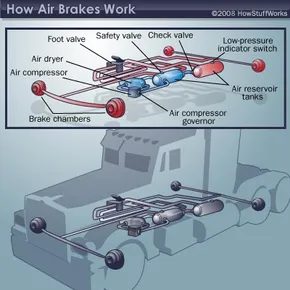

We have looked at the individual components. Now we step back to see the entire system in action. The diagram above is not just a schematic. It is a map of where the hardware lives in your rig. You will find the brake chambers along the axles. The lines snake through the frame rails. Everything connects to the air reservoirs near the cab.
This spatial understanding matters. When you are under a semi-truck, knowing where the components sit helps you diagnose leaks or wear. It also clarifies why certain failures happen in specific locations.
The Integration of Heavy-Duty Braking Systems
Putting the pieces together reveals the scale of the challenge. Passenger cars use hydraulic pressure. Trucks use compressed air. The difference is not just about pressure. It is about volume and response time.
When the driver hits the pedal, the relay valve opens. Air rushes to the brake chambers. The push rod extends. The cam rotates. The drum closes around the lining. Or the caliper squeezes the disc. This happens on every wheel simultaneously. The symmetry is critical. If one axle gets air faster than another, the truck will pull. That is a nightmare scenario at highway speeds.
The diagram shows the redundancy. Multiple lines run to each corner. A failure in one line does not mean total loss of braking. The system is designed to fail safe. If air pressure drops below a threshold, spring brakes engage. These are the large, round springs inside the chamber. They clamp down mechanically. No air is needed to stop the truck. Air is only needed to release them.
Why Air Brake Reliability Matters
The shift from drum to disc brakes on heavy trucks is not just about cooling. It is about consistency. Wet roads, steep downgrades, and heavy loads stress the system. Drum brakes can fade. Disc brakes dissipate heat better. They also self-adjust less frequently.
Studies show that air disc brakes offer better performance in extreme conditions. The National Advanced Driving Simulator tested this. The results were clear. Disc brakes maintained stopping power longer under repeated heavy use. This is why companies like Bendix and Spicer JV promote them. Fleet operators care about downtime. Fewer adjustments mean fewer maintenance visits.
But technology does not solve human error. The NTSB reports often cite brake failure. Usually, it is not the mechanical part that failed. It is the driver’s reaction or lack of proper pre-trip inspection. A leaking valve goes unnoticed. Pressure drops slowly. The spring brakes kick in too late. Or they do not kick in at all if the tank is empty.
How Drivers Use Brakes While Towing and Downgrading
Knowing how the system works is one thing. Using it correctly is another. Towing a trailer adds length and mass. It also adds a new braking system. The trailer brakes must engage slightly before the tractor brakes. This prevents jackknifing. The brake controller manages this timing. It senses deceleration. It sends an electric signal to the trailer’s relay valve.
The controller is simple. It has a gain dial and a manual override. But it requires skill to adjust. Too much gain causes the trailer to push the tractor. Too little means the trailer keeps rolling into the cab. Drivers learn by feel. And by checking the air pressure gauges.
Descending a long grade is where the real test begins. You cannot ride the service brakes. They will overheat. You need retarders. Engine


