


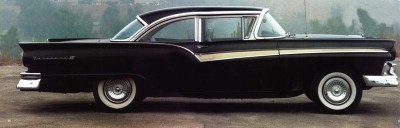
The 1957 standard Ford is the apex of the brand’s 1950s collectibility. This is a hard fact among enthusiasts, standing in stark contrast to the facelifted 1958 models which mark a distinct low point. The heavily reworked 1959s generate even less interest now. It is a paradox that deserves scrutiny. Both the ’58 and ’59 retained much of the iconic 1957 design language. Yet the market reaction tells a different story. The answer lies in the specific mechanical and aesthetic shifts that separated these seemingly similar years.
The 1957 Design Peak
The 1957 Ford represented the culmination of the early post-war design ethos. It was clean, purposeful, and undeniably stylish. This was the year the “Squarebird” began to gain traction, though the classic two-seat Thunderbird remained a separate entity. The standard sedans and coupes captured the public imagination in a way that subsequent years simply could not.
Collectors do not buy just for nostalgia. They buy for specifics. The 1957 model offered a particular blend of chrome, fin styling, and muscular stance that defined the era. It was the high water mark.
The 1958 Facelift and Its Flaws
The 1958 model received a facelift that many fans find derivative. It tried to mimic the success of the previous year but lacked the same cohesion. The changes were superficial. They failed to capture the magic that made the 1957 model special. The market rejected it.
Why did the 1958 Ford fail to resonate? The answer lies in execution. The designers tweaked the front end and rear fins, but the overall proportion felt off. It was a step backward in terms of design confidence.
The 1959 Redesign and Lack of Interest
The 1959 model underwent a more significant rework, yet it generated even less interest than the already unpopular 1958. The design became more extreme, with larger fins and more aggressive styling. But this aggression did not translate to desirability. The market saw it as a desperate attempt to stay relevant.
The 1959 Ford retained the core structure of the 1957 design. But the modifications were too heavy-handed. They stripped away the elegance that defined the earlier model. Enthusiasts look for subtlety. The 1959 Ford offered excess without justification.
The Paradox of Similarity
How can cars that look so similar receive such different receptions? The answer is in the details. The 1957 Ford had a perfect balance of style and substance. The 1958 and 1959 models lost that balance. They tried too hard. They failed to understand what made the original work.
The 1957 Ford remains the benchmark. The 1958 and 1959 models are cautionary tales. They show how quickly a design can lose its charm when the vision is not clear.
This is not just about aesthetics. It is about the feeling the car evokes
Detroit in 1957 wasn’t just busy. It was panicked.
For Ford, this was the moment everything hinged on. The automaker had to do something drastic. They couldn’t just tweak the lines. They had to rewrite the rules. The result was a lineup so radically different it made the iconic 1949 models look conservative by comparison. This wasn’t an update. It was a declaration of war against General Motors.
Why Ford Changed the Game
Chevrolet was winning. Ford knew it. If you can’t beat the leader at their own game, change the game entirely. That was the strategy. Ford decided to go after every segment below the Cadillac tier. They wanted to be all things to all people. And they did.
The 1957 standard line was massive. It sprawled across twenty distinct models. For the first time in postwar history, Ford used two separate wheelbases. (Ignore the Thunderbird. It played by its own rules.)
The variety was staggering. You had the usual suspects—two-door and four-door sedans, hardtops, wagons. But then there were the novelties. The retractable hardtop. A sedan-pickup hybrid. Neither had been done by a domestic maker since the war.
“The 1957 standard line was as broad as a Swedish smorgasbord.”
It wasn’t just about shape. It was about overwhelming the market.
The 1957 Ford Fairlane 500 Club Sedan
Take this specific example. The 1957 Ford Fairlane 500 Club Sedan. It’s a handsome beast. A testament to that new styling philosophy. It wasn’t just another car. It was a statement.
The colors alone could make your head spin. Two-tone combinations were everywhere. More paint options than a circus side show. Ford didn’t just cover the market. They drowned it.
Under the Hood: Power and Choice
Engines numbered six. Five of them V-8s.
That’s a lot of V-8 options in one year. It gave buyers choices. It gave them power. It gave them noise. Ford wasn’t messing around. They were building machines that demanded attention.
The Competitive Stance
This wasn’t just about sales. It was about relevance. GM had the lead. Ford had the talent. The 1957 lineup proved it. It showed that Ford could innovate. That it could create desire. That it could compete.
The Fairlane 500 Club Sedan sat at the center of this storm. It was stylish. It was practical. It was fast. It was everything a buyer could want. And it was just one of twenty models.
Twenty models.
Think about that. In a single year. Ford offered twenty ways to buy a Ford. Twenty ways to feel unique. Twenty ways to say “I’m not driving a Chevy.”
It was a lot of cars. A lot of choices. A lot of risk. But it worked. It worked because it was bold. It worked because it was different. It worked because it was 1957.
And the Fairlane? It remains a icon. Not just for
Most of the visual DNA in Ford’s 1957 lineup didn’t come from a sketchbook. It came straight from the 1957 Ford Mystere show car styling influence. That concept vehicle, unveiled in 1954, bled directly into the production models that hit dealerships three years later. Take a Fairlane 500 Sunliner, for instance. The one pictured often carries dealer-installed hood ornaments, front fender gravel guards, and rocker moldings that scream mid-50s Americana. But underneath those chrome accents lies a platform that was fundamentally reshaped for height and width.
Trimming the Hierarchy: Custom to Fairlane
Ford shook up the ladder in ’57. The old Mainline series was gone, replaced by a trio of Custom sedans. You had the standard Tudor and Fordor two-doorers, plus a stripped-down business two-door. These rode on a 116-inch wheelbase—half an inch longer than the 1955-56 models—and measured 202 inches in overall length. Just above that sat the Custom 300 sedans. Same chassis. Same length. They were the successors to the old Customline, offering a step up in trim without changing the footprint.
Then came the Fairlane.
This is where things got significant. The Fairlane stretched to 208 inches overall, boasting a new 118-inch wheelbase. For 1957, these were the longest dimensions Ford had ever put on a production car. The body style lineup included two-door Club Victoria and four-door Town Victoria hardtops, carried over from the previous year. If you wanted the hardtop look but didn’t want to pay the premium, the sedan equivalents offered thin, chrome-trimmed pillars that mimicked the hardtop aesthetic for about $60 less.
The top-tier Fairlane 500 series duplicated all four body styles but added the traditional Sunliner convertible. Later in the model year, Ford dropped the Skyliner, a hardtop with a retractable glass roof that was equal parts engineering marvel and marketing gimmick.
Wagons and the Ranchero
Wagons stayed in their own series for 1957, juggling five models on the shorter chassis. The returning two-door Ranch Wagon was trimmed to match the Custom sedans. Replacing the 1956 Parklane was the new Del Rio Ranch Wagon. This two-door came with Custom 300 level finery. It was essentially a half-answer to Chevrolet’s Nomad but priced several hundred dollars lower.
For families, the Country Sedans were the workhorses. These were four-doors with Fairlane 500 appointments. You could get a two-seat configuration for six passengers or a three-seat layout for nine.
At the top of the food chain was the Country Squire. This nine-place four-door was distinguished by its customary woody-look paneling on the bodysides and tailgate. It was the premium option for those who wanted to look like they owned a summer cottage in the Adirondacks.
Then there was the Ranchero.
Revived in December 1956 as a car-based pickup, the Ranchero was essentially a Ranch Wagon with an open load bed behind the B-posts. Available in standard and Custom trims, it was officially classified as a Ford Truck Division product. It wasn’t just a novelty; it was a practical bridge between the passenger car market and the utility segment.
Lower, Wider, and Just as Roomy
Except for the powertrains, the 1957 Fords were new from the ground up. The most striking change was vertical. Overall height was trimmed by an impressive four inches, dropping to 57.2 inches. Popular Science magazine quipped that they were “head-high only to a Belgian Congo pygmy.” The cars looked low. Squatty. Aggressive.
Yet despite the squat stance, interior volume remained unchanged from the 1955-56 models. They were just as roomy. The doors were wider, making entry and exit easier, and the lower roofline didn’t sacrifice headroom. It was a masterclass in packaging efficiency.
The Ghost in the Machine: Bill Boyer’s Mystere
If you want to understand the squinty-eyed look of the 1957 Ford, you have to look at the 1957 Ford Mystere show car design.
Bill Boyer of the Advanced Styling Studio created the Mystere in the summer of 1954. It was a space-age dreamboat, typical of the decade’s obsession with jet-age aesthetics.
“The Mystere was a full-size car,” Boyer recalls. “It had an operating canopy and a fully trimmed interior, but it was [only] a static fiberglass display model. It was done specifically for the 1955 January Detroit Auto Show.”
Here’s the twist: Ford kept the Mystere under wraps. They didn’t show it at the 1955 Auto Show to avoid tipping their hand. It likely didn’t appear publicly until 1956 or 1957, serving as an idea car preceding the actual 1957 production Fords.
The influence was undeniable. The Mystere dictated the “swash” bodyside molding found on the 1957 Fairlane 500. It also drove the development of the fins on the quarter panels and the taillight clusters on all models. The show car wasn’t just a preview; it was
The Mystery Behind the ’57 Ford Design
The 1957 Ford Sunliner wasn’t just another update. It looked sharp because it ripped off lines from the Ford Mystere concept car. That connection matters. It explains why the final product felt so futuristic for a standard production vehicle.
But the timeline is tricky. Design work started in earnest around the same time as the Thunderbird’s 1957 redesign. Ford management didn’t lock in two different wheelbases for passenger cars until 1955. That decision split the lineup. The original package became the Custom and Custom 300. A stretched version? That went to the Fairlane and the new Fairlane 500. Different sizes. Different targets. One team, lots of compromises.
Who actually drew the lines? Hard to say.
The final 1957 Ford was a Frankenstein of styles. No single designer gets full credit. Jack T. Boyle was there, pushing the vision from start to finish. But the early sketches? Those came from Frank Hershey. He didn’t work alone; Damon Woods helped him get the geometry right on the drawing board.
Then came the shifts. Bob McGuire took overall charge as things moved toward production. He wasn’t carrying the load solo. L. David Ash, Chuck Mashigan, and A.J. Middlestead all chipped in. Hands on the clay models. Eyes on the details.
Ultimately, the buck stopped elsewhere. George Walker, Ford’s styling chief, had the final say. Always. Unless Henry Ford II decided otherwise. And he did. Often.
The result was a car that felt cohesive, despite the revolving door of talent. The Mystere’s influence lingered in the chrome. In the fins. In the way it sat on the road.
Was it a triumph of individual vision? Or just the best of a messy process?
The 1957 Ford doesn’t care about the debate. It’s still there. Looking good.
The 1957 Ford Design Evolution
Ford’s design team hit the ground running with the 1957 model year, locking in the front-end architecture surprisingly early. The result was a blunt, face-forward aesthetic defined by a simple grille and square-lined fenders that sat level with a new, wider, and flatter hood. This clean, restrained front contrasted sharply with the chaotic creative process behind the cowl. Stylists were experimenting with a dizzying array of rooflines, A-pillar angles, bodyside trim, and rear-end treatments. Many of those early concepts were, frankly, awful. Yet, out of that experimentation came something smashing: the first truly long, low Ford. The final product was crisp, flowing, and remarkably restrained for an era obsessed with excess.
Take the Ford Fairlane 500 Club Victoria hardtop coupe as a prime example. It arrived with factory fender skirts and a spotlight, though it lacked the stock chrome headlight rims. It was a statement piece that signaled a shift in how Ford approached volume production.
Mastering Sculptured Body Panels
The most significant technical hurdle in this styling story was Ford’s debut of “sculptured” body panels. This wasn’t just about making things look sharp; it was a manufacturing nightmare. In 1957, automakers were still learning how to stamp sheetmetal with sharp edges, deep creases, and complex curves without causing the metal to fracture. Ford solved some of these issues in time for the 1957 launch, which helped achieve that tailored, high-end look. But they didn’t fix everything.
The body panel rejection rate was extremely high. The split-level wagon roof, featuring a tricky C-shaped character line, was particularly difficult to stamp correctly. It took until 1959–1960 for the entire industry to master these stamping techniques reliably. Ford pushed the envelope first, paying the price in waste and engineering headaches, but the result was a distinct visual language that separated them from the pack.
The 1957 Ford Victoria hardtop remained in production, specifically the four-door Town model found in the Fairlane 500 series. But beneath the sheet metal, engineers executed a significant structural overhaul. The new “cowbelly” frame was not just a styling cue; it was a functional response to the year’s lower-profile bodies.
Designers drew inspiration from the 1954 Oldsmobile chassis and the bespoke Continental Mark II. The goal was simple. Sit passengers deeper inside the chassis perimeter. To achieve this, the frame featured a dropped rear floorpan. The rear side-rails were kicked up further back and more abruptly than on the 1955-1956 models.
The result was a two-inch reduction in overall vehicle height. No interior space was lost. Back seat room actually improved.
Structural Integrity and Variants
Ford offered short- and long-wheelbase versions of the new frame. The distinction was minor but deliberate. The longer variant used slightly stronger metal stock. It extended five inches longer at the rear.
Both versions relied on five crossmembers for strength. Three of those crossmembers were tubular. This configuration provided the necessary rigidity without adding excessive weight to the lower body structure.
Suspension Geometry Overhaul
The front suspension underwent a simplification. Ford’s ball-joint setup, introduced in 1954, was refined for 1957. The redesign eliminated 33 percent of the parts. New “swept back” lower control arms were installed to promote a smoother, softer ride.
Rear geometry received similar attention. The semi-elliptic leaf springs were extended by two inches. For the first time, their front ends were pinned inboard of the side-rails.
A redesigned hypoid axle was placed further back on the springs. Extending from a new, tapered driveshaft, this adjustment reduced rear-end squat during acceleration.
Rolling on Smaller Dials
The final piece of the height-reduction puzzle was the rolling stock. Ford switched to 14-inch wheels and tires. This was an inch smaller than the previous year’s specification.
Combined with the frame and suspension changes, these smaller wheels contributed to the second two-inch drop in overall height. The result was a car that sat lower to the ground without sacrificing the cabin volume drivers expected from a full-sized American sedan.
Inside the 1957 Ford Fairlane: A Cabin Revolution
The interior of the 1957 Ford didn’t just update; it transformed. Where the 1955 and 1956 models relied on a more traditional, upright cabin layout, the new Fairlane 500 Town offered a perspective that felt radically modern. Sliding into the driver’s seat, your field of view opened up. The hood line sat nearly flat, visible through a windshield that was both wider and lower-set. It was a significant departure from the boxy verticality of the previous two years, creating a cockpit that felt less like a driving booth and more like a command center.
The A-pillars played a key role in this shift. Instead of standing straight up, they angled back toward the floorboards. This design choice improved sightlines but introduced a peculiar ergonomic quirk common to mid-1950s Detroit engineering: the “dogleg.” If your knees were anything like average, you likely banged them against the pillar every time you tried to exit the vehicle. It was a stylish compromise for visibility, but a painful reality for ingress and egress.
Dashboard Ergonomics and Instrumentation
Ford stripped away the visual clutter of the past. The new dashboard was a study in streamlined simplicity, anchored by a sweeping instrument cluster. A curved “strip” speedometer took center stage, flanked by fuel and engine temperature gauges. This entire arc sat beneath a wider, protective visor, grouping the critical data directly in your line of sight.
The steering wheel itself underwent subtle but meaningful changes. It was slightly smaller in diameter and mounted lower than the 1956 equivalent. The result? A more direct, intimate connection to the road. You weren’t just holding the wheel; you were gripping it. The deep-dish design, combined with the lower stance, pulled the driver into a more engaging posture without sacrificing the comfort needed for highway cruising.
The 1957 Powertrain Evolution: Efficiency Meets Torque
While the exterior screamed style, the 1957 engine bay whispered evolution. It marked the 25th anniversary of Ford’s first V-8, and rather than reinventing the wheel, Ford tightened the bolts. The changes were minor on paper but significant in performance. Every V-8 received higher compression ratios, larger intake valves, and bigger manifolds. Camshafts were redesigned for increased valve lift, and distributors swapped out the old full-vacuum timing mechanisms for a more responsive centrifugal/vacuum combination.
The lower hood height mandated a new breed of low-silhouette carburetors. They were simpler, more efficient, and controlled by streamlined linkages. This wasn’t just about looks; it was about squeezing every bit of performance and economy out of the block.
Engine Lineup Breakdown
The 1957 drivetrain chart offered six distinct engine options, all of which could be paired with one of three transmissions: a conventional three-speed manual, a three-speed manual with optional overdrive, or the two-speed Fordomatic automatic.
- The Mileage Maker: Returning at 223 cubic inches, the six-cylinder engine got a compression boost to 8.6:1. Horsepower climbed from 137 to 144. It still used a one-barrel carburetor, proving that economy didn’t have to mean sluggishness.
- The Base V-8: The 272 cubic-inch V-8, now rated at 190 horsepower (up from 173), benefited from the same compression squeeze. It was the entry point into V-8 ownership, reliable and punchy.
- The Thunderbird Special: The 292-cubic-inch engine, exclusive to Fairlanes and wagons, saw its compression rise to 9.1:1. Output jumped to 212 horsepower (from 200). This was the sweet spot for those wanting more power without stepping into premium fuel territory.
Exhaust Systems and Carburetion Nuances
Interestingly, Ford’s smaller V-8s ran on regular gas but outperformed their predecessors partly due to carburetor design. Their two-barrel setups offered a greater venturi area than the 1956 four-barrel models, enhancing performance in the low and middle speed ranges where daily driving happens.
Exhaust routing also changed. The crossover pipe on the standard single-exhaust setup was dropped. In its place came a more efficient Y-system, reducing backpressure and improving scavenging. Dual exhaust remained an option for both the 272 and 292, catering to those who wanted the sound as much as the slight power gains.
The Big Gun: Supercharged 312
At the top of the hierarchy sat two premium-fuel “Thunderbird 312” engines. The four-barrel “Special” produced 245 horsepower, while the twin-quad “Super” pushed 270 horsepower. Both featured dual exhaust and a higher 9.7:1 compression ratio.
But the real anomaly was the low-compression (8.6:1) supercharged 312. Equipped with a single four-barrel carburetor, this engine was a Ford exclusive. The official booklet didn’t mince words, claiming it puffed out a “surging” 300 horsepower. It
Inside the 1957 Ford Dashboard
The Country Squire didn’t just sit at the top of the Ford wagon hierarchy in 1957; it defined it with that iconic wood-grain aesthetic. You could add a roof rack, but only if you were willing to pay extra for the privilege of hauling more gear.
Step inside and the layout feels familiar to anyone who has sat in a Continental Mark II. You are positioned close to the wheel and the windshield, creating an intimate, driver-focused cockpit. The ignition switch sits to the left of the steering column, a standard Ford practice at the time. Next to it is the light switch. Drop your eye down to the lower right console, and you’ll find the wiper knob and cigarette lighter. The upper center of the dashboard is a cluttered mix of heater controls, the radio, and an optional clock if your budget allowed.
Color coordination was strict. Interiors matched exteriors exactly. You could choose all-vinyl or a vinyl-and-fabric hybrid, usually in bright, contrasting two-tone schemes that screamed mid-century optimism.
Road Tests Define the Fairlane’s Handling
Critics loved the 1957 Ford. Motor Trend was typical in their enthusiasm. They took a Fairlane sedan with a standard transmission and the 245-horsepower Thunderbird Special V-8 for a spin. The numbers didn’t lie. Zero to 60 mph took just 9.5 seconds. That is two seconds faster than the Fordomatic-equipped model they tested the previous year. In a world where 12-second nought-to-sixty times were common, 9.5 seconds was rapid.
The magazine editors were curious about roadability. The new Ford had a noticeably lower center of gravity. They wanted to see if that geometry translated to real-world driving. They started on roads that were exceptionally rough. The result? A definite improvement in spring and shock action compared to the 1956 model. The suspension felt more mature.
On smoother pavement, they looked for body roll. They noticed minimum nose dive when braking. The brakes themselves were smooth and positive. When they pushed into violent corners, the low center of gravity paid off. The new Ford stuck to the pavement. Body lean was modest. Built-in oversteer gave the driver a sense of confidence. You knew exactly what the car would do.
Motor Trend didn’t stop there. They later tested a Fairlane 500 four-door. Same engine. Same Fordomatic automatic transmission. The zero-to-1960 mph test clocked in at 11.1 seconds.
There were complaints. Workmanship was poor. Fit and finish left much to be desired. But the mechanical quality was high. The overall roadability was excellent. The car might have had shaky panel gaps, but on the road, it was a competent, confident machine.
The 1957 Ford Skyliner retracting its convertible top is one of those images that defines an era. It wasn’t just a gimmick; it was the culmination of a year where Ford pushed engineering to its limit.
Production hit a staggering 1.67 million units for the 1957 model year. That is 170,000 more vehicles than Chevrolet managed to move. It was a massive number. Convertible output also shattered previous records. You had 77,726 conventional soft-top Sunliners. Then there were the new Skyliner retractable hardtops, with 20,766 built. Some stats claimed Ford had overtaken Chevy in sales for the first time since 1935. The race was closer than that headline suggested, a dead heat at best. But for the planners in Dearborn, it felt like a victory lap.
The appeal was simple: new muscle and a “longer-lower-wider” aesthetic. It worked.
The 1958 Styling Overhaul
The party didn’t last. By 1958, Ford had to rethink its approach. They applied a heavy facelift to the lineup. They also introduced the Fordor Ranch Wagon, a new addition to the stable.
Sales didn’t just slide; they collapsed. Total production dropped to 987,945 units. That includes about 40,000 of the stylish, four-seat Thunderbirds.
Why the crash? Blame the economy. A national recession hit hard, depressing sales across the entire industry. But car fans and historians rarely give Ford an pass on the aesthetics. The styling changes for 1958 get the bulk of the blame. The “longer-lower-wider” momentum stalled. The new look failed to capture the same magic.
The 1957 Skyliner remains a benchmark for mechanical complexity, even if the 1958 styling misfire is remembered more loudly.
Ford had peaked too early. The recession was the trigger, but the design fatigue was the powder keg.
Why the 1958 Ford Is Called the Ugliest of the Decade
Sales figures for Ford’s 1958 lineup, particularly the Fairlane 500 Skyliner with its retractable hardtop, took a nosedive. The automaker had a clear checklist for this mid-cycle update. They wanted to tie the brand identity closer to the new Thunderbird. They needed to patch up the structural weaknesses inherent in the 1957 body panels. And they had to stand up to Chevrolet’s radically new “gull-wing” design.
Looking back, the result holds up better than the era’s other “Chromes-mobile” rivals or the over-decorated Buicks. At the time, though, buyers hated it. Collectors agree today. The 1957 model is widely considered the most beautiful Ford of the 1950s. The 1958 iteration? Often labeled the ugliest.
The Controversial Elliptical Rear Deck
The most jarring shift from the previous year was the elliptical indentation on the rear deck. Ford didn’t do it for aesthetics. They did it to stiffen the body panels. The shape also framed four oval taillights for the first time since 1952. Two were mounted in the body. Two sat inside the trunk lid.
Round lights were out. Oval was in.
This push for rigidity didn’t stop at the rear. Ford added seven longitudinal grooves, or “flutes,” to every roof panel. This included wagons. The goal was simple: make the roof stronger.
Front End Changes and Interior Upgrades
Up front, Ford jumped on the quad-headlight bandwagon. It was an industry trend that year. They also borrowed two ideas from the 1958 Thunderbird. One was a fake hood air scoop. It wasn’t functional. It was purely for panel strength.
The other was a wide, mouth-like bumper and grille assembly. This design maximized airflow to the radiator core. The Thunderbird used a one-piece unit. Passenger cars got a cheaper two-piece version.
Both the 1957 and 1958 hinged from the front. This helped assembly line efficiency. It didn’t necessarily help the average buyer.
Interiors saw a genuine improvement. Durability got a boost. So did the look. Pleated door panel trim became standard. Silver-finish dash appliques added a touch of class. These were the most noticeable changes inside.
How the 1958 Ford Compares to Rivals
The 1958 Ford was a response to market pressure. Chevrolet had launched a bold new design. Buick was covering its cars in chrome. Ford needed to look competitive.
The result was a car that prioritized structure over style. The elliptical rear deck and roof flutes were engineering solutions. They sacrificed clean lines for strength. Buyers noticed. Sales suffered.
Collectors view the 1958 as a mistake. But the engineering choices were real. The oval taillights became a lasting legacy. The front-end design influenced future models.
The 1958 Ford is a study in compromise. It tried to be everything to everyone. It ended up pleasing no one.
Yet, the details remain interesting. The quad headlights.
Let’s be honest about the aesthetic. If you look back at the 1950s, the 1958 Ford Fairlane 500 Town Victoria hardtop sedan is often cited as the ugliest car of the decade. It looked clumsy compared to its sleek predecessor. But appearances were deceiving. Under the sheet metal, the 1958 model was a significantly better machine than the 1957 version. Ford engineers tightened up the ride. They adjusted the shock calibrations, tweaked the front upper control arms, and softened the rear spring rates. The result was a slightly more compliant ride without sacrificing structure.
Steering also got a major overhaul. Ford made its recirculating-ball steering system standard across the entire lineup. For drivers, the difference was palpable. Even cars without power steering felt surprisingly light, mimicking power assist in most driving scenarios. The only time the difference was obvious was during tight parking maneuvers. The gear ratio remained steep at 4.5 turns lock-to-lock. Power steering added a 35 percent boost in oil pressure to the system, but the fundamental feel was already improved.
Under the hood, the old guard was purged. The 272 and 312 V-8s were discarded. The inline-six gained a single horsepower, barely a footnote. The 292 V-8 returned to its 1956 status as the base engine, rated at 205 horsepower. That was a seven-horsepower drop from its previous iteration, a move that seemed like a step backward until you looked at what Ford introduced next.
The New Big-Block Options
The real story for 1958 was power. Ford launched its first three-speed automatic transmission. It was a game-changer for daily driving. Alongside it came two all-new big-block V-8s. These engines shared a common architecture. Both featured a massive 4.00-inch bore. This wide bore allowed for larger valves and better airflow.
The smaller of the two was the 332 cubic-inch engine. It used a 3.30-inch stroke. You could get it with a two-barrel carburetor and single exhaust for 240 horsepower. Or you could spec a four-barrel carb and dual exhausts for 265 horsepower. Both versions ran at a 9.5:1 compression ratio. It wasn’t about peak numbers; it was about versatility.
Then there was the 352. Ford increased the stroke to 3.50 inches. This displacement bump created a four-barrel, dual-exhaust powerhouse. It pushed out 300 horsepower at 4,600 rpm. The compression ratio jumped to 10.2:1. This engine was the real attraction.
Performance Realities
How fast could these new engines move the car? With either the manual or the silky new Cruise-O-Matic automatic, the 1958 Ford could hit 60 mph in 9.5 seconds. That is respectable. But it wasn’t a record-breaker. Motor Trend tested a 1957 Ford with the 312 engine and a manual transmission and found it just as quick. The new mechanicals hadn’t translated into a significant time improvement over the previous year’s performance.
Nor was it faster than the competition. A full-size 1958 Chevrolet with the new 348 cubic-inch V-8 was quicker. The Chevy engine actually had 20 fewer horsepower than the Ford 352. Yet, it beat the Ford in a straight line. That discrepancy hints at weight distribution, gearing, or drivetrain loss. The Ford was good. But it wasn’t the fastest big car on the road.
Engineering the FE-Series
The design of the 1958 Ford FE-series engines prioritized serviceability. Mechanics would appreciate the layout. Spark plugs were positioned
The Fairlane 500 Club Victoria looked restrained compared to the flamboyant tailfins of 1958. But under the hood, Ford was building something far more radical. The engineering wasn’t just about looks. It was about a fundamental rethinking of internal combustion.
Inside the FE Series Architecture
The improvements were visceral. Bigger bearings with greater journal overlap meant less wear, more durability. Combustion chambers moved from the block into the heads. They sat at a clean right angle. Intake ports swelled in size. Valve lift increased dramatically. Exhaust valves were spaced out so no two sat next to each other. This design choice wasn’t arbitrary. It allowed for better exhaust scavenging and reduced heat transfer back into the intake charge.
Valve rotators became standard. These devices spun the valves slightly as the engine ran. The result? Better lubrication distribution and significantly extended valve life. The valvetrain itself was lighter. Less complex. It shed the weight of the older Y-block design, Ford’s first overhead-valve V-8. New valve springs were heavier, designed to prevent float at high RPMs. Even though the FE cylinder heads were physically smaller than the Y-block family’s, the intake manifolds grew larger. Engineers equalized the length of the manifold passages. This ensured more even fuel distribution across all cylinders.
Collectors often brag about 292s and 312s. They overlook the milestone improvements hidden in the FE-series. Much of this was the work of Robert Stevenson. He became chief engineer at Ford Engine & Foundry in 1957. The design targeted displacements up to 425 cubic inches. It proved incredibly durable. Trouble-free operation made it long-lived. Production of the 390 version continued into the early Seventies. That is a long run for any automotive platform.
Decoding the 332, 352, 390, and 430
Confusion still swirms around the 332, 352, 390, and Lincoln 430 engines from this era. The 390, introduced in 1961, was built from the ground up for performance. It resembles the 352. It uses the same camshaft and heads. But the bottom end required entirely different castings. Stronger components. Larger oil passages. It wasn’t just a bore-stroke change. It was a structural overhaul.
The Lincoln 430 is a different story. It has no direct relation to the others. Stevenson designed it concurrently with the 352. The architecture differed significantly. Pushrods ran through tubes in the intake manifolds instead of through the heads. Combustion chambers were housed completely within the cylinder bores. This layout simplified the head but isolated the combustion geometry differently.
1958 Ford Features and Transmission Tech
The 1958 Ford lineup offered a mixed bag of features. The new Cruise-O-Matic transmission debuted as an option for Fairlanes and wagons. It reminded drivers of GM’s dual-range Hydra-Matic. The operation was butter-smooth. The selector featured two Drive positions.
- D2 started the car in second gear. It shifted down from third only to second.
- D1 started in Low. It shifted down all the way to Low from third.
You could still shift to L (Low) for engine braking or heavy pulling. A built-in “hill-holder” added convenience. It held the brakes automatically when stopped on uphill grades. No more rolling back. No more slipping the clutch.
This transmission setup changed how drivers interacted with the road. It smoothed out the chaotic start-stop of early automatics. It also hinted at the performance potential of the FE engine family. The hardware was ready. The software, in the form of driver control, was evolving.
What happens when you pair that smooth shifting with a 390 cubic inch motor? The answer would define American performance for the next decade. The 1958 models were just the warm-up.
The Ford Aire Nightmare
The 1958 Ford Custom 300 Tudor sat comfortably in a lineup defined by ambition and failure. Ford wanted air suspension like General Motors, but the “Ford Aire” system was its own special kind of disaster. It wasn’t available everywhere. You had to buy a Fairlane or a wagon to even have a chance at it.
The hardware was cramped. A 300-psi compressor and an air storage tank sat shoulder-to-shoulder in the right front of the engine bay. From there, lines ran to air domes at each corner. Three leveling valves managed the pressure—one for each front dome and one near the right rear spring. The front suspension looked mostly standard, sticking with coils. The rear was different, using trailing arms to locate the axle instead of the semi-elliptic leaf springs GM systems usually required. That saved Ford from a total chassis redesign, but it didn’t save the project.
“In practice, Ford Aire proved so troublesome that only 100 or so 1958s were so equipped.”
The theory was elegant. Step in, and solenoids linked to the door courtesy lamps triggered the compressor. Air pumped into the domes to adjust ride height based on weight distribution. Drive off, and the leveling valves compensated for bumps and hard braking. It sounded good on paper.
It failed in reality. The air bags leaked. Water condensed and froze in the lines. The system was a mechanical headache. Only about 100 cars got the upgrade. No Thunderbirds, Lincolns, or Mercurys ever saw an air-sprung version, despite Mercury advertising one. By 1960, only Cadillac and Rambler still offered the option. They dropped it soon after. Ford wouldn’t touch air suspension again until 1984.
1959 Styling: A Square Turn
Ford didn’t reinvent the wheel for 1959. It grafted new outer body panels onto the existing structure. The inner frame from 1957 and 1958 was modified, but the bones were there. Ford called the result “The World’s Most Beautifully Proportioned Cars.”
That claim was arrogant. It was also winning. The Comite Francais de l’Elegance awarded Ford a Gold Medal for styling at the Brussels World’s Fair. People liked the look. It was squared-off. Conservative.
Compare that to the Chevrolet. The ’59 Chevy had bat-wing tailfins that reached for the sky. Ford’s design felt grounded. One might argue they were targeting different buyers. Chevy went for flash. Ford went for substance. Or at least, the illusion of it. The market shifted anyway. The era of the massive, air-sprung sedan was ending.
The Mystery of the ’59 Ford Design Shift
Ford’s 1959 styling evolution was a jarring transition from the wild excesses of the previous year to something decidedly milder. The reverse-slant backlight stood out as the most prominent example of the gimmicky roof treatments Dearborn favored during this period. Yet, the logic behind the 1959 design remains an enigma. Principal designer Joe Oros never explained his choices. Alex Tremulis, a free-thinking presence in the studio then, later condemned the 1959 model as a worse mistake than the disastrous 1958 design. George Walker, the former company styling chief, offered a contradictory take, claiming it was the best-looking Ford ever produced under his supervision.
Product planners likely aimed for one clear metric: loads of extra trunk space. But the broader goal seemed to be shrinking the gap between Ford and its luxury siblings, Lincoln and Mercury. They wanted the 1959 lineup to match those brands in both size and appearance.
All models now sat on a standardized 118-inch wheelbase. This change swelled overall length by five inches on wagons and nearly six inches on low-line sedans. Width increased fractionally. Curb weights went up as well. The real gain was in cargo volume, which bloated by 11 cubic feet compared to the previous year.
Visibility improved through aggressive glass expansion. Curving the front windshield upward and outward increased the glass area by 29 percent. The backlight followed suit, becoming higher and significantly more curved. These changes were not just cosmetic. They were attempts to redefine the midsize sedan’s footprint.
Why did Ford pivot so hard toward a more conservative, Lincoln-like aesthetic? The answer lies in market pressure. The late 1950s saw buyers fleeing the extreme tailfins of the previous era. Ford had to recalibrate. The 1959 model was their attempt to find balance. It failed to please everyone. Enthusiasts missed the drama of 1957 and 1958. Traditionalists found the 1959 too plain. But the engineering shifts were concrete. The larger cabin, the wider stance, the extra trunk space—these were functional answers to a changing market.
The reverse-slant roofline became a signature, a visual cue that signaled a departure from the past. It was a design choice that prioritized interior volume over aerodynamic purity. Did it work? Sales figures suggest a mixed response. The model sold, but it lacked the cultural impact of its predecessors. Ford had tried to make a sensible car in an era that still craved spectacle.
The 1959 Ford was a compromise, a vehicle caught between the excess of the late 50s and the restraint of the 60s.
The styling evolution was not just about aesthetics. It was about repositioning the brand. Ford needed to appeal to a broader audience without alienating its core customers. The result was a car that looked different, felt different, and sat differently. It was a step toward the more refined designs of the early 1960s. But it was also a step away from the boldness that had defined the company’s recent history.
The 1959 Ford remains a point of contention. Some see it as a bland correction of
The front end took the biggest hit in terms of visual change. Quad headlamps dominated the fascia, topped by those distinctive “gullwing” eyebrows. Below them sat a shallow, full-width grille packed with four rows of star-like ornaments. The bumper was still massive—a conventional wraparound design—but it carried two bullet-shaped outriggers to house the turn signals and parking lamps.
Ford resisted the finny excess that defined so much of late-50s American automotive design. Instead of exaggerated tail fins, they opted for subtle chrome-lined ridges atop the rear fender tubes. The upper rear fender form was cylindrical, extending from about mid-body.
“Taillamps became round again, nestled in huge ‘jello-mold’ reflectors that made for mile-away brightness.”
The rear was anchored by a heavily sculptured “Flying V” back panel. How you identified the trim level depended on what you saw there. Fairlane 500s got a full-width chrome molding. Standard Fairlanes sported a stubby gold-color chevron. Everything else wore a large Ford crest. The round taillights were bright enough to see from a distance, thanks to the massive reflector housings. Advertisers nicknamed them “Iris Eyes.”
Inside, the shuffling of colors and trim materials was standard fare. The dash got a restyle, featuring a large, square instrument cluster. The layout was basically the same as before, but the white-on-silver markings were notoriously difficult to decipher.
Model Lineup Shifts
Ford started 1959 with a leaner lineup. The Custom 300 replaced the discontinued Custom as the base group, offering the same three sedan body styles. The Fairlane was trimmed down to just two models: the two-door Club Sedan and the four-door Town Sedan.
Mid-year, everything changed. Ford grafted a T-Bird-style wide-quarter roof onto the four Fairlane 500 closed body styles. This created the new top-shelf Galaxie series. It also absorbed the convertible and retractable hardtop models via a simple change of rear fender script. Curiously, all Galaxies retained the Fairlane 500 rear deck identification. The Ranchero was still available but in its final year as a big-car derivative. By 1960, it would switch to the new Falcon compact platform.
1959 Ford Features and Specifications
Recession economics hit hard in 1958. Ford reacted by lowering compression ratios across the board. The goal was simple: allow all engines to run on regular gas.
The “Mileage Maker” six-cylinder returned at 145 horsepower. Power figures dropped elsewhere. The 292 V-8 slid down to 200 horsepower. Ford scratched the four-barrel 332 entirely. The two-barrel version of that same engine was down to a mere 225 horsepower.
The 352 V-8 was different. It still ran at 9.6:1 compression. Its 300 horsepower rating probably wasn’t too happy on low-calorie feed. Here is a detail that rarely makes the brochures. You could actually order the 350-horsepower Lincoln-Mercury 430 V-8 on standard Ford passenger models this year. It was available for the Thunderbird as well. It wasn’t listed in the general passenger model catalogs, which is why it was rarely ordered.
The 1959 Ford Engineering Overhaul: Comfort, Cost, and Longevity
The 1959 Ford lineup marked a distinct shift in philosophy. Engineers prioritized passenger space and ride comfort over razor-sharp handling, a trade-off that alienated some driving purists but appealed to the mass market. The foundation of this new direction was a heavier, more robust frame. The siderails were bowed outward, nearly reaching the width of the track, to carve out additional interior room without increasing the vehicle’s overall footprint.
Suspension geometry received similar attention, though the goal was softness, not agility. Ford installed a link-type front stabilizer bar and switched to variable-rate rear leaf springs. The intention was to absorb road imperfections with grace. The execution, however, was polarizing. In sharp corners, the bodies leaned excessively. Reviewers weren’t shy about it. They called out the wallowing chassis and the literal squealing of tires under lateral load. It was a ride built for Sunday drivers, not canyon runners.
Transmission Refinements and Limited-Slip Differentials
Under the hood, the transmission strategy split between two paths. The Cruise-O-Matic automatic saw only minor tweaks. It remained a heavy, torque-converter unit that required little change from the previous year’s formula. The Fordomatic, however, was stripped down and rebuilt from the ground up.
This two-speed unit became significantly lighter and mechanically simpler. Ford eliminated 105 parts in the process. The result was a cheaper-to-produce gearbox that traded some gear ratios for reduced complexity and weight. It wasn’t just about cost savings for the factory; it was about making automatic transmissions more accessible and reliable for the average buyer.
On the rear axle, Ford finally caught up to General Motors. Chevy had introduced “Positraction” as a limited-slip differential to improve traction. Ford responded with its own solution: the Equa-Lock axle. Available as a factory-installed option for $38.60, it provided the same benefit of sending power to the wheel with grip rather than spinning the loose one. It was a small cost for a significant handling improvement in wet or loose conditions.
Maintenance Milestones and Rust Prevention
Perhaps the most forward-thinking changes in 1959 Ford were invisible to the eye. Ford began pushing for longer service intervals and reduced maintenance costs, setting a trend that would dominate the automotive industry throughout the 1960s. Three standard features highlighted this shift:
- Aluminized Mufflers: Standard across all 1959 models, these exhaust components were engineered to resist corrosion. Ford claimed they would last twice as long as the steel mufflers used in previous years.
- Full-Flow Oil Filters: These filters changed the oil change interval from the traditional 1,500–2,000 miles to 4,000 miles. This was a massive reduction in ownership cost and time.
- “Diamond Lustre” Enamel Paint: This finish was marketed as requiring no waxing. While the long-term durability of the paint job often depended more on owner habits than factory claims, it signaled a push toward lower-maintenance exteriors.
These updates came alongside a broader move to allow engines to run on regular-grade gasoline. Models like the Galaxie Sunliner from
The 1959 Galaxie: A Compromise of Style and Substance
The late-1959 Ford Galaxie Sunliner struck a difficult balance. It was noticeably more fuel-efficient than its 1957 and 1958 predecessors, yet that gain in thrift came at the cost of performance. The detuned engine simply couldn’t match the acceleration of the earlier big-blocks. Motor testers didn’t mind the slower speed as much as they appreciated the better gas mileage.
Designers leaned into the era’s “hatbox” aesthetic, a look most magazines liked. But the high-rise windshield was a design fail. The angle was so severe that wind buffeting plagued drivers, even with the windows up. It was a noisy, uncomfortable experience at highway speeds.
Construction quality told a different story. Ford had fixed the shoddy assembly issues from 1957 and 1958. Motor Trend praised the 1959 Galaxie’s body rigidity, noting that the doors closed with the satisfying thud of a bank vault. This solid feel put Ford ahead of Chevy and Plymouth in perceived quality.
Sales Victory Despite Production Deficit
These improvements helped Ford navigate a recovering auto industry in 1959. Chevrolet actually beat Ford in total production, winning by fewer than 12,000 units (1,462,140 versus 1,450,953). Ford won the sales race instead, finishing ahead by a similar margin.
Division chief Robert S. McNamara pushed for standard lines to mimic the Thunderbird’s style. The strategy worked. The four-door hardtop Galaxies pulled in over 405,000 orders. That number represented more than 27% of total production, even though their selling season was cut short. McNamara’s focus on profitable, no-nonsense models killed off gimmick engineering. The Skyliner vanished after 1959 and never returned.
Collector Hierarchy: Why 1957 Reigns
The 1957-1959 Skyliner remains the most desirable Ford from this era. Low production totals (48,394 units across three years) and the retractable hardtop mechanism drive demand. Finding one in good condition is nearly impossible.
But collectors also hunt Sunliners. As a ragtop, it’s always a prize. The preference ranking for value is clear:
1. 1957 Sunliner
2. 1959 Sunliner
3. 1958 Sunliner
This order holds true for all body styles. The 1957 models command premium prices despite early rust issues and scarcity. Big-block V-8s, the Cruise-O-Matic transmission, and the 1959’s better build quality don’t beat historical significance and superior styling.
Styling dictates both new-car sales and collector values. It’s a rule that hasn’t changed since the Fifties.
The 1957 Ford Skyliner: Innovation on Wheels
The 1957 Ford Skyliner wasn’t just a car. It was a statement of American technological supremacy. While the Soviets launched the first satellite, Ford built the first retractable hardtop. It was the perfect symbol of an era where US engineering was the global envy.
The Forgotten Pioneers of Retractable Roofs
People love to talk about the 1957 Ford Skyliner retractable hardtop as if it dropped from the sky fully formed. It wasn’t. Peugeot in France had the Eclipse way back in 1936. Chrysler showed off the 1940-1941 Thunderbolt concept cars with hide-away tops too. But Ford? Ford was the only automaker to actually try selling these complex “retracs” in volume.
It started with Gilbert Spear, a company stylist. His concepts intrigued William Clay Ford, Henry Ford II’s younger brother. At the time, Bill Ford ran Special Projects. They were prepping the Continental Mark II for 1956. A hardtop coupe that turned into a convertible felt like the natural partner for that ultra-luxury flagship. Ford ponied up $2.19 million for development. Special Projects built a working prototype using a 1952 Lincoln Capri convertible.
The car was nominally a six-passenger vehicle. The roof was simply too big for even the massive Lincoln trunk. So, the team hinged the roof 10 inches from the front. This created a “flipper” that tucked under the main section for stowage. It was a clever fix for a space problem.
By mid-1955, the mechanism had been tested. And tested. Ten thousand times. Then the accountants stepped in. They looked at the numbers and realized Ford could never recover the investment with the Mark II’s low projected volume. The retractable top was handed off to Ford Division. They spent another $18 million on a crash program to integrate it into the all-new 1957 line. Time was tight. Less than two years.
The Ford Skyliner (a name revived from the 1954 Plexi-roof hardtop) arrived late. It debuted at the New York Auto Show in December 1956, sitting alongside the Ranchero. It trailed the rest of the fleet.
Engineering Headaches
The integration wasn’t seamless. Stylist Bill Boyer recalled the physical compromises. They had to extend the rear quarter panels by three inches. They designed a decklid that hinged from the back. The gas tank moved behind the rear seat. The spare tire took the place of the tank.
The rear seat became a nightmare. Its position and angle forced it to stand practically straight up. You didn’t sit back; you sat up. To make room for the mechanism, designers raised the deck. They blunted the back panel. They reshaped the beltline. The result? The stern looked ungainly at best.
“We had a lot of trouble with the rear seat… [Its] position and angle [are] such that it stands practically straight up.” — Bill Boyer
A Mechanical Marvel That Broke the Bank
The 1959 Ford Skyliner remains a technical marvel. It was not a showroom success. The mechanism was an electrical nightmare. It used 600 feet of wiring. This wiring ran through 10 power relays. There were eight circuit breakers. Ten limit switches monitored the process. Three drive motors handled the movement. Four lock motors secured the roof.
A dashboard warning light told you when things went wrong. A safety interlock prevented operation unless the transmission was in Neutral. You couldn’t just flip a switch while driving. You had to stop. Shift. Then engage.
The complexity was staggering. For every owner who admired the engineering, another drove it to a dealer because a relay failed. The cost of production ate the profit. The weight of the machinery hurt the handling. It was a car that looked incredible with the top down. It looked ridiculous with the top up.
Sales numbers dropped. Ford realized they couldn’t sell a car that cost more to build than people were willing to pay for a two-tone paint job. The Skyliner was a dead end. A one-year wonder that lasted three model years.
Why the Skyliner Failed
The Ford Skyliner tried to do too much. It wanted to be a luxury cruiser and a sporty convertible. It ended up being neither. The added weight made it sluggish. The complex top mechanism was prone to failure. Repair costs were astronomical.
Imagine buying a car in 1957. You pay a premium. You get a roof that vanishes into the trunk. Two years later, the motor burns out. The dealer quotes you a price that could buy a new Chevrolet. You drive it to church on Sundays. You keep the top up.
The Skyliner was a cautionary tale. It showed that engineering prowess doesn’t
The 1959 Ford Skyliner Hardtop Convertible Mechanism
The 1959 model year marked the end of the line for the Ford Skyliner’s retractable hardtop. The engineering was staggering in its complexity. You started by flipping a switch on the steering column. This triggered two switches in the 1957 and 1958 models, or three in the final 1959 iteration. The deck motor kicked in, lifting the heavy lid via twin shafts running along each edge. Once the deck hit full open, it tripped a switch for a second motor. That motor raised the package shelf to sit flush with the deck.
Then came the real magic. Another motor engaged to unlock the roof panels. Two more motors (just one in the 1959) then pushed the folded roof up and back into the cavernous trunk space. A separate servo folded the “flipper” panel to complete the tuck. It was a domino effect.
Troubleshooting the Retractable System
You could reverse the sequence at any step. But because the operation was strictly sequential, a single point of failure killed the whole system. If a motor died or a switch failed, the roof froze. The stopping point actually told you where the break was. Ford included a hand-cranked emergency override, so you weren’t stuck driving with a half-mast roof.
For such a fragile chain of events, the system was surprisingly reliable. Its success even inspired the soft-top mechanisms for the 1958-1966 Thunderbird and the 1961-1967 Lincoln Continental convertibles. People loved watching it work. In some towns, the disappearing roof drew bigger crowds than the local circus. Ford stoked the fire with ads asking, “How can it be a hardtop convertible if the top doesn’t go down?”
Why the Skyliner Failed Despite the Hype
Public fascination didn’t translate to sales. The numbers tell the story. After a strong 20,766 units in the abbreviated 1957 model year, production slid to 14,713 in 1958, then dropped further to 12,915 in 1959. Price was the killer. The Skyliner cost $437 to over $500 more than the standard soft-top Sunliner.
Buyers couldn’t justify the premium for a sideshow roof that brought practical nightmares. Luggage space vanished when the top was up, and disappeared completely when it was down. Getting to the spare tire was next to impossible. It was a car that demanded you ignore basic utility for the sake of engineering novelty.
The Road Not Taken: Thunderbird and Falcon
Ford didn’t give up on the idea entirely. They experimented with a retractable hardtop for the 1961 Thunderbird program, but it never made it to production. Nor did a 1960 Skyliner based on the new “aerodynamic” passenger car design. Styling was a hurdle; retractable engineering demanded boxy bodywork, which clashed with the sleeker direction Ford was taking.
The real culprit, however, was the McNamara regime. Lee Iacocca and his team were shifting focus away from marginal marvels like the Skyliner toward practical, profitable products. The 1960 Falcon compact became the priority. The Skyliner was a relic of the hula-hoop era, a two-tone ballpoint pen on wheels. It was the answer to a question nobody asked. That brevity is exactly why we still remember it.
Production numbers for the 1957-1959 Fords follow.
Related Topics
- Muscle Cars
- Sports Cars
- Consumer Guide New Car Search
- Consumer Guide Used Car Search
The late 50s were a messy time for Ford. You either loved the fins or you thought they looked like they were going through a growth spurt. The numbers don’t care about your taste. They just show you what people bought.
The 1957 model year kicked things off with a massive lineup. Ford had stretched the wheelbase on the Fairlane series to 118 inches. The Custom and Custom 300 stayed at 116 inches. Prices started low. A basic Custom 2-door sedan cost $1,991. It weighed 3,211 pounds. You could grab one for 116,963 units.
If you wanted more power, you looked at the Fairlane 500. The standout was the Skyliner. It had a retractable hardtop. A mechanical marvel that cost $2,942. It weighed nearly 4,000 pounds. Only 20,766 of those were made. Not everyone wanted the complexity. The standard Fairlane 500 Victoria hardtop coupe sold 183,202 units. That was the bread and butter.
Engines changed too. The base inline-six was still there. 223 cubic inches. 144 horsepower. But the V8s were the draw. The 292 Y-block offered 212 horsepower. It was standard on Fairlanes and wagons. The big dog was the 312. It came in two tunes. 245 or 270 horsepower. Standard on everything else.
By 1958, production took a hit. The economy dipped. People stopped buying. The Custom 2-door sedan dropped to 36,272 units. A steep fall from the year before. Prices went up slightly though. That same sedan now cost $2,055.
Ford introduced a new engine. The 352 cubic inch V8. It made 300 horsepower. Standard on all models. The 332 was also new. It came in 240 or 265 horsepower flavors. The 292 was downgraded to 205 horsepower. Maybe to make room for the bigger blocks. Or maybe just to confuse the spec sheets.
The Skyliner came back. Still retractable. Still expensive. $3,163. Production slid to 14,713 units. The wagon lineup grew. The Ranch model came in two versions. One with a single roof rail and one with dual. The Country Squire stayed the luxury option.
Then came 1959. Ford changed the nameplates again. The Custom 300 became the main entry level. The wheelbase was now 118 inches across the board for the sedans. The Fairlane name remained, but the hierarchy shifted.
The Galaxie arrived. This was Ford’s answer to the big car market. It sat on the 118-inch wheelbase. The Skyliner hardtop returned. It wasn’t retractable this time. Just a sleek hardtop. $3,346. Only 12,915 sold.
The Galaxie 4-door sedan was a hit. 183,108 units. It was practical. It was spacious. It wasn’t as flashy as the hardtops. But families liked it. The Victoria hardtop coupe followed with 121,869 units.
Wagons got heavier. The Country Squire weighed 3,808 pounds. Cost $2,958. That was top dollar for a family hauler. The Ranch wagon lost the Squire trim but gained a new model designation. The 1959 wagons used a 118-inch wheelbase.
Engines in 1959 were mostly carryover. The 352 still made 300 horsepower. The 332 dropped to 225 horsepower. Wait, did it? Or did the rating change? The 292 was now 200 horsepower. It seems like power outputs were being tweaked for efficiency or emissions. Hard to say without digging into the engineering logs.
The inline-six remained. 145 horsepower. Standard on everything except the Galaxie Skyliner. That model had to have a V8. No compromises there.
Look at the production numbers. They tell a story of shifting preferences. The hardtops sold well. The sedans sold okay. The wagons held steady. The Skyliners? Niche products. Expensive toys for people who wanted attention.
The Fairlane 500 Sunliner convertible in 1959 disappeared from the top spot. It was replaced by the Galaxie Sunliner. Same style. Different badge. Different price. $2,839.
The Country Squire wagon remained the most expensive vehicle in the lineup. $2,958. It weighed nearly four thousand pounds. It had a V8. It had wood paneling. It was the ultimate status symbol for the suburban dad.
Did anyone actually drive these cars to their limits? Probably not. Most sat in driveways. Or drove to the store. But they looked good doing it. The styling was bold. Some say ugly. Others say iconic.
The numbers don’t lie. People bought volume models. The sedans. The hardtops. The wagons. The exotic options sold in small numbers. But they kept the brand interesting.
Ford’s strategy was clear. Cover every segment. From the cheap Custom to the luxurious Galaxie. From the basic sedan to the retractable hardtop. They had it all.
The 1957-1959 period was a transition. The end of the fin era. The beginning of the muscle car era. The engines were getting bigger. The cars were getting heavier. The prices were creeping up.
It was a golden age of excess. And variety. You could buy a car that matched your wallet. Or your ego. Or both.
The data is here. The specs are clear. The history is written in steel and rubber. What you make of it depends on where you stand.
The market moved on. The models changed again. But the legacy of these years remains. In the garages. On the shows. In the numbers.
Which one would you pick? The reliable sedan? The flashy hardtop? Or the wagon that carried the family?
The choice was never easy.


