The sleeve valve engine is based on a concept that sounds simple but feels foreign to modern gearheads. Instead of using poppet valves – the familiar mushroom-shaped metal parts that flutter open and close in almost every car you’ve ever driven – this design relies on a sliding or rotating sleeve. This sleeve controls the flow of air and fuel into the combustion chamber during the compression stroke. The core objective is the same as any internal combustion engine: ignite the mixture to power the pistons and drive the crankshaft. Only this flow control mechanism sets it apart.
If you want to understand how sleeve valve engines differ from traditional poppet valve designs, you need to look at the hardware. In conventional engines, intake valves are used to let in the air-fuel mixture and exhaust valves are used to expel the burnt gases. These open and close at precise moments so that the motor runs smoothly at different speeds. The three-valve engine goes a step further, allowing manufacturers to introduce adjustable valve timing to improve efficiency and performance. But the sleeve valve does away with valves altogether.
The Hardware Inside a Sleeve Engine
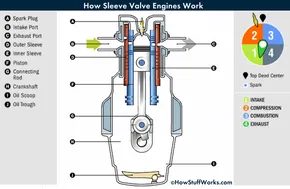
The anatomy of a sleeve motor is different. The key components are the spark plug, which ignites the charge, and the piston and crankshaft, which do the mechanical work. However, the core of the system is the dual-sleeve setup. They have an outer sleeve and an inner sleeve that work together. These sleeves slide or rotate to expose openings in the cylinder wall allowing gas to enter or exit. It’s a neat, if complicated, mechanical solution to a problem that poppet valves solve with springs and cams.
This design is not just theoretical. It has been used in special applications where its unique properties are important. While you may find two-stroke engines powering lawn equipment, jet skis, mopeds, dirt bikes, small outboards, and radio-controlled airplanes, the sleeve valve engine has a different niche. Because of its smoothness and lack of valvetrain noise, it has traditionally been popular in high-performance aircraft and luxury cars, although it never gained mass acceptance in the average sedan.
Why it matters now
Understanding which engines use sleeve valves will help you understand why this technology is often discussed in heritage circles or advanced engineering debates. It provides an alternative to the complex modern variable valve timing systems found with three or four valves per cylinder. By eliminating springs, guides and complex cam profiles from individual valves, the sleeve design reduces the number of moving parts in the head. However, compromises in sealing and lubrication have meant that it has been largely excluded from mass production since the mid-20th century.
It’s not just a matter of which parts are included. It’s about why we’re still talking about them. The sleeve valve represents a path that the automotive industry has not taken. It highlights the tension between mechanical elegance and practical manufacturing. When we look at where sleeve valve engines fit into automotive history, we see a technology that promised smoothness and durability but struggled with the details of actual implementation.
“A sleeve valve uses a sliding, sometimes rotating sleeve to adjust how much air and fuel get detonated during each compression stroke.”
It’s a reminder that not all technical solutions follow the same path. While modern engines rely on electronic precision and complex valvetrains, the sleeve engine harkens back to a time when mechanical simplicity was the ultimate goal. Whether it makes a comeback in