


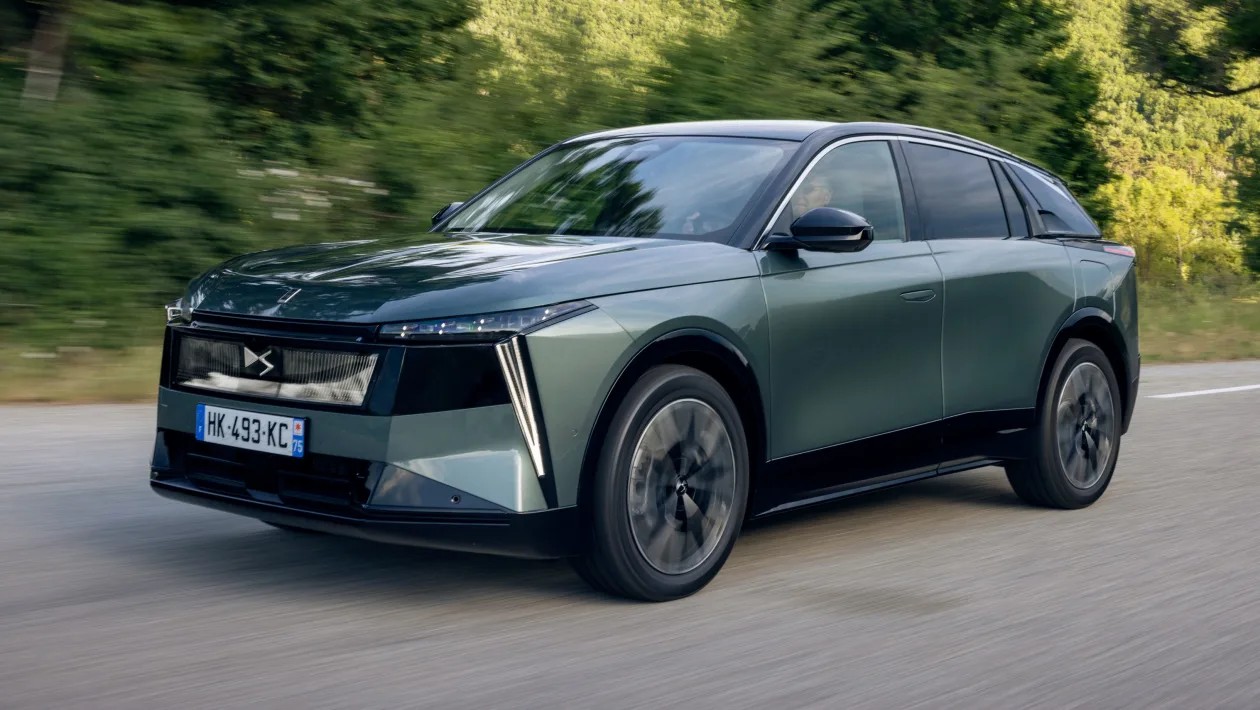
It is a good car. Actually, in certain ways it is exceptional. But knowing exactly what sits underneath that fancy badge ruins the fantasy for anyone who has the budget.
The new DS No.7 is built on the STLA Medium platform. It shares this DNA with the Vauxhall Grandland, the Peugeot E-3008, and the Citroën C5 Aircross. That matters. DS wants you to ignore those names and instead picture the Audi Q4 or the Volvo EX30. They want you to think of Chanel.
DS has branded its EVs as E-Tense, trying to attach a luxury gloss to shared Stellantis architecture.
The company says this second wave of models aims for the premium elite. In the UK that goal feels ambitious. Perhaps even delusional.
The design works mostly. The angular lines come from the DS 8, giving the No.7 a stern, corporate face. From the rear it looks generic enough to pass as a Kia EV9 stretched by a foot. It is imposing though. Large without being vulgar.
Inside the cabin feels grown up. The wheelbase is longer than the old DS 7 which makes legroom abundant. Materials are high quality. Soft leather, decent stitching. The driving position sits well.
Then there is the steering wheel. It looks like a plus sign. Why? No one knows how to rest their hands on it. It is uncomfortable and bizarre. A bold design choice that misses the mark.
The 16-inch touchscreen is another frustration. It shares the same shallow UI with the Vauxhall. Menus run across the top like a letterbox. Trying to read map text while driving is painful. Plus the screen gets hot. Not just warm. Hot. Our test car had a digital rear-view mirror that burned if you touched it. DS likely forgot the cooling fans for those chips.
Space remains the strong point. The boot holds 560 litres. Generous.
Electric or Nothing?
This SUV offers the No.7’s first true electric powertrains. Three variants exist. The base model has a small battery and front-wheel drive. The top model adds all-wheel drive and extra power.
We drove the Long Range Etoile. This makes the most sense. It uses a massive 97.2 kWh battery. It pushes 276 brake horsepower to the front wheels during boost. Normal output sits at 242 bhp. Zero to 62 mph takes 7.8 seconds. That is brisk.
The suspension here is clever. Active Scan uses cameras to read the road ahead. Dampers stiffen before the wheel hits a bump. It works. The ride is supple. Quiet. The aerodynamics (0.26 Cd) keep wind noise at bay. For pure transport comfort, DS nailed it.
Cornering feels odd. The steering is weighty but soulless. It lacks feedback. Artificial resistance everywhere. You turn it and the car responds. That is all.
The Hybrid version is worse. The 1.2-litre three-cylinder engine produces just 143 bhp. It sounds strained. It pulls weakly. Zero to sixty takes 10.4 seconds. In a luxury segment, lethargy is a crime.
The Price of Pretension
Here is the rub. The Hybrid costs less. The most expensive Hybrid La Premiere tops out at £46,875.
The cheapest EV starts at £49,380.
Our Long Range tester? £57,455. The range-topper with four-wheel drive costs nearly £67,000 £66.715.
Why pay BMW money for a Grandland?
The DS No.7 is polished. It drives well. The electric variants are genuinely excellent machines. But the value proposition crumbles under scrutiny. A BMW iX3 or Neue Klasse challenger will undercut it while offering genuine premium heritage.
This is a nice car. Easy to like. Hard to justify. The posh frock covers a common body.


