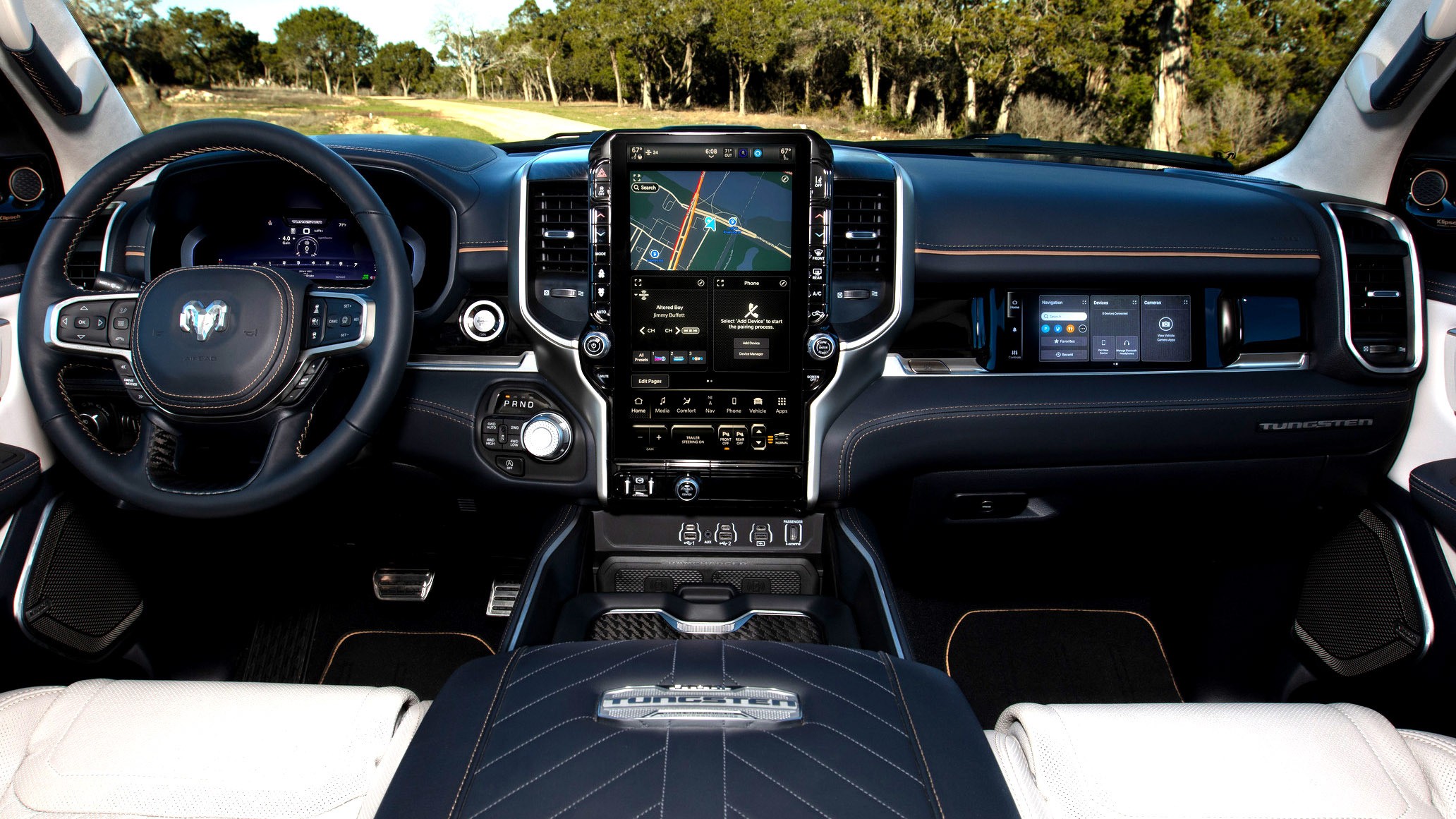
A Canadian driver is facing a massive repair bill—estimated at nearly $15,000 USD (CA$20,000) —after the airbags in his brand-new 2025 Ram 1500 deployed unexpectedly while he was driving. Despite the driver’s claim that the incident occurred without warning, the automaker, Stellantis, has refused to cover the costs, citing data that suggests the vehicle was in the middle of a rollover event.
The Incident: A Sudden “Explosion” on the Road
The owner, Victor Sanchez, reported that the incident occurred during his early morning commute. According to Sanchez, the truck’s curtain airbags and both seat-mounted airbags deployed simultaneously while he was driving under normal conditions.
The sudden deployment had immediate physical and mechanical consequences:
– Driver Disorientation: Sanchez described the event as a “huge explosion” that left him disoriented and nearly caused a collision.
– Extensive Damage: The deployment triggered a cascade of required repairs, including the replacement of the headliner, seat repairs, new seatbelts, and various control modules.
– Financial Burden: Beyond the repair costs, Sanchez is currently incurring additional expenses for a rental vehicle while his truck remains unusable.
The Manufacturer’s Defense: Data vs. Driver Experience
The dispute centers on a fundamental disagreement between the driver’s perception and the vehicle’s digital record. After a month of silence from the dealer, Stellantis responded to media inquiries by revealing they had analyzed the truck’s Occupant Restraint Control (ORC) module —essentially the vehicle’s “black box.”
Stellantis maintains that the airbags did not malfunction, but rather performed exactly as programmed. Their technical analysis claims:
1. The onboard systems detected a vehicle tilt consistent with an impending rollover.
2. The deployment was a “commanded” action triggered by the vehicle’s sensors to protect the occupants.
3. No manufacturing defect was found in the airbag systems themselves.
Because the company classifies the event as a driving incident rather than a mechanical failure, they have categorized it as an “external factor,” which falls outside the scope of standard warranty coverage.
Why This Matters: The Complexity of Modern Vehicle Safety
This case highlights a growing tension in the automotive industry: the reliance on automated safety systems and the data they generate.
As vehicles become more “intelligent,” the decision-making process for safety deployments (like airbags) is increasingly handled by complex algorithms. This raises several critical questions for consumers:
– Sensor Accuracy: Can sensors misinterpret road conditions or vehicle movement as a rollover?
– The “Black Box” Authority: When a vehicle’s internal data contradicts a driver’s experience, who holds the ultimate authority in a legal or insurance dispute?
– Warranty Boundaries: As safety systems become more proactive, the line between a “mechanical failure” and an “operational event” becomes increasingly blurred, potentially leaving drivers liable for systems that trigger without their input.
Stellantis maintains the vehicle operated as designed, while the owner remains stuck with a significant financial loss for an event he claims was unprovoked.
Conclusion
The standoff between Sanchez and Stellantis underscores the legal and technical complexities of modern vehicle safety, where data-driven decisions by onboard computers can lead to significant financial disputes between manufacturers and consumers.