Is the Cadillac Vistiq better than a Hyundai or Kia electric SUV?
Cadillac entered Australia quietly.
Really quietly. Just one dealer. One car—the Lyriq—sitting out there since early 2025 while GM tried to remember how this market works.
That stops now.
By Q3 2025, the Optiq arrives. Then, in Q4, the big gun: the 2026 Cadillac Vistiq. And it is here where the brand stops being polite and starts being competitive.
Is the Vistiq just another flashy badge? No. It’s actually compelling.
It sits atop the local lineup. It is the flashiest. But more importantly, it might just be the best value three-row electric SUV under 120000 currently on offer in Australia. Yes. That is not a typo. It undercuts its rivals in a way that feels almost accidental, rather than strategic.
Why does it cost less than a Hyundai? Read on.
What does the Cadillac Vistiqu look like compared to an Escalade?
GM knows the only reason Australians know Cadillac is either vintage tailfins or the Escalade.
The Vistiq leans into that comparison hard.
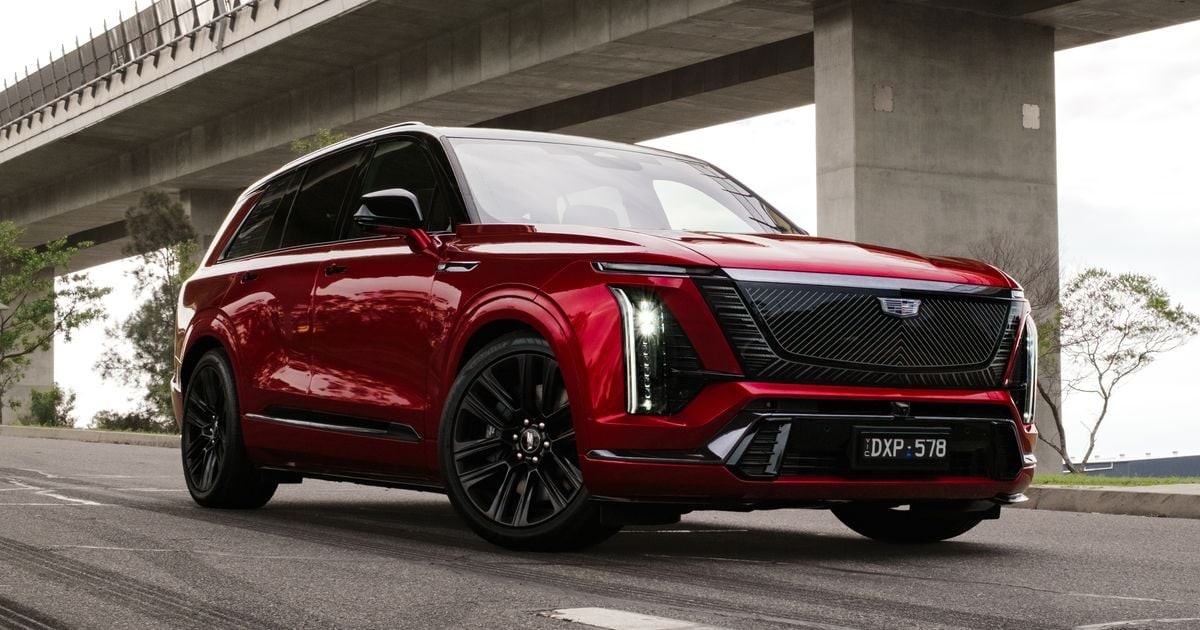
It borrows the vertical LED lighting signature from the current-gen Escalade. The lights animate when you unlock it, setting a theatrical tone. The body is boxy but sharp, aided by an angled D-pillar that refuses to look entirely squared off.
You might spot ‘Mondrian’ graphics on the rear windows in pre-production shots. Ignore those. Cadillac Australia confirmed local models won’t get them.
We are looking at the Platinum trim here. That means body-colour cladding, black 22-inch alloys, and Brembo brakes hiding up front. It is imposing.
Is it the electric Escalade? Sort of. There is a larger EV version in the US, left-hand drive only. We drove it. It is massive. Heavier. More extravagant. But Cadillac made the smarter move engineering this smaller, right-hand drive version for Australia.
The name? A miss. Vistiq means nothing. Lyriq and Optiq swap letters for style. Vistiq is just a word that doesn’t exist. Shame they dropped ‘Symboliq’.
If you want American presence without paying GMC Yukon V8 prices, this is the path. If the Kia EV9 lacks that specific luxury swagger and the Hyundai Ioniq 5 feels too premium for your wallet, look here.
How much is the 2026 CADillac Vistiqu and is it a good deal?
Here is the kicker.
$116,000. Before on-roads.
In the US, it lists at $98,490 USD. Converted, that’s roughly A$140,00+. You are getting a discount by living in Australia. That rarely happens in car buying.
Compare it:
– Hyundai Ioniq 9 : $119,750+.
– Volvo EX90 (all-wheel drive): $134,99+.
– Kia EV9 : Sits around this price point, but the Vistiq offers more kit for less money in this trim.
It is the most expensive Cadillac in Aus, sure. But it is cheaper than any Chevrolet or GMC you could buy here. The flagship brand is the budget option. That is the narrative Cadillac needs to build on.
Does the interior match the exterior styling?
Inside, it posh. Specifically, the Kona Brown colorway elevates the space immediately.
It shares hardware with the Lyriq and Optiq. The 33-inch curved display is standard across the GM luxury EV range. So is the column shifter, the door-mounted seat switches, and the rotary volume dial.
But the Vistiq adds weight. Literally.
Open-pore wood grain lines the console and doors. Back-lit, actually. Metallic trim breaks up the dashboard monotony. Gloss black is mostly avoided, which is good—though the steering wheel switches still show smudges like everyone else.
The wheel itself? Leather and metal. Nice feel. Missing a third spoke makes low-speed maneuvering slightly disorienting, but a minor quirk.
There is a separate 8-inch screen for climate control at the bottom of the stack. It works like Land Rover does it. No haptics, though. Just taps.
Wireless charging sits behind that screen, alongside USB-C ports. Below that is a storage shelf with low lips. Put a phone in there? Corner too hard. Good luck.
Audio performance is where it shines. AKG Studio system with 23 speakers. That includes tweeters in the headrests. The sound is spacious. Deep.
Material quality is generally high. Hard plastic exists on the bottom doors—a luxury car cheat code—but elsewhere it is soft-touch or leather. Stitching is everywhere.
Front seats heat, cool, and massage. The massage is average. The auto-temp feature that senses outside air and pre-cools/heats seats when you enter is genuinely clever. You can turn it off if you hate surprises.
The infotainment UI is clean. We want larger icons. Opening the glove box via touch screen is a design choice that defies logic, but here we are.
No Head-Up Display in RHD models. That stings. But the digital cluster compensates. You can project full-screen maps right there, right before your eyes.
Build quality notes: The first few imports had quirks. Loose trim. A-pillar gaps letting in light. One reviewer even noted jagged carpeting. These are early import teething issues, not design flaws. GM flagged a fix for the third-row headrests not folding down fast enough, which should be patched by customer delivery.
Where do third-row passengers sit comfortably?
Access is easy. No crawling needed because second row captain’s chairs allow easy passage to the back.
Child seats: Second row has ISOFIX. Third row? None. Only top-tether. So rear-facing kids have to sit middle. Forward-facing fits in back, but installation is tighter.
Space is decent. At 180cm, I had headroom in the back, thanks to the fixed glass panel above the third row. Legs were a bit cramped, requiring the second row to slide forward.
Third-row amenities: USB-C, cup holders, vents. Speakers, too. It feels considered, not afterthought.
Cargo reality check:
– Third row up: 430 litres. One suitcase, maybe a bag of dog food.
– Third row down: 1218 litres. Flat floor. Useful.
– All seats down: 2271 litres. Big, but with a step up due to the captain’s chairs not folding completely flush.
No frunk. All the high-voltage tech eats that space.
What is the range and charging speed?
Official WLTP range is 461 km. The display shows a peak of 502 km on a full charge, but live in real driving? Expect somewhere in between depending on how aggressively you floor it.
Charging speed is the compromise.
DC Fast Charge maxes out lower than rivals like the Kia or Hyundai. You will spend more time at the pump than expected.
However, it supports 22kW AC charging. Most cars cap at 11kW. At home, or at workplace chargers, this Vistiq charges faster than almost any other EV. That is a hidden gem feature for owners who charge daily but rarely fast-charge.
No off-peak scheduling? Weird oversight. It just charges until the percentage or timer hits. Simple, but inefficient if you pay variable electricity rates.
How does the Cadillac Vistqu drive and handle?
Quiet.
Extremely quiet. Active noise cancellation does heavy lifting here. Only on coarse tarmac do you hear tire roar. The electric motor sound options in ‘My Mode’ are cosmetic, but even on Sport, it remains inoffensive.
It floats. Adaptive air suspension eats potholes for breakfast in Tour mode.
But here is the surprise.
Drop it to Sport mode. The ride lowers. The steering gains heft. The car stays planted.
This is not just a floaty sofa. Rear-axle steering aids turning at low speeds. At highway speeds, those rear wheels turn with the front ones for stability. Body control is surprisingly sharp for something so heavy on 22-inch wheels.
If GM offered these with smaller 19-inch tires? Ride quality might have been sublime. With low-profile rubber on big rims? Some bumps translate. Sharp impacts get through.
But mostly, it is composed. You can hustle it. You just don’t want to.
Is it the CT5-V Blackwing sports sedan we didn’t get? No. But it doesn’t need to be.
It is a big, American, electric cruiser. It looks expensive. It sits comfortably in three rows. It costs less than its Korean competitors.
And nobody seems to care why.
That is either Cadillac’s biggest opportunity in decades… or nobody will notice until they try it.