


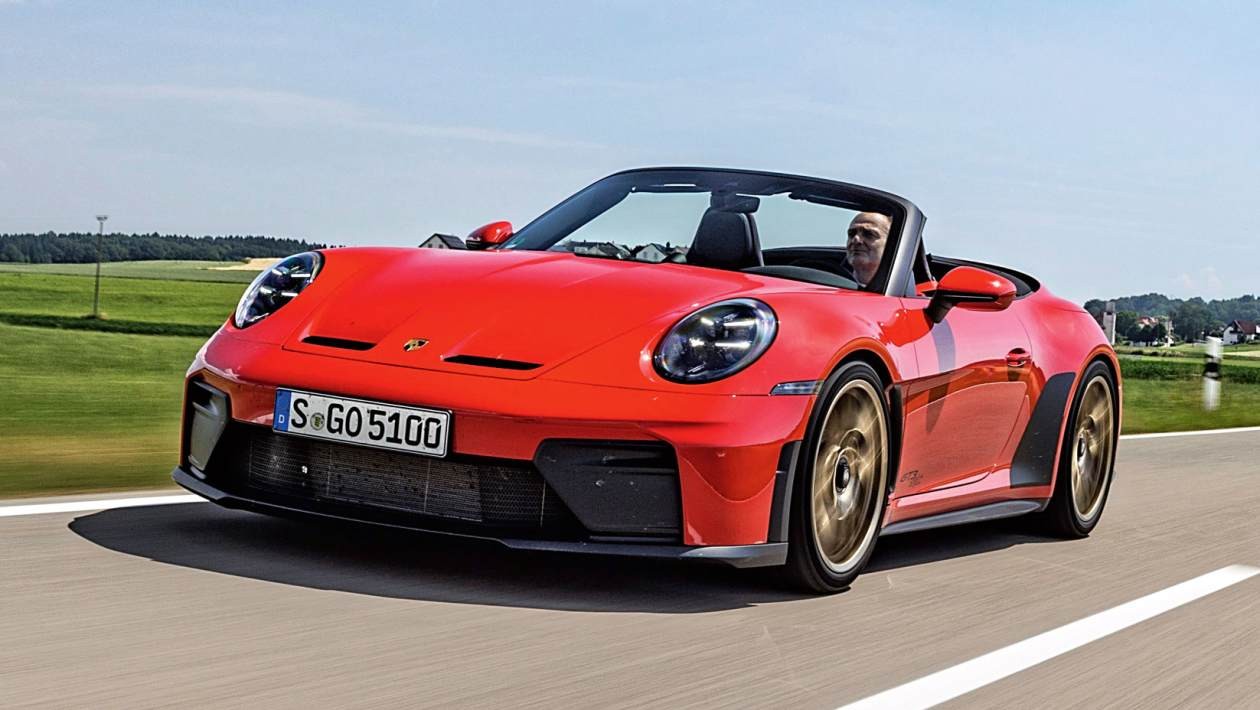
They said no roof on a GT3. Bad idea. Dangerous handling compromise. Too much vibration. The engineers ignored them. They wanted to see what would happen if they took the hard-core race car soul of the 911 GT3 and shoved it into the Cabriolet shell. It sounds like madness on paper. What they delivered is pure joy.
Strictly speaking, the Porsche 992-generation 911 GT3 RS Cabriolet (often nicknamed R/T by enthusiasts, though Porsche sticks to the GT3 RS C designation) shouldn’t exist. Or rather, it should have failed. The structural integrity of an open top fights the lateral stiffness a 525-horsepower rear-engine track weapon demands. But Porsche is obsessive. And when they want something to be light, they remove the world around it.
The Diet Plan
The scale of weight reduction is terrifying. It is a scavenger hunt for grams.
- Carbon fibre hood? Gone.
- Carbon fibre wings and doors? Yes.
- Even the anti-roll bars are carbon fibre now.
Carbon-ceramic brakes come standard because steel rotors are too heavy. You lose 20 kilos there alone. The wheels? Forged magnesium. Twenty inches at the front. Twenty-one at the rear. That sheds nine kilos of unsprung weight, meaning the tires stick harder. Even the battery has been optimized to be four kilos lighter. The magnesium struts of the fabric roof? They help too.
The result? The GT3 RS Cabriolet tips the scales at 1,433 kilograms (curb weight with 90% fuel and a 75kg driver). This makes it 95 kilograms heavier than the Coupe. Heavy for a Porsche lightweight. But consider the context: it is actually 150 kilograms lighter than the 911 Carrera GTS Cabriolet, the soft-top car it replaces in the pecking order. That is the comparison that matters. You aren’t trading away weight for the open top; you’re trading it away for the base platform.
Interior: Strip it Out
Inside, the air is thin. There is no climate control in the second row. The seats? Standard in our tester were the semi-buckets with carbon fiber backing. They hold you like a vice during high-G corners. If you want more weight savings, you can opt for full carbon fiber bucket seats, losing another 5 kilograms.
The carpets are lighter. The door trims are simplified, echoing the one-off 911 Speedsters from previous generations. Even the interior door pulls are carbon. Every surface screams “utility,” even if the Alcantara and stitching whisper “luxury.”
The infotainment screen is there, but the star of the dash is the rev counter. Set to Track Display, the digital speedo vanishes. You see only RPM and lap time. The redline sits at 9,020 RPM. That is not a number. That is a destination.
The Engine Sound
You turn the key. Or rather, you press the start button and hold it down. The 4.0-liter naturally aspirated flat-six wakes up with a staccato pop. This engine does not rev; it explodes. It screams. It hisses through the titanium exhaust pipes in the dry centers of the wheel wells.
Driving this car is about volume control. There is no volume. You drive at the edge. The six-speed PDK automatic gearbox (manual is no longer available) is incredibly fast. But it’s the rev-matched downshifts that matter. Drop from fourth to second. The car chirps, corrects, and dumps fuel. It’s mechanical theater. A stereo system would be an insult. You do not need music when the engine sounds like it is tearing the sky open at 8,000 RPM.
The numbers are brisk, of course. 525 horsepower. 0-62 mph in 3.2 seconds. 198 mph top speed. These stats are irrelevant. Anyone who has driven this car will tell you that 60 mph is where the fun starts and the fear ends. The steering is heavy. Precise. It tells you exactly when the rear end wants to step out.
Dynamics and Compromises
Here is the catch. The double-wishbone rear suspension of the Coupe has been replaced with the multilink setup from the previous GT3 RS generation. Why? To maintain ride height and allow for the wider bodywork. This change softens the car slightly. It feels less like a razor and more like a scalpel. It is still aggressive. It will break your neck if you aren’t careful. But the connection between road and tire is filtered. Just a bit.
The aerodynamics are brutal. The active rear spoiler deploys automatically at high speeds to keep the nose down. In wet weather, the fabric top can be operated while moving at up to 37 mph. It takes about 12 seconds to retract. You can drive with it open at 43 mph (70 km/h) legally. Most drivers close it sooner because the noise floor rises and the wind buffeting in the cabin increases.
But you do not buy this for commuting. You buy it for mountain roads with no traffic and a view.
The Price of Entry
The price tag is the one part that stings. The 911 GT3 Cabriolet starts around $220,000 in the US. The GT3 RS Cabriolet? Push past $330,000 before options. Add the carbon fiber packages, the ceramic brakes (standard now), the magnesium wheels. You are easily looking at over $400,000 for a complete example.
For that money, the interior feels a bit… sparse. Some plastics look cheaper than expected. The hazard light buttons feel hollow. These are petty complaints, certainly. You are not buying a family hauler. You are buying the best driving engine in history wrapped in carbon fiber.
Is it better than the Coupe? No. The Coupe is stiffer. It commits faster. The Cabriolet introduces wind noise. It lacks that solid, connected thud of the fixed roof.
But then the top drops. The air fills the cabin. The sun hits the leather. You fire the engine. That 4.0-liter boxer sings its final aria.
And for that feeling, everything else is noise.
“It’s not about going faster. It’s about feeling everything.”
The GT3 RS Cabriolet is a paradox. A heavy lightweight. A civilized weapon. It costs an arm, a leg, and your firstborn child’s college fund.
So, will you buy one?
Probably not. You’ll rent one. Or watch one fly by at red lights while the owner grins, terrified, at the rev needle pinning to 9,020.
That grin says enough.


