


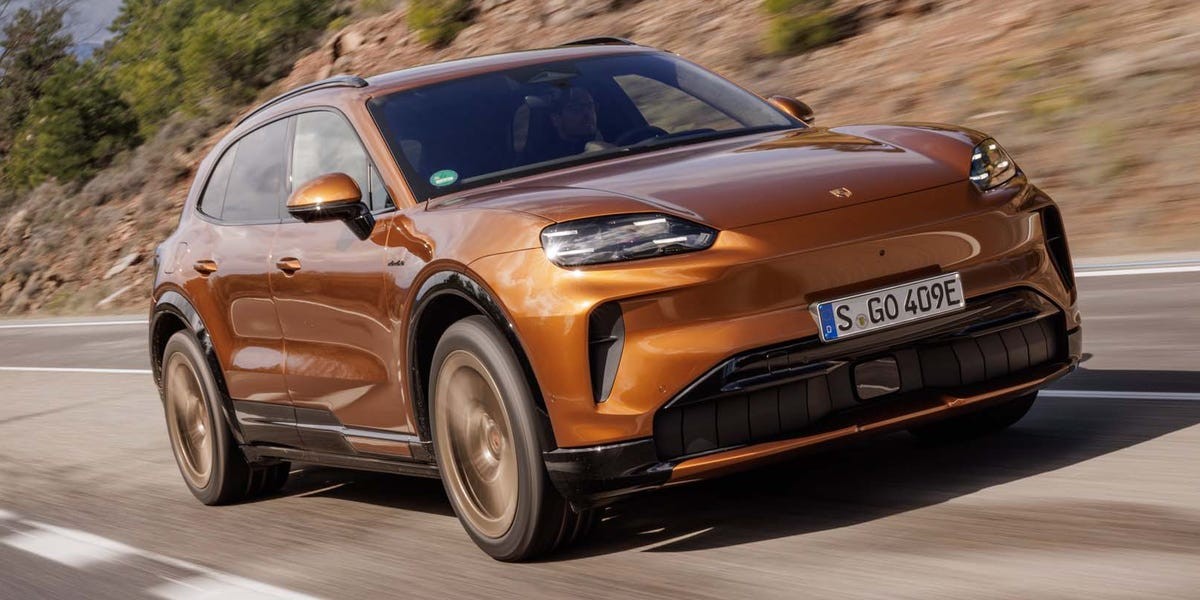
Purists might groan. They want leather, they want exhaust notes, they want the smell of burnt rubber. But Porsche didn’t build this EV to please ghosts. The all-new Cayenne Electric is here to prove an electric mid-size SUV can still drive like a Porsche.
It’s fast. Violently fast.
We’re talking about a machine that handles like it’s on rails while carrying six people and their gear. It’s practical without being boring. That’s the tricky part, right? Most EVs feel like computers on wheels. This feels like a sports car that learned how to haul.
Let’s look at the numbers. Because with a Turbo model making 1,139 horsepower, you need them.
Powertrain Options: How Many Horsepowers Are Enough?
There are three flavors. All have dual motors. All send power to all four wheels. You can’t buy a rear-wheel-drive version, and frankly, you shouldn’t want one.
The base model starts with 435 horsepower. It’s plenty quick. Maybe too plenty. If you want the “S” badge, you’re looking at 657 horsepower. That’s serious acceleration for daily driving.
But then there’s the Turbo.
1,139 horsepower.
It’s the most powerful Porsche ever built. The gas-guzzling V8s from the past can pack a punch, but this is silent torque that pins you to your seat before your brain realizes what’s happening. The claimed 0-60 time? 2.4 seconds. We think it’ll be quicker.
The Cayenne Electric uses an 800-volt architecture. This isn’t just marketing fluff. It allows for faster charging. And the Turbo trim adds active aerodynamics. Aero blades pop out behind you at highway speeds to slice through the air. Less drag means more range. It’s engineering you can see.
The Turbo is the stunner. It doesn’t just drive fast; it changes how the car interacts with the wind.
Performance: 0-60 Times and Handling
Base models hit 60 mph in 4.5 seconds. The S takes 3.6. The Turbo? Porsche claims 2.4. Our tests haven’t confirmed the Turbo’s real-world time yet, but given the physics, it will likely dip into the low 2-second range.
Think about that. A heavy SUV. Over 6,000 pounds. Moving faster than supercars half its price.
Porsche equips almost all trims with Active Ride suspension. If you haven’t experienced it, imagine a magic carpet. The car flattens itself out over bumps. Body roll? Gone. During our test of the standard Cayenne EV, the comfort was staggering. Models without Active Ride get two-valve dampers and air springs. Still good. Still refined. But Active Ride is the dream.
Rear-axle steering is available. It helps this large vehicle turn tighter in parking lots. The Turbo includes a torque-vectoring limited-slip standard. It puts power where you need it. Cornering stability? Impressive.
In comparison: The gas-powered Cayenne Turbo GT is fast. The electric Turbo is faster. And lighter? No, it’s heavier. By over 1,000 pounds. Yet it beats the internal combustion monster. Physics has a sense of humor.
Towing and Payload: Can It Haul?
Here is where it gets interesting. The Cayenne Electric tow rating is 7,716 pounds.
Most people don’t tow with an EV. Most people don’t own an SUV. But if you do, this number matters.
Why does it matter? Because 7,716 pounds puts it in luxury territory. The Cadillac Vistiq? It pulls 2,716 fewer pounds. The Rivian R1S? It ties the Cayenne at 7,716. It’s not just a commuter. It’s a utility vehicle disguised as a grand tourer.
Range and Charging: The Real Numbers
EPA hasn’t stamped the final numbers yet. Porsche isn’t either. But Car and Driver estimates a real-world range of 330 to 340 miles.
That’s enough for most. For others, it’s not. EV adoption is still waiting on that magic 400-mile standard for everyone. But for the average daily drive plus a weekend trip? You’re fine.
Charging is where the 800-volt system shines.
Peak charge rate: 400 kW.
Porsche claims 10% to 80% in just 16 minutes. That’s faster than almost any other electric vehicle on the market today. Even faster than the Lucid Air in some conditions.
And look at the plug. Porsche is adopting the NACS standard (Tesla’s port). You can plug into Superchargers directly. There’s also a CCS port on the other side if you prefer legacy networks. This dual-approach makes range anxiety a non-issue for owners who already use Tesla’s network.
Charging an electric vehicle is no longer about planning your life around outlets. It’s about grabbing coffee. The Cayenne Electric proves it.
Interior: Tech Over Tradition?
Slide inside. It looks like a gas Cayenne if you squint. The seats are familiar. The steering wheel is familiar. But the dashboard has undergone a radical change.
Gone is the traditional cluster layout. In its place is the “Flow Display.” It’s a curved OLED screen that wraps toward the driver. It connects with the center console like a single piece of glass. It’s beautiful. It’s modern. Some will miss the analog dials. Others will crave the clarity of the digital readout.
Optional passenger display: 14.9 inches.
Yes, your front passenger gets a dedicated screen for navigation or video. It’s controversial. Is it distracting? Maybe. Is it cool? Absolutely.
Space and Cargo
The wheelbase is five inches longer than the gas model. Why? To accommodate the battery pack further back. The result? More rear legroom.
Cargo space is competitive.
- Seats up: 20 cubic feet.
- Seats folded: 56 cubic feet.
That’s not huge. The BMW iX offers more. But it’s practical for groceries, gym bags, or a pair of skis. There’s also a frunk (front trunk). It’s small—about 3 cubic feet—but great for chargers or dirty shoes. Keep the trunk clean.
The Coupe version (the sloping roofline model) sacrifices a bit of vertical space. You’ll know when you test drive it. But it looks better. Trade-offs exist.
Safety and Driver Assist
Porsche includes the basics. Standard features:
- Automated emergency braking
- Adaptive cruise control
- Lane-keeping assist
You can pay extra for the remote parking assistant. You can pay extra for a 360-degree camera. These are nice-to-haves, not must-haves. The Cayenne handles itself well at speed. You rarely need the cameras once you learn the boundaries.
Check NHTSA and IIHS sites for crash stats. Porsche usually scores high. They prioritize structure and airbag placement. It’s a heavy car, after all.
Warranty: The Fine Print
Here is the catch.
The limited warranty is standard: 4 years or 50,00 miles. The powertrain follows suit.
The battery warranty is 8 years or 100,00 miles.
Compare that to Tesla. Tesla offers unlimited mileage on the battery for 8 years. Porsche caps yours at 100k. It’s a difference. For most buyers, 100k is plenty. For fleet operators or long-distance commuters, Tesla’s unlimited term wins. But for the average family keeping the car for seven years? Porsche is safe.
No complimentary maintenance. You still have to pay for tire rotations and inspections. It’s internal combustion habits die hard.
Final Thoughts
Is it worth it?
The Porsche Cayenne Electric isn’t just a gas car with a battery glued to the floor. It’s engineered. The handling is sharp. The charging is fast. The brand value holds up.
Luxury buyers are skeptical. They want range. They want speed. They want status.
This car offers all three. The Turbo model is a land yacht with a supercar’s heart. The base model is a competent, fast luxury SUV.
It’s not perfect. The cargo space isn’t class-leading. The warranty mileage is capped. But it drives like no other EV in this segment. The Lucid Gravity is roomier. The Rivian R1S is tougher. But can they dance like this?
Probably not.


