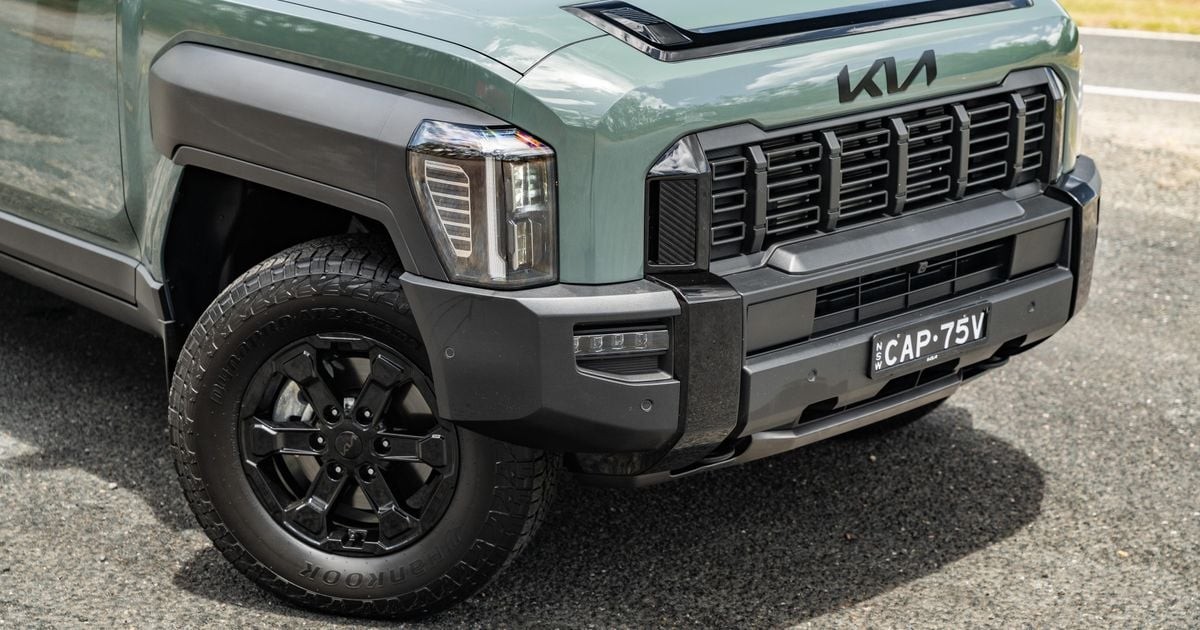
Kia Australia has officially dismissed rumors regarding an accelerated facelift for its new Tasman pickup truck. Despite significant public debate over the vehicle’s unconventional design, the manufacturer maintains that the model will follow a standard product lifecycle. However, with sales falling far short of initial projections, the company is exploring aggressive strategies—including potential price cuts—to gain market share.
Addressing the Facelift Rumors
Speculation regarding a rapid design revision for the Tasman intensified following sightings of camouflaged prototypes and the circulation of AI-generated images online. Critics have frequently pointed to the ute’s “polarizing” aesthetic as a potential barrier to mainstream adoption.
Raymond Pok, Kia Australia’s product planning manager, clarified the company’s position:
“There’s no fast-track for a facelift for Tasman. Our focus is continuing the success of [Tasman] in its current form. Normal timelines and lifecycle for Tasman will be where it sits.”
While a mid-life update is standard for most vehicles in this segment, Kia is not rushing to change the Tasman’s appearance in the immediate future.
The Sales Gap: A Challenging Market Entry
The primary concern for Kia is not design, but volume. The Tasman is currently struggling to find its footing in Australia’s highly competitive dual-cab ute market.
The disparity between the Tasman’s performance and its established rivals is stark:
– Ford Ranger (4×4): ~11,592 sales
– Toyota HiLux (4×4): ~8,951 sales
– Mitsubishi Triton (4×4): ~4,856 sales
– Kia Tasman: 1,167 sales
Kia had initially forecasted annual sales of 20,000 units for the Tasman. Currently, the model is tracking well below those expectations. Kia Australia CEO Damien Meredith acknowledged the shortfall, noting that while the vehicle has only been on the market for nine months, the brand has “a lot of work to do” to reach acceptable levels.
Competitive Pressures and Strategic Pivots
The Tasman is facing a “pincer movement” from two different directions in the Australian market:
- The Incumbents: Established giants like Ford and Toyota hold massive market share and deep consumer trust.
- The New Entrants: Newer players, particularly Chinese brands like BYD (Shark 6) and GWM (Cannon), have rapidly captured volume through aggressive pricing and modern features.
To combat this, Kia is considering several “levers” to improve competitiveness. These include:
* Pricing Adjustments: While the Tasman’s entry-level 4×2 single-cab starts at approximately $38,010, it remains more expensive than equivalent models from Toyota and Mitsubishi.
* Fleet Focus: Kia plans to introduce entry-level, fleet-oriented variants in 2026 to secure high-volume commercial contracts.
* Repositioning: The brand is looking at how to better communicate the vehicle’s value to attract buyers away from established leaders.
Context: Why This Matters
The ute segment is one of the most lucrative and fiercely contested categories in the Australian automotive market. For a brand like Kia, which has successfully transitioned from a budget player to a mainstream contender in SUVs, the Tasman represents a critical test of its ability to compete in the heavy-duty, lifestyle-oriented segment. Success or failure here will determine if Kia can truly diversify its lineup beyond passenger vehicles and small SUVs.
Conclusion
Kia is doubling down on its commitment to the Tasman, opting to refine its pricing and fleet strategy rather than rushing a design overhaul. The brand’s ability to close the massive sales gap between itself and leaders like the Ford Ranger will define the long-term viability of its pickup ambitions.