Four-cylinder engines are great. Really great. In a small car, they are brilliant. Fuel efficient, punchy, efficient in every sense. We like them. But this is not a small car.
This weighs over two tons. It costs seventy large.
In a vehicle this heavy, at this price, a four-banger feels like a compromise. A concession. We prefer big holes in the cylinder block. We want displacement. Mercedes-AMG finally seemed to hear the grumbling.
Out goes the hybrid four-cylinder. In comes the 2027 GLC53.
The Engine That Wasn’t
They are burying the GLC43. They are killing the GLC63 hybrid. The GLC53 takes their place.
Under the hood sits a supercharged, turbocharged 3.0-liter straight-six. This is the updated M256 engine. You will find the same iron block in the heavily revised S500 coming next year. But for the GLC, it means a return to sanity.
They built a new head. A new camshaft. A new intake manifold. And a bigger intercooler. The twin-scroll turbo is still there, but the electric supercharger has grown.
Previously, that motor put out 7 horsepower. Now? Ten.
It still carries that 48-volt mild hybrid system. The starter-generator adds 23 horses and 151 lb-ft of torque, mostly just to smooth out the start. That power doesn’t count toward the grand total, but it helps.
The total, then, is 443 horsepower. Up from the old four’s 416. It makes that power lower in the range—5500 to 6000 rpm. No screaming to 6750. Not necessary here.
Torque? 443 lb-ft. At a lazy 2200 rpm.
That’s where it feels different. The old four needed to hit 5000 rpm to get 369 lb-ft. The six is heavy before it even turns over. There’s also an overboost function. Briefly, you get 472 lb-ft.
Moving Mass
Nine-speed auto. AMG 4Matic all-wheel steer.
Mercedes says this thing hits 60 in 4.1 seconds. The GLC43 was slower, at 4.7. The GLC63 hybrid was faster, obviously—3.4 seconds flat. AMG usually understates. Expect the high threes for this one. 3.8 maybe?
The number isn’t the story though. It’s how it feels.
Effortless. That’s the word. Muscular, but calm. I drove one in Hamburg on a Friday evening. Rush hour traffic. Gridlock that reminded me painfully of the 405 in LA.
From a stop, the launch is instant. The mild-hybrid motor takes the first step, silent and sharp. Then the electric supercharger kicks in. No lag. Just immediate pressure. Finally, the turbo spools up to 21.8 psi. It stacks beautifully.
It feels like one of the old 6.3 V8s. The ones from the bad old days. The NA beasts.
Except the sound.
The sound is a droning hum in Comfort mode. A little artificial. We’d like more anger from this block. Maybe more pipe resonance? But the delivery? The delivery is spot on. It doesn’t struggle against its own weight.
The Heavy Truth
Here’s the thing nobody mentions at the start. It’s heavy.
4800 pounds. Almost. That is nearly 800 pounds heavier than a Mazda CX-50 hybrid. Same footprint. Different universe of mass.
You feel it in the steering. Even with standard 2.5 degrees of rear-wheel steer, the front end feels a touch ponderous. It doesn’t pivot on a dime. It rolls. It turns with authority, yes, but you’re moving a lot of aluminum and carbon fiber.
The brakes, though, are direct. Good feel. They have 15.4-inch fronts. 14.2 in the rear. They will stop the bus.
Standard adaptive dampers sit over multilink suspensions. It soaks the roads. It’s composed. But it is not light. Don’t expect a hot hatch feel. Expect a grand tourer that learned to corner.
Inside Out
Looks? Barely changed.
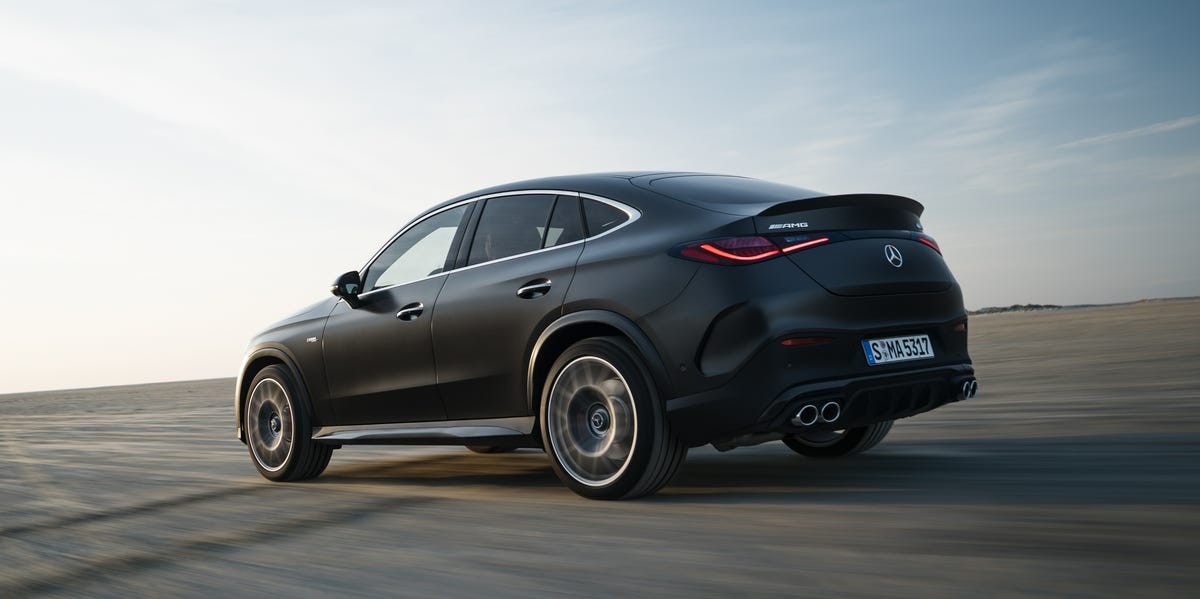
Aggressive grille. Chunky side skirts. That rear spoiler that says “I am sporty” without whispering it. Front intakes wide enough to eat small children. Optional 21-inch wheels add height and bulk. It sits tall. It looks powerful, hulking even. The coupe version exists too, trading trunk space for a roofline that drops off a cliff.
Inside is familiar Mercedes fare.
Two screens float. One for the cluster, one for everything else. Highly customizable. I counted eight themes for the instrument cluster. One of them is analog dials. Classic. Large. Speedometer left, tachometer right.
Everyone should offer that by default. Why do we need digital noise when we can just have speed?
There is an option menu as long as your arm. Performance seats? Check. Nappa leather or Alcantara or carbon fiber wheel? Check. Driver assists? More checks.
The AMG branding allows for specific performance tuning parts separately. You can buy the seats. You can buy the wheel. You can buy your soul back in bits and pieces.
The Cost of Entry
American dealerships see these in late 2026.
Price tag? Unknown.
The old GLC43 started at $68,920. The GLC63 at $88,140.
The new 53 replaces both. No plug-in battery complication. Simpler powertrain. Easier to build? Probably cheaper too.
Expect $70,000 at the base. Maybe $75,00. But we both know you won’t order the base car.
Options add up fast. Wheels, brakes, suspension tweaks. Leather that costs more than a used sedan. You will easily clear six figures by the time you click “configure.”
Is it worth it?
It feels like the AMGs used to feel. Before the electrification math got in the way of the engineering joy. Before efficiency became the only metric. It is smooth, strong, and satisfyingly analog in its delivery, if not in its sound.
A little drone in the exhaust. A bit of weight on the turn.
But when you ask it for speed, it gives you six-cylinder thrust without hesitation. It moves like the good old days, even if it arrives with a digital price tag.