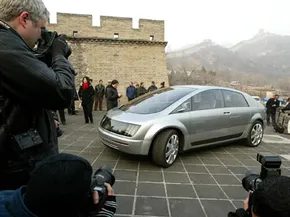
Sit in the driver’s seat. Grip the yoke. Push it forward and you go. Tilt it left or right and you turn. Slam the throttle and you accelerate until you hit a stoplight, where you brake to a halt.
Sounds like a racing sim? No. It’s the future of the showroom floor.
We are talking about drive-by-wire systems. You might also hear them called “x-by-wire” or just “by-wire.” These systems swap out the traditional mechanical and hydraulic guts of a car for electronics. Instead of metal rods and fluid pressure, computers and sensors take over. They handle acceleration, braking, and steering.
Conventional cars are built on decades-old physics. They work. But they are complex. They wear out. They are inefficient. Drive-by-wire promises to strip away that clutter.
Aviation fans have seen this before. Planes have used “fly-by-wire” since the 1990s. Electrical signals replace cables. It’s safer. It’s more precise. Now, carmakers are bringing that logic to the road.
The goal isn’t just novelty. It’s comfort. Functionality. Safety. Computers read your intent and execute it with precision humans can’t match. There’s an environmental angle, too. Better control means better fuel economy. Cleaner emissions.
But how does it actually work? And is it safe? Let’s look at the types of drive-by-wire systems that are starting to appear in modern vehicles.
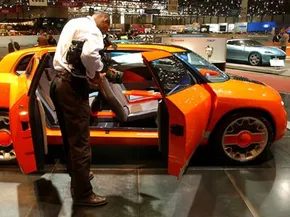
The average car is a tangled mess of hydraulic fluid, steel cables, and mechanical linkages. You have the brake booster, master cylinder, steering column, shaft, rack-and-pinion gear, and a dozen other parts all fighting for space. They work together to keep the ride smooth. They also add dead weight. And they degrade over time.
Drive-by-wire changes the equation. It strips away the tangle. Most of those physical connections get replaced by electrical wires and data packets.
How x-by-wire actually works
In any x-by-wire system, sensors do the heavy lifting. They record input. Then they pass that data to a computer—or a series of computers. The computer translates that digital signal into electrical energy. Finally, actuators convert that energy back into mechanical motion.
It’s not a single technology. It’s a family of technologies. Hence the term “x-by-wire.” Here is how the three main branches operate.
Throttle-by-wire
Accelerate-by-wire was the pioneer. It’s been in production cars for years. The system swaps the physical cable connecting your foot to the engine for a sensor array.
Press the pedal. Sensors measure the displacement. The data goes to the Engine Management System (EMS). The EMS is a computer. It calculates fuel requirements. It sends a command to an actuator. The actuator moves the throttle plate.
The pedal itself doesn’t have to look like a traditional lever. It could be a simple pad near the floor. Or it could be a joystick.
Brake-by-wire
Braking is getting complicated, too. There are two distinct paths here.
- Hydraulic (Wet) Brake-by-wire: This keeps the hydraulic fluid but adds electronic pressure modulation. It’s a hybrid approach.
- Electric (Dry) Brake-by-wire: No fluid. No master cylinder. Just an electric motor clamping down on the calipers.
The dry system is cleaner. It saves space. But it requires massive redundancy to ensure you stop when you need to.
Steer-by-wire
Steering is the holy grail of x-by-wire. Sensors detect the angle of your steering wheel. They send that vector to a microprocessor. The processor sends commands to actuators on the axles.
The wheels turn. No mechanical column connects the steering wheel to the front tires. You can design a cockpit with a yoke. Or a screen. Or nothing at all.
“The pedal could be the same pedal drivers have become accustomed to using today, an easy-to-reach pad… or it could be incorporated into a joystick or videogame-like controller.”
This last point is where it gets weird. If the accelerator is a hand controller, you use your hands for acceleration, braking, and steering. The cabin layout shifts. The driving experience shifts.
It sounds efficient. It sounds like the future.
But efficiency isn’t the only metric. Reliability is. And safety. And the psychological comfort of knowing that turning the wheel physically moves the tires.
Next, we look at the benefits. And the drawbacks.
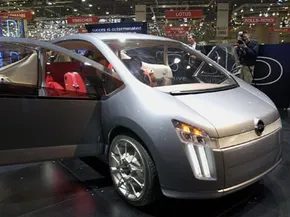
Drive-by-wire technology isn’t just a theoretical concept anymore. It’s a tangible shift away from mechanical linkages toward electronic control. The appeal is straightforward. Replace the physical throttle cables and hydraulic lines with sensors and actuators. You reduce moving parts. You cut weight. You gain precision.
“Less weight and better accuracy would equal better fuel efficiency and fewer emissions, too.”
This isn’t just about shaving grams off the curb weight. It’s about operational accuracy. Fewer mechanical components mean less wear and tear. Service intervals stretch out. Some systems might not need service at all. For an enthusiast, the idea of a car that runs tighter and cleaner for longer is attractive.
But adoption has been glacial. Why?
The Safety Trust Gap
Airline industry veterans know fly-by-wire well. It’s been standard for decades. Cars? Not so much. The core barrier isn’t engineering. It’s psychology. Manufacturers struggle to convince drivers that electronic systems are safe.
Drive-by-wire systems rely on complex software. Software can fail. Always has. Always will.
Consider brake-by-wire. In a worst-case scenario, a sensor miscalculates pressure. The brake calipers and pads apply the wrong force to the rotor. Too light. Or too strong. The driver presses the pedal expecting a specific response. The car delivers something else. An accident follows. The driver is unaware of the internal logic error until it’s too late.
This isn’t paranoia. It’s a valid concern. Any system using software has an inherent vulnerability. Testing catches bugs. It doesn’t eliminate the possibility of failure.
Who’s Already Doing It?
Despite the fears, the technology is here. Several major automakers have integrated drive-by-wire systems into their lineups.
- BMW
- Mercedes-Benz
- Land Rover
- Toyota
- GM
- Volkswagen
- Nissan
These aren’t experimental prototypes. These are production vehicles. The industry is moving. But the pace is dictated by consumer comfort, not just technical capability.
The Programmer’s Responsibility
Critics point to a simple truth: software is only as good as the programmers and manufacturers who built it. If the code is flawed, the hardware fails. If the sensors are misaligned, the actuators respond incorrectly.
Fly-by-wire worked in airplanes because the stakes were higher, the testing more rigorous, and the redundancy more robust. Car manufacturers are now applying that same level of scrutiny to drive-by-wire in automobiles. Experience and product testing are closing the reliability gap.
The question isn’t whether drive-by-wire will become standard. It’s how long it will take for consumers to trust it completely.
Related Articles
- 5 Ways Hybrid Battery Packs are Being Improved
- How Brake Assist Works
- How Brakes Work
- How Brake Pads Work
- How Brake Calipers Work
- How Brake Rotors Work
Sources
- Burgin, Richard and Will Valdez. “Death-By-Wire.” Software Engineering Ethics Research Institute. 2002. (April 15, 2009) http://seeri.etsu.edu/SECodeCases/ethicsC/DeathByWire.htm
- CNET Glossary. “Drive-by-wire.” (April 14, 2009) http://reviews.cnet.com/4528-6029_7-6211213-1.html
- Cobra Automotive Accessories. “Explanation of Drive-By-Wire.” (April 13, 2009) http://www.cobracaralarms.com.au/cruise-controls/drive-by-wire
- Dorissen, Hans Theo and Klaus Durkopp. “Mechatronics and drive-by-wire systems advanced non-contacting position sensors.” Automotive Electronics. July 16, 2002. (April 18, 2009) http://www.sciencedirect.com/science?_ob=ArticleURL&_udi=B6V2H-475RD8-2&_user=10&_rdoc=1&_fmt=&_orig=search&_sort=d&view=c&_acct=C000050222&_version=1&_urlVersion=0&_userid=2&md5=3d3d96969d915d9131f6508cb2c2b
- Eisenstein, Paul A. “GM Hy-Wire Drive-By-Wire Hybrid Fuel Cell Vehicle.” Popular Mechanics. August 2002. (April 15, 2009) http://www.popularmechanics.com/automotive/new_cars/1266806.html
- Krebs, Michelle. “Your Car, 2022.” Popular Science. April 7, 2002. (April 15, 2009) http://www.popsci.com/cars/article/2002-04/your-car-2022
- Quinion, Michael. “Drive-By-Wire.” World Wide Words. Dec. 6, 2003. (April 13, 2009) http://www.worldwidewords.org/turnsofphrase/tp-dri1.htm