Michelangelo once claimed that every block of stone holds a statue inside, waiting for the sculptor to set it free. That romantic view of creation works fine for marble. It falls apart completely when you are trying to slice through hardened steel sheets destined for a car chassis. Steel is the backbone of automotive manufacturing because it offers the necessary strength without dragging the vehicle into the ground with excessive weight. But tough material is hard to shape. How do you turn a flat, rigid sheet of metal into the complex, curving doors, hoods, and frame rails that make up a modern automobile?
The answer lies in the chaotic, high-speed world of industrial fabrication. While a final car body involves welding hundreds of subassemblies together, the process begins long before those pieces ever touch. It starts with cutting. This is where suppliers and independent shops transform raw stock into precise components. And they rarely do it by hand anymore. Computers now dictate the movement of the tools, ensuring that every cut meets exact specifications. From the outer body panels to the internal engine mounts, digital precision is the new standard.
The Evolution of Automotive Metal Cutting
The techniques used to slice automotive steel share DNA with shipbuilding and heavy aerospace fabrication. If you are a weekend hobbyist working on a low-volume project in a home garage, you might get by with simple hand-operated shears. You can hack away at mild steel and make it work, provided you don’t mind filing down the edges later.
But mass production doesn’t have time for filing. It doesn’t have time for error.
In a professional manufacturing environment, accuracy is not a luxury. It is a financial imperative. When you are building thousands of identical parts, a mistake in one cut means a mismatch in assembly, which means wasted labor and scrapped materials. To solve this, manufacturers rely on computer-controlled machinery. The big three players here are lasers, plasma cutters, and waterjets.
These machines offer distinct advantages over manual labor. They move fast. They ignore fatigue. And most importantly, they adhere to strict tolerances. Tolerance, in this context, refers to the allowable deviation from a specified dimension. In automotive manufacturing, these bands are incredibly narrow. A millimeter of error on a door frame can mean the difference between a sleek, quiet cabin and a rattle-prone disaster. By using automated systems, factories minimize waste and cut costs, keeping them competitive in a razor-thin margin industry.
Breaking Down the Heavy-Duty Cutting Tools
Each cutting technology has its own physics, strengths, and specific applications within the assembly line. Understanding how they work reveals why a specific tool is chosen for a specific part.
Lasers
Lasers are the go-to choice for precision cutting of thinner materials. They excel at slicing through sheet steel up to 0.5 inches (1.27 centimeters) thick. For aluminum, the limit drops to about 0.33 inches (0.9 centimeters). The beam is focused so tightly that it vaporizes the material along the cut line.
However, lasers are picky. They require high-quality, consistent materials. If the steel sheet has impurities, inclusions, or uneven thickness, the laser beam can scatter. This leads to ragged edges or, worse, molten metal splashing back onto the sensitive laser lens. That splash can damage the equipment and halt production. So, while lasers offer incredible accuracy, they demand clean, uniform stock to function properly.
Plasma
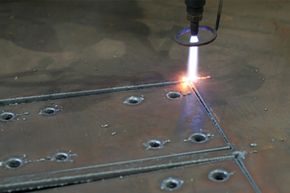
If lasers are surgeons, plasma cutters are sledgehammers with a scalpel’s aim. Plasma cutting works by forcing a gas, such as oxygen or nitrogen, through a narrow nozzle at high speed. An electric arc forms between the nozzle and the workpiece, ionizing the gas. This creates a jet of superheated plasma that melts the metal, blowing it away to create a cut.
The temperatures involved are staggering. The plasma arc generates heat ranging from 20,000 to 50,000 degrees Fahrenheit (11,093 to 27,760 degrees Celsius). This intense heat allows plasma cutters to handle thicker materials than lasers can manage efficiently. The metal itself acts as part of the electrical circuit, completing the path for the arc. This makes plasma a versatile workhorse for structural components where extreme precision on the sub-millimeter scale is less critical than sheer cutting power and speed.
The Push for Tighter Tolerances
As vehicles become more complex, the margin for error shrinks. A body panel that fits poorly doesn’t just look bad; it affects aerodynamics, noise, vibration, and harshness (NVH). It compromises safety. It ruins the resale value.
To meet these demands, the industry is constantly pushing the boundaries of what these cutting tools can achieve. New computer algorithms adjust cutting speeds and gas pressures in real-time. Advanced sensors detect minor variations in material thickness and compensate automatically. The goal is always the same: tighter tolerances. Less waste. Faster production.
But even with all this technology, the fundamental challenge remains. You are still taking a tough, unyielding block of metal and forcing it into a shape it never wanted to be. The next step in this process involves taking these precisely cut pieces and joining them together. How do you fuse steel without warping the metal or weakening the structure? That is where the heat of welding meets the cold precision of robotics.
EDM: Precision at a Snail’s Pace
Let’s talk about Wire Electrical Discharge Machining or EDM. If you’re looking for raw speed, look elsewhere. But if you want an edge so precise it defies belief all the way to the edge, this is the one for you.
Here’s how it works. A negatively charged electrode (usually molybdenum or galvanized brass) floats near the positively charged metal workpiece. There is no physical contact. Just proximity. When the gap closes, a strong electric spark is produced. The heat vaporizes the metal. On a microscopic level, it’s a controlled explosion.
The result? Accuracy 1/10,000th of an inch.
Looking at this tolerance is 10 times narrower than a human hair. Tolerances in engine parts, transmission gears, and highly stressed structural components are at extreme limits, and millimeters can mean the difference between smooth operation and catastrophic failure.
Obviously, there are some pitfalls.
First, the metal must be conductive. Insulators are out. Second, it’s slow. Incredibly slow. It’s about 10 times slower than the next method on the list. You don’t use EDM to rapidly prototype body panels. Can be used when accuracy is the only metric that passes the check.
Waterjets: Cold Erosion for Thick Metal
Enter the waterjet.
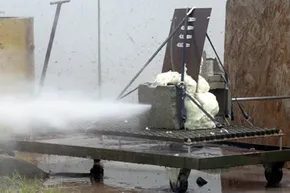
Forget lasers. Forget plasma. This is waterjets, also known as liquid sandpaper on steroids. This process is based on a method called “cold supersonic erosion”. Sounds very technical. It is.
An abrasive additive (usually garnet or similar grit) is mixed with high-pressure water and blasts through material. There is no heat affected zone. There is no warping. Only pure cold mechanical removal.
Why is this important for cars?
Because waterjetss can cut metal up to 10 inches (25.4 centimeters) thick while maintaining high precision. It’s not just sheet metal. That’s armor. That’s structural reinforcements. That’s heavy-duty fabrication.
This is not niche industry trivia. Water jets have come to the attention of the public through high-profile exposure. Jay Leno’s garage features them. West Coast Customs uses them in custom builds. It is versatile. They cut metals, composites, glass, even stone. If it is solid, it may be possible to cut it with a waterjets without dissolving into a puddle.
The learning curve is shallow too. It’s relatively easy to do compared to the finicky nature of EDM. You get precision, versatility and speed.
The Trade-Offs
Car manufacturing is a balancing act. Buyers want cars that are lighter, stronger and safer. They also want to buy them at a price that doesn’t require a second mortgage. Technology bridges that gap.
EDM provides fine precision for internal components. Waterjet offers excellent versatility for structural and custom work.
One is slow but accurate. The other is fast and adaptable.
Neither is “better” than the other. They are just tools for different jobs.
The industry doesn’t stop here. The new linear drive technology improves the accuracy of the waterjets and reduces costs. Laser, plasma and EDM are always compared to waterjets features in terms of efficiency and cut quality. But the important fact remains the same. You should choose the tools based on what you want to build.
If you want gear teeth measured in thousandths of an inch, you have to wait until the spark comes on. If you want a custom exhaust kit or reinforced chassis components, prime the pump.
All that remains is the cleaning.