


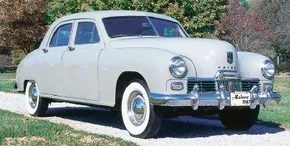
Henry J. Kaiser and Joseph W. Frazer didn’t just part ways in 1949. They had been clashing since 1942. Back then, Kaiser was toying with plastic-bodied cars. He hinted they’d sell for $400 to $600 after the war. He also demanded that automakers announce their postwar plans now. Frazer hated it.
The industry vet was furious. “I resent a West Coast shipbuilder asking us if we have the courage to plan postwar automobiles when the President has asked us to forego all work which would take away from the war effort,” Frazer said. He called Kaiser’s challenge “half-baked.” He mocked the plastic models. Artists made them with glass tops. Frazer noted those artists probably wouldn’t want to sit under those tops in the summer and sweat.
By July 1945, the public brouhaha was forgotten. Kaiser and Joe joined forces to form Kaiser-Frazer. They compromised. The relationship was amicable, at least for a while. Henry realized his plastic car for the common man was wishful thinking. But he had high hopes for a more-radical Kaiser than what ultimately emerged.
It would have stemmed from the 1946 K-85 prototype. It looked like the conventional Frazer then already locked up. But it employed unit construction on a shorter 117-inch wheelbase. Suspension and the “Packaged Power” drivetrain, worked out by engineer Henry C. McCaslin, were very different.
Why the K-85 Prototype Failed
For one thing, an 85-horsepower Continental six drove the front wheels, not the rears. A conventional three-speed transmission sent power via a helical-gear transfer case to a front differential. Then it went to the wheels by U-jointed halfshafts. Equally novel was four-wheel independent “Torsionetic” suspension. A pair of longitudinal torsion bars, each 1.3 inches thick by 44.5 inches long, twisted to provide spring action like conventional coils or semi-elliptics.
McCaslin wanted unit construction because “we needed to use more of the operation in the plant. We had the welding equipment but lacked large dies and cranes. It was a compromise to get the car into production.”
But the front-drive K-85 didn’t have a chance. Aside from exorbitant tooling expense, technical problems such as heavy steering, gear whine, and wheel shimmy proved insurmountable. With so much weight over the front wheels, the K-85 would have needed power steering. That would have added $900 to the retail price.
So in May 1946, K-F decided to abandon this idea for a conventional rear-drive Kaiser priced below the Frazer.
The Willow Run Factory and the 1947 Kaiser
Production for both new makes began that June at Ford’s huge wartime bomber plant in Willow Run, Michigan, near Detroit. K-F had leased it from the federal government’s Reconstruction Finance Corporation. Like the Frazer, the new Kaiser Special was a 1947 model. Initial price was $1868. Postwar inflation quickly boosted it above $2000.
It was very much like the Frazer, of course. A roomy flush-fender four-door sedan with 123.5-inch wheelbase. Styling by the eminent Howard A. “Dutch” Darrin. A “stroker” six making 100 bhp from 226 cubic inches. The Kaiser wore a multipiece grille that was cheaper to make than the Frazer’s because the pieces were smaller. Furnishings were naturally more-basic, in line with the lower price.
Perhaps inevitably, a fancier Kaiser Custom was added late in the model year. It cost about $350 above the Special and $150 more than the standard Frazer. But some $250 less than the top-line Frazer Manhattan.
A bit later, Customs were offered with optional dual intake and exhaust manifolds that boosted bhp to 112. Kaiser would have no automatic transmission through 1950. After that, a proprietary GM Hydra-Matic was offered. Only a standard three-speed manual available with overdrive as an $80 option.
Though plans called for building two Kaisers to every Frazer, the 1947 ratio was 1:1 so as to fill initial orders. Both lines were basically unchanged for 1948. Very few Customs were built, though Kaiser volume far outpaced Frazer’s. These were outstanding years for what came to called the “postwar wonder company.”
Kaiser production totaled more than 70,000 for ’47 and nearly 92,000 for ’48. All told, K-F made a healthy $30 million profit on 1947-48 volume that put it ninth in production. The highest independent.
“It was a compromise to get the car into production.” – Henry C. McCaslin
For more on defunct American cars, see:
- AMC
- Duesenberg
- Oldsmobile
- Plymouth
- Studebaker
- Tucker
1949 Kaiser Special Traveler and Kaiser Custom Vagabond
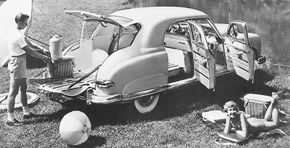

The 1949 Refresh: Style Over Substance
The 1949 model year didn’t bring a new body, just a fresh coat of paint and some chrome. A broader, shinier grille and larger taillights were the headline changes. Kaiser renamed its Custom trim to DeLuxe and finally standardized the 112-horsepower engine across the board. But the real story was in the new model lineup. Henry Kaiser had a specific vision for utility sedans—basically a budget-friendly substitute for a full station wagon, which K-F never actually built.
These utility models featured a double-door rear hatch and fold-down back seats. The Special Traveler hit the showrooms at $2,088. If you wanted leather upholstery, the Custom Vagabond cost an extra $200. They were practical, sure, but they were also expensive.
Then there were the flashier newcomers. Kaiser introduced the four-door convertible and the Virginian four-door hardtop. These were the first postwar uses of those body styles, and they were pure DeLuxe luxury. Removing the steel B-posts gave them excellent visibility, though they kept vestigial pillars with glass panes to maintain structural rigidity. The convertible was even reinforced with fixed side-window frames and a heavily braced X-member frame.
The Price Problem
Here is the rub: these stylish, innovative cars cost as much as some Cadillacs. Priced between $3,000 and $3,200, they were simply too rich for the average buyer. Production numbers were tiny. An estimated 946 Virginians were made, and just 54 convertible sedans. Unsold 1949s were stamped with new serial numbers for the 1950 model year.
Kaiser-Frazer did one thing right: color. They offered an unusually wide range of paint and upholstery options. Carleton Spencer, the design chief, took cues from House & Garden magazine’s home interior research. The results were bold. You could get Indian Ceramic (a vivid pink), Crystal Green, Caribbean Coral, or Arena Yellow.
Detroit as a whole offered 218 exterior colors in 1949. K-F had 37. Of the 150 interior fabrics available industry-wide, Kaiser-Frazer owned 62. These names were written in chrome script on the front fenders of the Custom models. It was a level of customization that Detroit competitors couldn’t match.
The Dashboard and the Disaster
Inside, the cheap, horizontal gauge cluster of the launch model was gone. In 1949, it was replaced by a more ornate panel featuring a giant speedometer for the driver and a matching clock on the passenger side. The DeLuxe dashboards sparkled with chrome and stainless steel, topped with a massive ivory steering wheel and a semicircular chrome horn ring.
It was flashy. It was colorful. It masked an aging design that was rapidly becoming obsolete.
And that’s where the disaster began. Henry Kaiser planned to build 200,000 cars for 1949. His partner, Joe Frazer, knew better. The Big Three were launching all-new models that year. Frazer urged a holding action, suggesting K-F wait until its own new designs arrived in 1950. Kaiser wouldn’t listen. “The Kaisers never retrench,” he reportedly stormed.
The power struggle was real. Kaiser’s people had overtaken Frazer’s influence in the boardroom. Frazer yielded the presidency to Kaiser’s son, Edgar, staying on the board only for appearance’s sake. By year’s end, Frazer was gone.
The Aftermath
He should have listened. K-F’s 1949 sales were a fraction of the goal: only about 58,000 units. That left 20 percent of the inventory unsold. To keep the factories running, they recycled these cars with new serial numbers as 1950 models. Experts estimate that 1949 production accounts for about 84 percent of the total Kaiser output, mostly because they were stuck in limbo.
The shiny grille and new taillights couldn’t save a company that built too many cars that nobody wanted at that price. The 1951 models would try to fix it. They wouldn’t.
For more on defunct American cars, see:
- AMC
- Duesenberg
- Oldsmobile
- Plymouth
- Studebaker
- Tucker
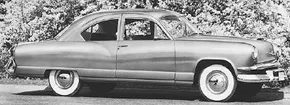
The 1951 Kaiser was a genuine shock to the system. Dutch Darrin and K-F Styling had cooked up something that looked nothing like the rest of Detroit’s lineup, branding it with “Anatomic Design” as if they were tailoring a suit rather than stamping sheet metal. It was supposed to debut in 1950, but the factory was still drowning in leftovers from the previous year. By the time the 1951 models hit showrooms in March, the wait had only sharpened appetite.
The result? Sales exploded.
Nearly 140,000 units moved in a single model year. That was a staggering number for a brand that had languished at 17th place in Detroit just two years prior. Kaiser rocketed up to 12th, holding its ground against giants. Why did people buy it? Because it looked different. It was slender. It was beautiful.
The Art of Visibility
The 1951 Kaiser offered 700 square inches more glass than its nearest competitor. That isn’t a typo. The beltline sat lower than any Detroit car would manage until 1956, giving the interior a sense of openness that felt almost predatory in its simplicity. The wheelbase shrank to 118.5 inches, yet the car appeared miles longer and sleeker than its first-generation predecessor.
Color engineer Spencer turned the exterior into a palette of bewildering choices. The interiors were high-fashion, too. But the real selling point wasn’t just aesthetics. It was safety.
For the first time, a car actually marketed its safety features to the consumer. The dash was padded. Gauges and controls were recessed so they wouldn’t break your knuckles in a crash. Roof pillars were slimmed to kill blind spots. And the windshield? It was designed to pop out if hit with more than 35 pounds per square inch of force. Think about that. A safety feature that literally ejected itself to save your life.
Underneath, chief engineers John Widman and Ralph Isbrandt refused unit construction. They built a rigid separate body for a frame that weighed a mere 200 pounds. Low center of gravity. Terrible curb weight at just 3,100 pounds. The suspension delivered a ride quality that defied physics. A Chrysler engineer who drove one later admitted it handled like a 4,500-pound car.
Missing the Mark on Power
Kaiser sat in the lower medium-price field, with prices ranging from just under $2,000 to a touch over $2,400. The Special and DeLuxe series returned, offering regular and utility Traveler sedans in two- or four-door configs, plus the long-deck club coupe. There was even a stripped Special business coupe for the pragmatic.
But look at what was missing. No hardtops. No convertibles. No station wagons. And certainly no V-8.
K-F had plans for all of them. They just didn’t have the cash to market them. The old inline-six was tweaked to 115 bhp using a two-barrel carburetor and dual exhausts. But without a V-8, Kaiser was already losing the war. The absence of a powerful engine would prove a fatal sales liability in the years to come.
The “Continental” Interlude
A facelift scheduled for 1952 fell behind. So, Kaiser sold Virginia models in the interim. These were basically leftover 1951s fitted with “Continental kits”—spare tires mounted on the trunk lid. About 5,500 of these stopgaps rolled off the line.
The “real” 1952s arrived later, featuring bulbous taillights and a grille that looked heavier, more aggressive. Two-door Travelers and the business coupe were axed. Specials became DeLuxes. Previous DeLuxes were reborn as Manhattans, borrowing the old Frazer nameplate.
These “second-series” 1952s are rare today. Only 7,500 DeLuxes and 19,000 Manhattans were produced.
Dragon Fever
Kaiser tried to pivot to the fashion market in 1951 with the $125 Dragon trim options. These limited-edition four-door sedans came in Golden, Silver, Emerald, and Jade. The interior featured alligator-look “Dragon” vinyl, color-keyed exteriors, and padded vinyl tops.
It was a gimmick. But it worked.
The idea resurfaced in 1953 with the “Hardtop” Dragon sedan. This was the most luxurious Kaiser ever built. You spotted it by the gold-plated hood ornament, badges, and keyhole covers. The roof was usually padded with “bambu” vinyl—a tough, oriental-style material that also dressed the dash and parts of the seats.
Seat inserts used “Laguna” cloth, a fabric with an oblong pattern designed by fashion consultant Marie Nichols. Amenities included tinted glass, Hydra-Matic Drive, whitewalls, a twin-speaker radio, and Calpoint custom carpet. The final touch? A gold-plated dash plaque engraved with the owner’s name.
It was spectacular. It was also $3,924.
That price tag was nearly as much as a Cadillac Coupe de Ville. Sales were limited to just 1,277 units. A few had to be given away just to get them out of the lot.
The Decline
Otherwise, the 1953 Kaisers saw little change. A pair of stripped Carolina sedans was fielded in the $2,300 range to build showroom traffic. Only 1,800 sold. Club coupes were cut. The inline-six was coaxed up to 118 bhp. Power steering arrived late in the season as a $122 option.
But the numbers were bleeding out. Sales dropped to 32,000 in 1952. By 1953, they were down to 28,000.
The compact Henry J had squandered development funds. Money that could have gone toward new styling, new body types, or a V-8 engine had vanished. Cash reserves were further depleted in 1954 when Henry Kaiser decided to buy Willys-Overland. Willys was no better off. Kaiser had spent its future on a 1951 gamble, and the bill was coming due.
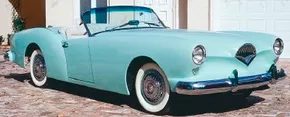
Moving operations from the massive Willow Run plant to W-O’s facilities in Toledo was a desperate cost-cutting measure. Edgar Kaiser hoped a fresh face would save the brand, enlisting stylist Arnott “Buzz” Grisinger to tweak the lineup.
The 1954 models stared back with a wide concave grille and dummy hood scoop. Headlights floated in oval housings. It looked eerily like the Buick XP-300 show car, which Kaiser adored. Behind them, “Safety-Glo” taillights wore finned covers. A lighted strip ran along the top of the fenders.
Traveler models were dropped entirely. The Manhattan line got a power bump. A McCulloch centrifugal supercharger added 140 horsepower when the pedal hit the floor. Unsupercharged Specials also appeared.
Two flavors of Special existed. The first used ’53 Manhattan bodies with ’54 front ends. Clearing inventory, obviously. The second series featured genuine ’54 cars with wrapped rear windows, matching the Manhattans.
Sales didn’t budge.
1954 production totaled a dismal 8,539 units. That breaks down to 4,110 Manhattans, 3,500 early Specials, and just 929 late Specials. For 1955, only the Manhattan returned. It sported a taller hood scoop fin. That was about it. Sales collapsed to 270 units.
Export numbers told a slightly different story. 1,021 units left the U.S., mostly for Argentina. Kaiser Motors hoped to keep building them in South America via a subsidiary. The design lasted longer there. The ’55 model rolled off the line in Argentina through 1962 as the Carabella. Barely changed.
Then there was the Darrin.
The 1954 Kaiser-Darrin was a final, frantic attempt to spark interest. Howard Darrin designed it in late 1952. He pitched it on the 100-inch wheelbase Henry J chassis. He convinced Henry Kaiser to sell it for $3,668.
Only 435 were built before U.S. production ceased.
It remains a standout design. The fiberglass body still turns heads. The sliding doors were unique. Darrin had patented the idea back in a 1946 prototype unrelated to this car.
The official designation was DKF-161. It featured a three-position landau convertible top. You could leave it halfway up. Full instrumentation came standard. A three-speed floor shifter with overdrive was typical.
The engine was the 161-cid Willys six from the Henry J. It made 90 bhp. Fuel economy hovered around 30 mpg. Acceleration? Zero to sixty took about 13 seconds. Top speed sat near 100 mph. Not exactly thrilling.
Darrin was devastated by the car’s commercial failure. He bought back roughly 100 leftovers. He swampped in Cadillac V-8s. He sold them for $4,350 at his Los Angeles showroom. Those V-8 Darrins could hit 140 mph. Potent, sure. Too late.
Kaiser exited the American market in 1955. Ten years. $100 million in losses.
They made good cars. They were often innovative. The public just didn’t care. Edgar Kaiser had a theory. He claimed slapping a Buick badge on them would make them sell like hotcakes.
He was probably right.
For more on defunct American cars, see:
-
AMC
-
Duesenberg
-
Oldsmobile
-
Plymouth
-
Studebaker
-
Tucker


