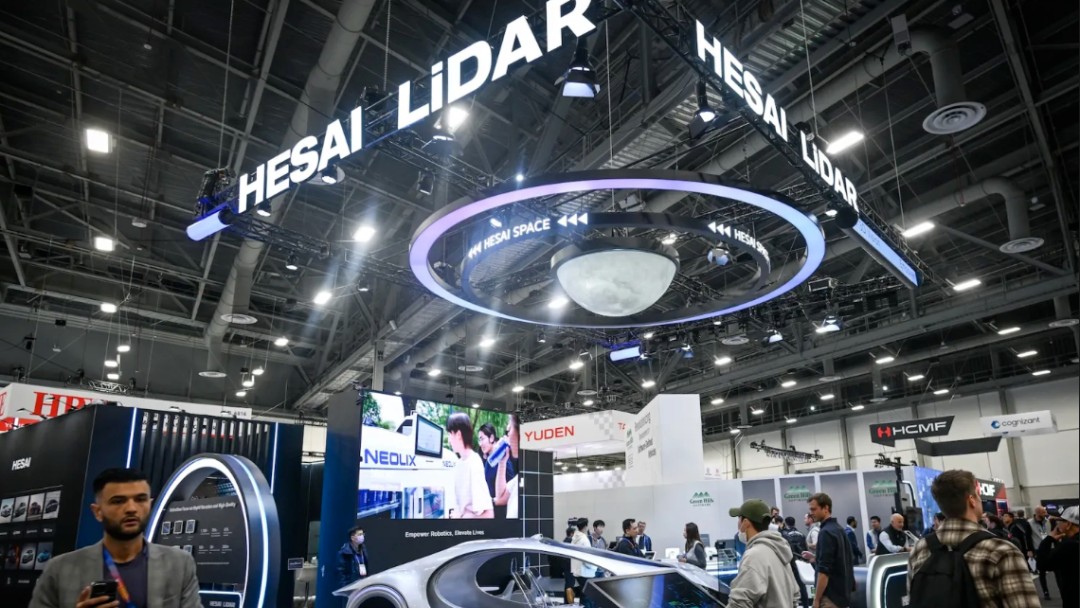
Hesai Technology, a dominant force in the LiDAR market, has announced a significant technological leap with the launch of the world’s first 6D full-color LiDAR sensing chip and the high-resolution ETX platform. Unveiled during the company’s 2026 Technology Open Day, these innovations signal a pivot in the industry: moving away from a simple race for higher “line counts” toward a focus on the quality and depth of environmental perception.
From Black-and-White to Full Color: The Picasso SPAD-SoC
To understand the significance of this launch, one must look at the limitations of current technology. Traditional LiDAR systems function much like a black-and-white camera; they can map the three-dimensional space (XYZ coordinates) to show where an object is and what its shape looks like, but they lack color data. This makes it difficult for a vehicle to instantly distinguish between a red traffic light and a green one, or to clearly identify specific road signs and lane markings through color alone.
Hesai’s new Picasso SPAD-SoC chip solves this by fusing color sensing with Time-of-Flight (ToF) ranging at the pixel level. The result is a “6D” output : 3D coordinates (XYZ) combined with color information (RGB).
Key technical advantages include:
– Enhanced Vision: A Photon Detection Efficiency (PDE) exceeding 40%, placing it among the top tier of global technology.
– Superior Clarity: The ability to detect smaller targets and maintain high performance even in low-light or dark environments.
– Native 6D Point Clouds: Real-time generation of color-accurate 3D maps.
The ETX Platform: Scaling Resolution for Safety
Complementing the new chip is the ETX platform, an ultra-high-resolution system designed to handle the massive data loads required for advanced driving. While previous industry standards focused on increasing the number of laser lines, the ETX platform offers unprecedented density, with configurations reaching up to 4,320 lines —roughly three to four times the capacity of current flagship products.
The platform’s performance metrics highlight its capability to handle complex, real-world obstacles:
– Long-range detection: Up to 600 meters.
– Object recognition: Capable of identifying small wooden blocks at 150m, small animals at 280m, and water barriers at 300m.
– Reliability: Utilizing Photon Isolation 2.0 technology, which integrates hardware design with intelligent algorithms to minimize false alarms and missed detections.
Market Context: The Drive Toward L3 Autonomy
This technological surge is driven by a rapidly expanding market. In China alone, the number of new vehicles equipped with factory-installed LiDAR grew by over 86% in 2025. As the industry moves toward Level 3 (L3) autonomous driving, the requirements for perception are becoming much more stringent.
Standard radars are no longer sufficient for the complex task of recognizing small targets at long distances or maintaining stable perception in all weather conditions. Hesai’s move to provide “color-aware” perception addresses the exact gap needed for vehicles to navigate complex urban environments safely and autonomously.
Roadmap and Market Position
Hesai is moving quickly from concept to commercial reality. The ETX platform is slated for mass production in the second half of this year, with widespread deployment across global flagship vehicle models expected between 2027 and 2028. The company has already secured contracts with several top-tier automakers.
Currently, Hesai holds a commanding position in the sector, boasting a 51% market share as of February. This new launch reinforces its role as a primary provider for the next generation of autonomous driving systems.
The transition from 3D to 6D perception represents a fundamental shift in how machines “see” the world, moving from mere spatial mapping to true environmental understanding.
Conclusion
By integrating color data with high-resolution 3D mapping, Hesai is addressing the critical perception gaps that currently limit autonomous driving. The ETX platform is positioned to become a cornerstone technology for the transition to Level 3 and higher autonomy in the coming years.