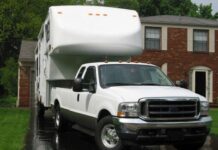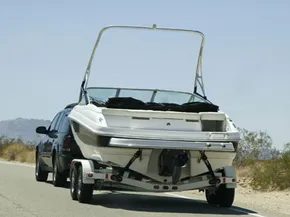
You have probably seen a heavy-duty pickup hauling a massive load of bricks. It looks like a magic trick. It feels like a violation of basic mechanics. It isn’t. It is just Newtonian physics doing its job.
A 5,000-pound truck can tow 10,000 pounds. The math holds up. The energy from the engine fights against gravity and inertia. It is not easy. Your truck fights back the moment it moves. Newton’s Third Law of Motion is strict. Every action gets an equal and opposite reaction.
Understanding how a truck moves means understanding how it tows. The process breaks down into three distinct physical states. Rest. Acceleration. Constant velocity.
Resting Against Gravity
When your truck sits in park, it is at rest. Nothing moves. This is not because the engine is off. It is because forces are perfectly balanced. Gravity pulls the truck down toward the center of the earth. The ground pushes back up. This upward push is called the normal force.
These two forces cancel each other out. An object at rest stays at rest. This is Newton’s First Law. It is stubborn. You cannot move a truck that is sitting still without overcoming this inertia.
Applying Force to Move
You do not want to sit there. You want to tow. This requires applied force. Your engine provides this. It generates energy to turn the wheels. This force pushes the truck forward.
But the ground does not just let you roll. Friction exists. It acts parallel to the ground. It pushes in the opposite direction of your intended travel. Friction resists acceleration. It tries to keep the truck still.
Gravity and normal force still exist. They just stop being the primary obstacle. Now you have to fight friction. You have to overcome the weight of the trailer. You have to deal with air resistance.
“There are forces that oppose it every step of the way.”
This is the reality of towing. It is a battle of forces. Your engine wins by producing more applied force than the sum of friction, gravity, and drag. If it does not, you do not move. If it does, you accelerate.
The physics is simple. The execution is hard. Your truck has to handle the load. You have to handle the controls. The laws of motion do not care about your cargo. They only care about force and mass.
When you hit constant velocity, the forces balance again. Applied force equals resistance. You stop accelerating. You just keep going. The engine still works. Friction still pushes back. But you are no longer fighting to start. You are fighting to maintain.
It is easier than starting. Harder than coasting. The physics of towing is a constant negotiation between power and resistance.
There are two types of frictional forces working against you while driving a truck. Static friction is what your tires face before reaching the threshold of motion. Once your wheels start moving, that threshold is crossed. Now your tires deal with kinetic friction or, more specifically in this context, rolling friction. To accelerate, you must overcome static friction with applied force. This does not apply to rolling friction. Instead, the goal is to accelerate until your applied force equals the rolling friction. When these forces match, you hit constant velocity. You know it as cruising speed. Just traveling along. No speeding up. No slowing down.
This physics matters because of how your engine uses applied force to propel the vehicle. It does this by producing torque. Torque is the energy that rotates a wheel on its axis. The force from your engine goes to the wheels through the transmission. The transmission turns the drive shaft. That shaft distributes torque to the wheels.
Torque differs from the energy needed to slide something across a flat surface. Imagine a quarter standing on its edge in your hallway. You can push its edge with your finger in a top-down motion to roll it forward. Or a bottom-up motion to roll it backward. You just applied torque. Try moving that quarter forward without rolling it. It does not work well. The quarter skids. It is hard to control. Inefficient. This is the challenge your truck faces every time you drive. Moving forward without skidding.
It seems simple. You push the gas pedal. The engine sends torque to the drive shaft. The shaft spins the axle. The axle spins the wheels. But if the engine produces too much torque, your tires overcome the rolling friction from the road. They skid. Uselessly. Possibly dangerously. You want your tires to never leave the road.
It sounds strange. But when your truck drives properly, the bottom of the tire stays at rest. Literally where the rubber meets the road. The location of the bottom changes. Every point on the tread gets a turn at the bottom during a full rotation. The location relative to the road changes too. But gravity and normal force see the bottom as at rest. It never leaves the road.
So what does this have to do with towing? Plenty.
The Physics of Towing
Physics of the Combined Unit
Towing isn’t a separate physics problem. It’s an extension of what keeps your truck moving. When you hook up a trailer, the laws of motion don’t change. They just scale up.
Consider your drivetrain. If you have all-wheel drive, all four tires get torque. They all push against the pavement. If you drive a rear-wheel drive truck, the rear wheels pull. The front wheels just follow. They’re attached to the frame, so they roll when the rear wheels turn. The mass of the truck matters here. Weight needs to be distributed evenly. Each wheel faces the same vertical load. That means each tire supports roughly one-quarter of the total vehicle mass.
This is where normal force comes in. Gravity pulls down. The road pushes up. The force the road exerts is proportional to the mass on that tire. Even distribution means equal normal force on all four tires. Equal force means equal static friction. When you accelerate, all tires break loose from rest at the same time. They move from static to kinetic friction together. Torque needed to spin one wheel is roughly enough to spin all of them. Uneven weight distribution breaks this symmetry. Tires with less weight lose grip first. They skid. The torque overcomes rolling friction before the tire can accelerate properly.
The Trailer as One System
Add a trailer to the mix and the math gets heavier. Literally. The truck and trailer become one unit. Physics doesn’t care about the hitch. It sees combined mass. The total weight determines the total friction.
Weight distribution becomes critical again. Proper load placement ensures every tire—whether on the truck or the trailer—faces similar friction thresholds during acceleration. If you have a 5000-pound truck towing a 10000-pound load, the engine must produce enough torque to rotate the drive wheels. It must overcome rolling friction on all tires. If the static friction is equal across the contact patches, the system accelerates as one. If the weight is skewed, the light tires hop. The heavy tires drag. You lose traction. You lose control.
Towing Capacities and Hitch Mechanics
Can a 5000-pound truck pull a 10000-pound trailer? Yes. But only if you use the right equipment. Consult your owner’s manual. You’ll see two ratings. Dead weight capacity. Towed weight capacity.
Dead weight limits are usually close to the truck’s own weight. Towed capacity is often three times higher. Why the difference? The hitch. A standard ball mount doesn’t distribute weight. It hangs the trailer. A proper weight-distributing hitch transfers load to the trailer axles and the truck’s front axle. It spreads the force. It equalizes the normal force across all wheels.
The engine works harder. Torque demand increases. But if the load is balanced inside the trailer and the hitch is set correctly, each tire encounters equal static friction. The engine rotates the drive wheels. The other wheels follow. The system moves. Unencumbered or loaded, the goal is the same. Keep friction equal. Keep torque sufficient. Keep the weight centered.
“If the weight is properly distributed within both the trailer and the coach vehicle, the static friction for each tire will be equal.”
This isn’t just theory. It’s why you see sway bars and brake controllers on serious tow rigs. It’s why you check tongue weight before you leave the driveway. Get the physics wrong and you’re dragging dead weight. Get it right and you’re moving a single unit. The road doesn’t care about the labels on your tires. It only cares about the force pressing them down.