Ford Motor Company is reportedly finalizing a strategic partnership with Chinese automaker Geely to repurpose idle manufacturing capacity in Europe. The agreement involves the sale of a specific assembly line at Ford’s Valencia plant in Spain, marking a significant shift in how legacy Western automakers are leveraging Asian expertise to navigate the electric vehicle (EV) transition.
Reviving the Valencia Plant
According to reports from La Tribuna de Automoción, Geely has signed a deal to acquire the Body 3 assembly line at Ford’s facility in Almussafes, located just south of Valencia. This line, currently the most modern at the site, has been dormant since 2023 following the discontinuation of the Galaxy and S-Max people movers. Prior to that, it produced the Mondeo hatchback and wagon.
Currently, the Valencia plant operates at reduced capacity, focusing primarily on the Kuga SUV. Most of the Kuga’s manufacturing occurs on the older Body 2 line, with supplementary assembly work on Body 1. The acquisition of Body 3 allows Geely to activate high-tech infrastructure that would otherwise remain unused, providing an immediate boost to local industrial activity.
A New Era of Collaborative Manufacturing
Local industry sources indicate that Geely intends to use this facility to produce vehicles based on its Global Intelligent Electric Architecture (GEA). This platform supports a versatile range of powertrains, including hybrid, plug-in hybrid, and fully electric options.
Crucially, the deal may extend beyond simple space rental. Reports suggest Ford and Geely are discussing a arrangement where Geely manufactures a specific model for Ford. If realized, this would make Geely the third major partner Ford has engaged to bolster its European EV lineup:
- Volkswagen Group : Provides the MEB architecture for the Ford Explorer and Capri electric SUVs, produced in Cologne, Germany.
- Renault : Agreed to produce two Ford-designed EVs based on the platform shared with the Renault 5 E-Tech and 4 E-Tech.
- Geely : Potentially adding a third pillar of collaborative production in Spain.
This strategy highlights a broader industry trend: rather than bearing the full cost and risk of developing proprietary EV platforms, legacy automakers are increasingly “buying” or partnering for technology to accelerate their electrification goals.
The Candidate: Geely’s EX2
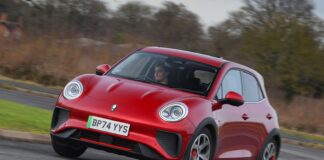
If the reports are accurate, the vehicle slated for production in Valencia is likely the Geely EX2. This compact SUV has already demonstrated significant market appeal:
- Dimensions : 4.1 meters long, positioning it as a city-friendly compact SUV.
- Powertrain : Currently available with rear-wheel drive electric options, featuring either a 58kW motor with a 30kWh battery or an 85kW motor with a 40kWh battery.
- Market Success : Since its late 2024 launch, the EX2 has become a phenomenon in China, selling 465,000 units in 2025 alone to become the country’s best-selling model.
Strategic Implications: Tariffs and Competition
The decision to produce these vehicles in Spain carries significant economic weight. By manufacturing in the EU, Geely—and potentially Ford—can bypass the 35.4% tariff imposed by the European Union on pure-electric cars manufactured in China. This allows the vehicles to remain price-competitive against European rivals while adhering to trade regulations.
Ford is not alone in this pivot. Earlier this week, Nissan confirmed it would shut down one of two production lines at its Sunderland plant in the UK. Rumors suggest Nissan is in talks to sell the closed line to Dongfeng, its Chinese joint-venture partner.
These moves signal a structural transformation in the European auto industry. Legacy manufacturers are increasingly turning their underutilized factories into hubs for Chinese technology and production, blending Western brand equity with Asian engineering efficiency.
Conclusion
The reported Ford-Geely deal represents a pragmatic solution to two pressing problems: Ford’s need to expand its affordable EV portfolio without massive capital expenditure, and Geely’s desire for European manufacturing presence that avoids punitive tariffs. As more legacy automakers consider similar partnerships with Chinese firms, the European automotive landscape is shifting from isolated competition to complex, cross-border collaboration.