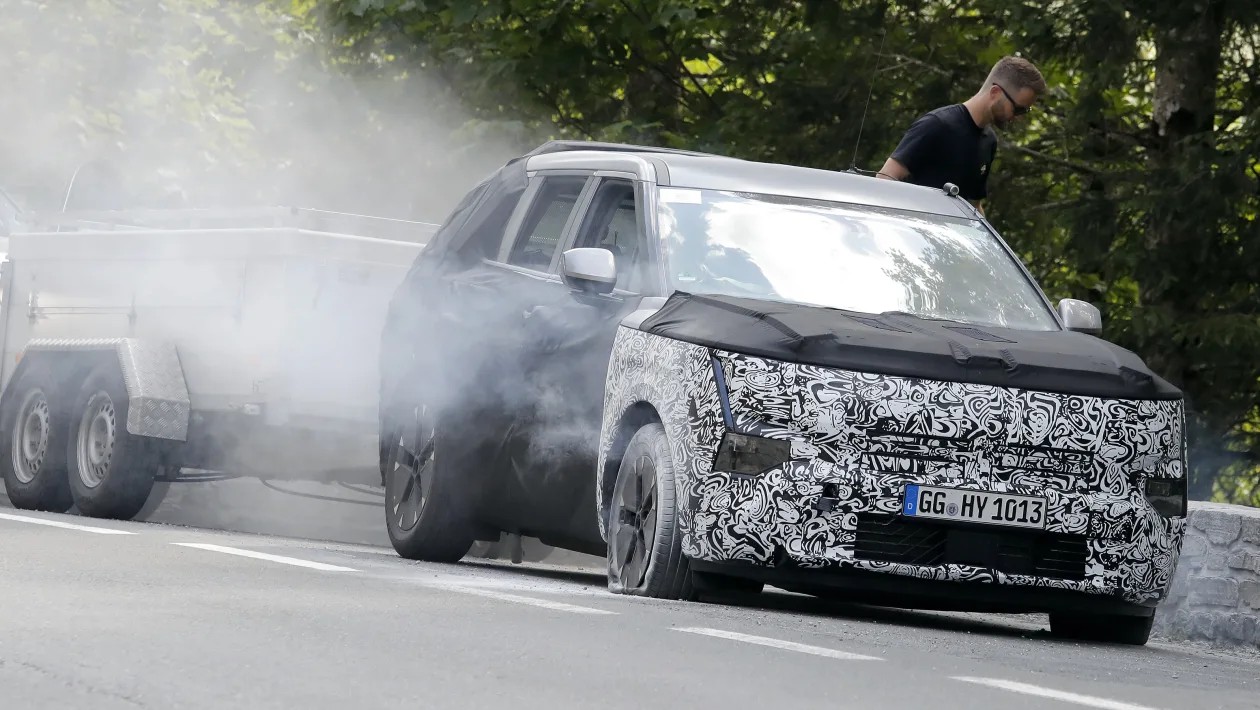
The next generation Hyundai Tucson is finally showing its face, and let’s just say it’s shedding the skin of its predecessor. Recent spy shots from European testing tracks reveal a Korean SUV that looks nothing like the current model. Hyundai has clearly abandoned subtlety. The new design language—dubbed “Art of Steel”—is aggressive, rugged, and frankly, much more interesting.
This isn’t just a refresh. It’s a fundamental rethink. And with rivals like the Nissan Qashqai and VW Tiguan circling, Hyundai is betting this new Tucson will be a best-seller in 2024. But is it worth waiting for? Or should you buy the current stock while the new one is still in stealth mode? Let’s break down what we know about this game-changer.
A Radical Redesign for the Next-Gen Hyundai Tucson
If you thought the current Tucson was the peak of Hyundai design, think again. Simon Loasby, Hyundai’s chief exterior designer, has laid out a clear path forward. The new Tucson shares DNA with the Korean Avante (which might eventually replace the i30 in Europe) but stands out with its own bold identity.
Look at the spy photos. You’ll spot the clamshell bonet—that single piece covering the engine bay—which gives the front end a sleek, uninterrupted look. The wheelarches are exaggerated, bulging over large, intricate alloy wheels. It’s boxy. It’s upright. It’s a distinct departure from the curvy, swooping lines of the old Tucson.
“We don’t like to do nesting dolls… you’ll see how that is developed across our products.” – Simon Loasby
The windscreen wraps around thanks to blacked-out A-pillars, creating a cabin-first appearance. Inside, the roofline sits higher. The tailgate is more vertical than before, which isn’t a stylistic whim—it’s a practical move to expand boot space. For families, that’s huge. The rear end won’t be sloping dramatically; it’ll be functional.
Interior Tech That Doesn’t Distract
Here’s where Hyundai might actually surprise you. In an industry obsessed with giant tablets on the dash, Hyundai is pulling back.
The next-generation Tucson will ditch the current twin-screen setup. Instead, expect a large central touchscreen accompanied by a row of actual physical buttons. Why? Because fiddling with menus while driving at 70mph on the M4 is a nightmare.
Loasby was blunt about this philosophy. “The safest way to drive is to keep eyes on the road,” he stated. “You quickly realize the center screen is just a distraction.”
The driver’s display is a small, high-mounted screen. To make it visible without obscuring the view, the steering wheel is smaller and flatter—Peugeot-style, if you will. The goal isn’t to make the interior look like a tech fest. It’s to make it feel calm, luxurious, and open.
Loasby claims nine physical controls are the sweet spot. Nine. That’s a lot more than the few buttons most rivals offer. You adjust climate, volume, and key car functions without taking your eyes off the asphalt. It’s a return to sanity in an era of screen saturation.
Hybrid Powertrains Take the Lead
What’s under the metal? Not a full EV. That’s reserved for the Ioniq 5 and the upcoming Ioniq 4, which targets a different segment. The Tucson, however, is doubling down on hybridization.
Expect mild-hybrids and plug-in-hybrids to dominate the UK and European lineups. But the star is the new in-house full-hybrid system. It combines a 1.6-liter turbocharged four-cylinder with two electric motors. One sits in the gearbox, the other acts as a starter generator.
The result? 380Nm of torque. That’s 13Nm more than the previous hybrid system. Efficiency is up by over 4%, according to Hyundai. It’s more responsive. It’s easier to drive.
And for those who want thrills? A high-spec “N” model is likely in development, using this new hybrid architecture to punch above its weight class. No fully electric Tucson is planned for the foreseeable future. The focus remains on electrified efficiency, not zero-emission purity.
Should You Buy Now or Wait?
The new Tucson is due for a reveal in the next few months. Final testing is underway in Europe. It’s part of a massive product offensive that will also bring updated Bayons, Kona models, and eventually a refreshed Santa Fe.
So, what’s the move?
If you can’t wait, buying current stock is smart. Dealerships are clearing out inventory, and prices might drop as the new model looms. You get a proven car, immediate availability, and likely good discounts.
But if you want the cutting edge, the wraparound design, the physical buttons, and that extra torque from the new hybrid system, the wait will be worth it. The next-generation Tucson isn’t just evolving. It’s changing the game.
And honestly? We’re ready.