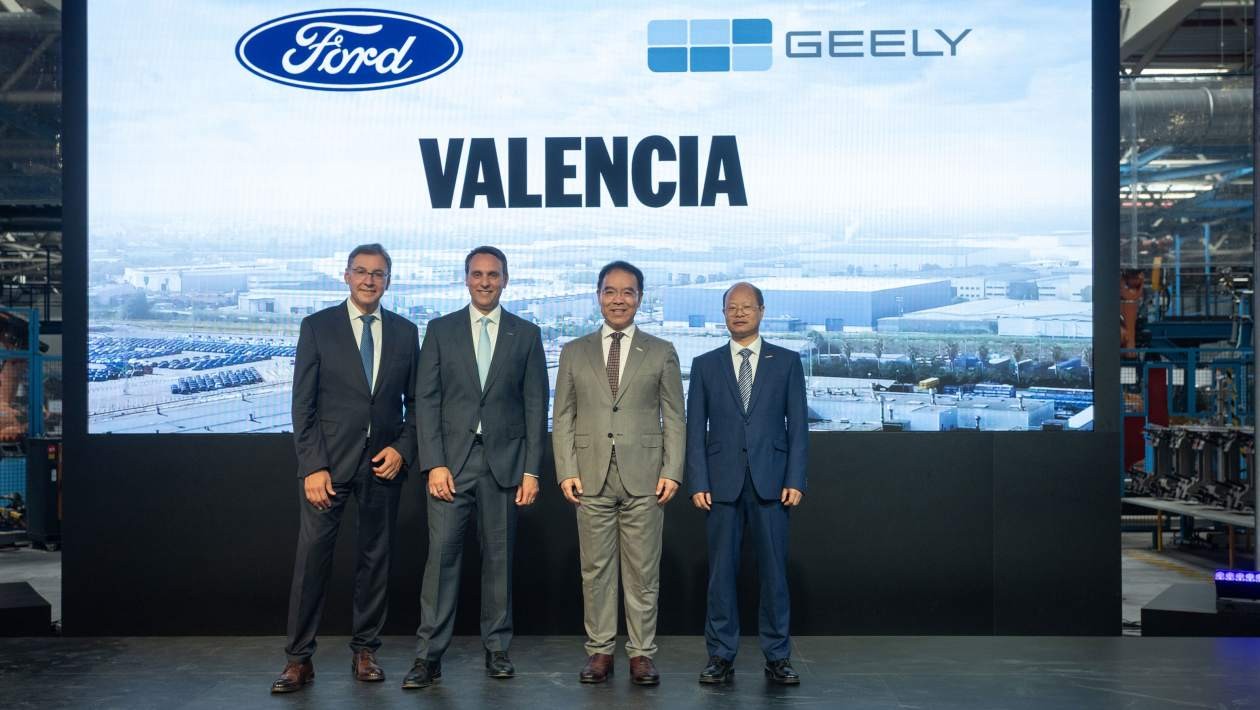
Ford is doubling down on its European strategy with a major pivot. The Blue Oval has partnered with Chinese auto giant Geely. This isn’t just a handshake. It’s a structural overhaul of how Ford builds cars in Europe.
The centerpiece? The Valencia factory in Spain.
For years, the plant’s future has hovered in the shadows. It has a 500,00-unit annual capacity. Currently, it only assembles the Kuga. But uncertainty is ending. Ford and Geely have confirmed a joint venture. The goal: to manufacture four new vehicles.
This move signals a clear departure from isolation. Instead of fighting alone against market shifts, Ford is integrating into a larger supply chain.
Breaking Down the Valencia Joint Venture Structure
The partnership is significant. Ford and Geely are pooling resources to create a unified manufacturing team. The entity will be owned 66% by Ford and 34% by Geely. This isn’t a minority stake. It is a deep, structural alliance.
Jim Baumbick, Ford of Europe’s president, made the intent clear. He told media outlets, including Auto Express, that the company is not selling assets. Instead, it is jointly investing in manufacturing capability.
“It is one system and one team supplying two brands.”
The logic is economic as much as it is strategic. Operating as a single unit allows the plant to achieve world-class efficiency. They are consolidating operations. One team. Two brands. Five vehicles in the pipeline.
This approach directly counters the rise of low-cost Chinese entrants in Europe. Ford has lost roughly 500,000 in European sales. Retreat isn’t the option. Collaboration is.
The Five New Cars Coming to Spain
So, what exactly will roll off the line in Valencia? The plan outlines a robust product offensive through 2029.
- The Ford Bronco: The compact SUV version of the iconic nameplate is coming to Europe. Valencia will be its home.
- All-New Multi-Energy Crossover: This vehicle replaces or follows the current Kuga line. It will likely carry the Kuga nameplate initially, bridging the gap until late 2028 when the new platform is ready.
- Two Geely Electric SUVs: The plant will assemble electric SUVs for its Chinese partner. These models will share components with the Ford crossover, maximizing economies of scale.
- The Current Kuga: Production will continue until the new multi-energy crossover is fully operational.
The component sharing is critical. By using common parts across Ford and Geely electric platforms, unit costs drop. Margins become sustainable. This is how legacy automakers survive the electrification transition without bankrupting their balance sheets.
Why Valencia Matters More Than Ever
The Valencia plant is historic. Ford opened it in 1976. The original Fiesta was born there. Today, it supports around 4,000 jobs.
Before this deal, the site was underutilized. Relying on a single model, the Kuga, left the workforce vulnerable to demand fluctuations. The new venture changes that calculus.
Baumbick emphasized that the alliance allows the workforce to expand. The team will now cover four distinct vehicle types. Job security improves. Production volume increases.
There is also a cultural component to this success. Ford and Geely share more than just factory floors. Their relationship dates back to 2010, when Ford sold Volvo Cars to the Chinese group. There is a shared history. A shared industrial culture.
The Broader European Context
Valencia is not Ford’s only play. Over the last eight months, the automaker has announced two major European alliances.
The first was with Renault. That deal brings the Renault 5’s RGEV small electric car platform into Ford’s fold. It will power replacements for the Fiesta and Puma models.
Now, the Geely deal adds depth to that strategy. Ford is actively curating a portfolio of partners to renew its lineup. They are tapping into external supply chains to lower costs. It is a defensive move that looks like an offensive one.
The irony is palpable. Ford is collaborating with a Chinese manufacturer to compete against Chinese brands entering the European market.
Does this mean the end of Ford as we know it in Europe? Not quite. It means the beginning of a new, hybrid model. One where brands are fluid. Where manufacturing is shared. And where survival depends on agility.