We all know the Mustang. It’s the star of the early sixties, the icon that defined an era. But if you dig into the archives of 1962-1964 Ford full-size cars, you’ll find a different story. A quieter one. A powerful, overlooked one.
For decades, these trucks-on-wheels and luxury barges were just… there. Background noise. Designers themselves have admitted they’ve let the details slip. Memory fades. But the machines didn’t. Under the hood, the engines were brutal. Not in the modern sense of horsepower figures, but in the way they grabbed the road. They were heavy, fast, and built like tanks.
Now, the tide is turning. Collectors are waking up. Specifically to the Galaxie 500 and the XL. These aren’t just old cars. They are the forgotten Fords. And their value is starting to reflect that.
Why the Galaxie 500/XL?
The Mustang gets the magazines. The Galaxie gets the garage. But in the collector market, the Galaxie 500/XL is making a serious move. Why?
- Size: Full-size meant presence. These cars were wide, long, and imposing.
- Power: The V8s from this era were big-displacement monsters. They didn’t need turbos or intercoolers. They just needed cubic inches.
- Scarcity of Care: Most of these cars were driven hard and traded in. Survivors in good condition are rare.
The Engines That Defined an Era
Let’s talk brass monkey. The engines in these 1962-1964 Fords weren’t subtle. They were high-compression, high-torque units.
- 352 Cubic Inch V8: The workhorse. Reliable. Punchy.
- 390 Cubic Inch V8: The option that made the rear tires scream.
- 427 Cubic Inch V8: The big gun. Available in select models. This wasn’t just for show. It was for passing trucks on two-lane highways.
These weren’t just engines. They were statements.
Collector Interest Rising
For years, these cars sat in fields. Rusting. Forgetting. But now? The market is shifting.
“The Galaxie 500/XL is emerging as a serious collectible, especially in original condition.”
Why now? Maybe it’s nostalgia. Maybe it’s the fact that you can’t build a car like this anymore. Maybe it’s just that the Mustangs got too expensive. Who knows. But one thing is clear: the 1962-1964 Ford full-size cars are no longer forgotten. They’re waiting.
And if you look closely, you’ll see why.
The lineage of mid-60s big Fords traces back to the 118-inch wheelbase 1957 Fairlane. Styling went through dramatic changes year over year, but the skeleton stayed put. Inner panels and floor pans barely budged. The wheelbase stretched by just one inch in 1960, settling at 119 inches. That dimension held steady through 1968. The real structural shift came later. 1965 models introduced a completely different “perimeter” frame design.
The Big-Block Blueprint
The heartbeat of these Fords was the engine bay. The mighty 390 Thunderbird Special arrived in 1961. It became the foundation for all big-block Ford performance engines for years. Engineers essentially bored and stroked the 352 V-8. Horsepower stayed at 300—the same as the 1960 top street engine—but torque jumped to 427 pound-feet at 2,800 rpm.
For police departments and hot-rodders, Ford offered a meaner 330-horsepower version. It revved to 5,000 rpm. This mill featured solid lifters, a high-lift cam, header exhaust manifolds, and other performance goodies.
Next came a 375-horsepower variant at 6,000 rpm. It used a high-performance block with a stronger bottom end. It included an extra oil pressure relief valve and larger oil passages. Heads matched the standard version. It was available in all models except wagons. Strictly a racing engine. Later that year, triple two-barrel carbs pushed output to 401 horsepower.
1962 Powertrain Updates
Ford entered 1962 with the 1961 engine lineup mostly intact. You could spec a 223-cubic-inch six, a 292 V-8, a 352 V-8, or the 300- and 330-horsepower 390s. Early in the year, the beefed-up 375- and 401-horsepower 390s were still options. The 352 and 390s (except the 401) used single four-barrel carburetors.
Early in the 1962 model year, Ford swapped out the 375- and 401-horsepower 390s for the new 406. Two versions were available. A four-barrel carb model made 385 horsepower. Triple two-barrels generated 405 horsepower. Both peaked at 5,800 rpm. Ford brought out the 406 to compete with Chevrolet, Pontiac, and Dodge engines that were already over 400 cubic inches. The 406 block had thicker walls than the heavy-duty 390. Compression ratio climbed to 11.4:1. Pistons and rods were tougher. Exhaust valves were larger.
Transmission Choices
Transmission options were as varied as The Music Man ‘s wardrobe. All engines except the 406 came with a three-speed manual standard. Overdrive was optional. The six, 292 V-8, and 352 V-8 offered an optional Fordomatic two-speed. It had been around since 1951 with some improvements. The three-speed Cruise-O-Matic was available with the 292, 352, and 390. Late in the 1961 model year, a Borg-Warner four-speed manual was added for the 352 and 390. This was the only transmission available for the high-performance 406s.
The Walker Departure
The 1962 was among the last Fords styled under George Walker. He had a falling out with Henry Ford II at the end of 1961. Walker recommended his “favorite son,” Elwood Engel, for the chief stylist position at Chrysler. “The Deuce” found out. He promptly sent Walker and his well-stocked wardrobe packing. Walker retired to become the mayor of Delray Beach, Florida. Before he left, he approved the styling of the 1962 and possibly the 1963 models.
Exterior Changes
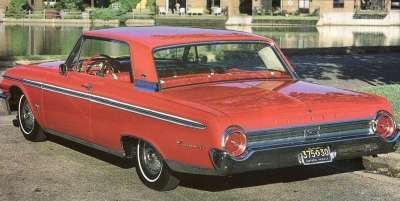
1962 bodies were very similar to 1961. Enough trim and body panel changes were made to confuse buyers. Vestigial fins were clipped in 1962, following an industry trend. Ford tried to make round tail-lights look new by dropping them into a sculpted rear bumper.
Overall dimensions remained the same as 1961. But the roof panel and roof rails were new. Upper back panel, rear quarter panels, deck lid, lower back panel, rear floor area, and rear crossmember were all updated. A flatter grille replaced the concave style of 1961.
Model Lineup Shifts
There was some model reshuffling. The Fairlane and Fairlane 500 names moved to the new-for-1962 intermediate line. Full-sized Fords now resided in the Galaxie 100 and Galaxie 500 series.
The Galaxie 100 was available only as two- and four-door sedans. The Galaxie 500 came in these body styles plus two- and four-door Victoria hardtops, and a Sunliner convertible. The station wagon line consisted of a six-passenger Ranch Wagon, six- and nine-passenger Country Sedans, and six- and nine-passenger Country Squires. All wagons were four-doors.
Dropped for 1962 were the striking, airy Starliner two-door hardtop. Also gone was the two-door Ranch Wagon, a Ford staple since 1952.
The Lively Ones
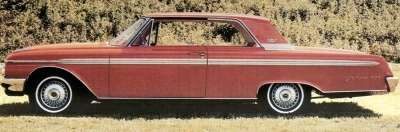
1962 was the year of “The Lively Ones from Ford.” Liveliest of all were the 1962 Galaxie 500/XLs. A mid-year-edition convertible and two-door hardtop. They sported bucket seats and a center console. Not necessarily hot engines. Standard motivation came from the 138-horsepower six.
Bucket Seats and The Shift in Strategy
Ford spent years stubbornly clinging to bench seats in its premium Galaxie line. The goal was simple: keep the Thunderbird distinct as the ultimate personal luxury car. But by 1962, the market had shifted. Competitors were flooding the segment with bucket seats and center consoles. Dearborn couldn’t ignore the trend any longer.
The 1962 Ford Galaxie 500/XL answered the call.
Standard equipment on the XL model now included deluxe front bucket and rear semi-bucket seats. A chrome-trimmed console housed a fancy shifter. Exterior details got the same treatment. Special wheel covers and chrome identification badges marked the higher trim level. Door panels and side trim were accented with Mylar trim, giving the body a chrome-like sheen without the maintenance.
Interior choices expanded. Buyers could pick from seven solid colors. Exterior paint options were nearly limitless, covering most of Ford’s palette.
Pricing and Option Bloat
The starting price for a 1962 Ford Galaxie 500/XL two-door hardtop was $3,268. That’s a clean number on the tag. But look under the hood or add the right options, and the bill jumps fast. A bigger engine plus extras could push the total well into the $5,000 range.
Ford introduced several new features for this model year. Two-speed electric windshield wipers became available. Power windows included a safety lock. Load-leveling shock absorbers helped manage heavy loads. A remote-control trunk lid release added convenience. Seat belt anchors were installed, though the belts themselves remained optional equipment.
In March, Ford rolled out transistorized ignition. This electronic switch replaced the mechanical points in some applications, promising better reliability and easier starting.
Maintenance and Durability
Ford pushed its long-interval maintenance philosophy hard. Chassis lubrication was required only every 30,000 miles. Oil changes were allowed every 6,000 miles. Radiator coolant was marketed as lasting two years.
Rust prevention saw upgrades too. Single mufflers were fortified with aluminizing. Dual mufflers were fabricated entirely from aluminized steel. Body areas prone to rust received special attention. Nylon bushings replaced metal ones in key spots to reduce lubrication needs and wear. More parts were plated to stave off corrosion.
The 12,000-mile or one-year warranty program entered its second year. Quality control had been a focus since 1959. The 1962 Ford racing program helped highlight these improvements. Since 1946, Ford had seen ups and downs. Some years brought better bodies. Others offered superior engines, interiors, or chrome plating. 1962 was shaping up to be a strong year for build quality.
Production Numbers
The 1962 Ford Galaxies were introduced on September 29, 1961. By the end of the model year, 704,775 units had been produced. This total included wagons. It represented a drop of 86,723 units compared to 1961.
Total Ford production across all models, however, rose by more than 220,000 units. The Galaxie lost volume, but the brand as a whole gained.
For deeper dives into other categories, check out sections on Muscle Cars, Sports Cars, and Consumer Guide Automotive. The Consumer Guide Used Car Search also offers historical data for later buyers.
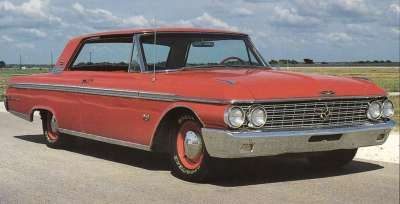
The 1962 Ford: Quality Improvements and Racing Struggles
By 1962, Ford had tightened its quality control significantly. The cars built that year were more reliable than their 1961 predecessors, a trend that continued into 1963 and 1964. Management was actively borrowing techniques from the missile industry to eliminate manufacturing defects and boost overall durability.
But manufacturing wasn’t the only place Ford was looking for answers. The company used its racing program as a rigorous testing ground. Ford wasn’t just racing to boost sales; they pushed stock cars to the breaking point on the track. The data gathered from these extreme conditions helped engineers reduce drag and improve engine longevity in the street-legal versions of their big Fords.
NASCAR Superspeedways and the 406 vs. 421 Battle
On the NASCAR superspeedway circuit in 1962, the competition was fierce. Ford faced off directly against Pontiac. In the eight major events at Daytona, Darlington, Charlotte, and Atlanta, Ford held a slim advantage with four wins compared to Pontiac’s three. Chevrolet managed one win in those specific high-profile races.
However, the broader picture was less favorable for Ford. Pontiac dominated the full NASCAR Grand National season with 22 victories. Ford secured only six wins out of 52 starts, marking their worst NASCAR performance since 1955.
The issues weren’t the drivers. Ford fielded a talented roster that included Nelson Stacy, Fred Lorenzen, Marvin Panch, Larry Frank, Norm Nelson, Bill Cheesbourg, and Troy Ruttman. The bottleneck was hardware. The 1962 Ford Galaxie equipped with the 406 cubic-inch engine simply couldn’t compete with the Pontiac 421.
Two specific problems plagued Ford:
* Aerodynamics: The Galaxie’s roofline created excessive drag at high speeds.
* Engine Durability: Early 406 engine blocks suffered from cracking. Later revisions to the block design improved reliability significantly.
To address the aerodynamic deficit, Ford engineered a bolt-on “Starlift” fastback roof for convertibles. This design mimicked the sleeker Starliner hardtop roof used in 1960 and 1961. It was a clever solution, but NASCAR banned the Starlifts after just one race. Today, any 1962 convertible with this original roof is a rare collector’s item.
Ford’s struggles extended to the drag strip as well. Pontiac and Chevrolet dominated the quarter-mile, leaving Ford fans with a season best forgotten. Help was coming, though.
The 1963 Ford: Enter the 427
The 1963 model year brought immediate changes under the hood. The 406 cubic-inch engine remained available early in the year, producing 385 or 405 horsepower. But after January, it was replaced by the new 427.
This wasn’t a completely fresh design. It was essentially a 406 bored out by one-tenth of an inch. Technically, it displaced 425 cubic inches, but Ford rounded up to 427 to align with NASCAR’s displacement limits at the time.
The new engine packed serious upgrades designed for high-performance applications:
* Cross-bolted main bearing caps for increased strength
* A new side gallery oiling system
* A forged steel crankshaft
* Wedge-shaped combustion chambers
* Large valves and solid lifters
* An 11.5:1 compression ratio
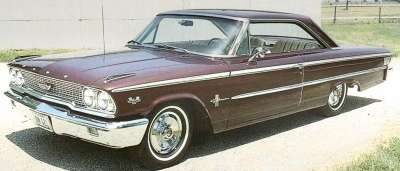
The 1963 Ford Galaxie: Performance, Styling, and the Slantback Legacy
The heart of the 1963 Galaxie remained a massive 427 cubic-inch V8. Ford rated it at 410 horsepower when equipped with a single four-barrel carburetor. Step up to the dual Holley setup sitting on an aluminum manifold, and that output jumped to 425 horsepower. For the street drivers, there was even an optional transistorized ignition system available for the 410-horse version. Just like the previous 406, this beast only came with a four-speed manual transmission.
Why the Slantback Design Mattered
The 427 didn’t just sit under the hood; it powered the debut of the “slantback” hardtop roof design. This sloping rear window was a direct response to drag issues. The previous Thunderbird-inspired hardtop was too boxy. It created too much aerodynamic drag. The new semi-fastback shape smoothed the airflow.
For years, racing fans have insisted this shape was invented specifically for the track. Joe Oros, Ford’s Division Chief Stylist at the time, disputed that. He said the design wasn’t purely a racing project. It was also about style. Whether for speed or looks, the result was a sharper, more aggressive profile.
Total Performance on the Tracks
1963 was Ford’s finest year in NASCAR history. The marketing slogan “Total Performance” finally matched the results on the asphalt.
- Riverside 500: Dan Gurney took the win in the inaugural race in January.
- Daytona 500: Tiny Lund drove a Ford to victory.
- Atlanta 500 & Charlotte World 600: Fred Lorenzen was behind the wheel for both wins.
- Southern 500: Fireball Roberts, riding a new Ford convertible, claimed the trophy.
Ford dominated the 55-race season. They won 23 events. That included a streak of seven consecutive victories. Plymouth was the closest rival with 19 wins. Ford didn’t just win. They controlled the championship picture.
Drag Racing Limitations
The “Total Performance” brand didn’t translate as easily to the dragstrip. Ford did build special cars for the strip. They used a dual-quad 427 with an aggressive cam and a high 12.0:1 compression ratio. They also built 50 lightweight Galaxie slantbacks. These stripped-down cars weighed only 3,425 pounds.
They were fast. They could run low 12-second quarter-mile times. But they weren’t the fastest. The Galaxie was simply too heavy. Their rivals were lighter and quicker. As a result, Ford was shut out of the National Hot Rod Association championship. The strategy had to change. By 1964, Ford shifted its drag racing hopes to the Fairlane. They stuffed a high-rise manifold 427 into a smaller, midsize body. It was a much better fit for the task.
Restyled for the Consumer
Regular buyers saw a major change. The Galaxie received a complete exterior refresh. The slab-sided look of 1962 was gone. In its place came sculpted sides. A sharp crease ran the full length of the car along the beltline. It added visual weight and angle to the profile.
The front end got a concave grille back. It featured a floating Ford crest. This badge did double duty. It served as the hood release latch.
The rear was equally distinct. The signature taillights moved up. They sat above the bumpers. Their round shape influenced the top of the rear quarter panels, giving them a softer curve.
Galaxie 500 and XL models had extra flair. They featured bold bi-level side chrome. Seven hash marks adorned each rear fender. The rear panel echoed the front grille’s design. Inside, the dashboard was completely new. It was the first full redesign since 1960. The cabin finally matched the aggression of the exterior.
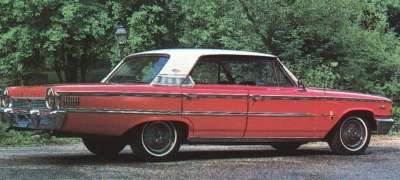
The styling shift for the 1963 Galaxie wasn’t just cosmetic. Taillights were moved up above the bumpers, giving the rear end a cleaner, less cluttered look. But the real story was the aggressive reshuffling of the model lineup.
Ford introduced a stripped-down 300 series to hit the sub-$2,400 price point. You got two- and four-door sedans here. Meanwhile, the low-end Ranch Wagon was axed entirely. The Galaxie 500/XL line got the star treatment with the arrival of the Town Victoria four-door hardtop, priced at $3,333.
Then came the mid-year twist. Ford dropped the “slantback” Sports Hardtop into both the Galaxie 500 and 500/XL lines. It arrived late in the game, but it sold like hotcakes. Production numbers tell the tale: 134,370 slantbacks rolled off the line. Break that down, and you have 100,500 Galaxie 500s. Compare that to the 79,446 formal hardtops produced. The public clearly preferred the sharper profile.
Engine Options and Transmission Choices
Under the hood, the lineup was complex. The 223-cubic-inch six remained the standard engine for everything except the XL models. But where it got interesting was the V-8 count. There were eleven variants, though you couldn’t order all of them simultaneously.
At the bottom of the V-8 stack, Ford replaced the aging 292 with a new 260-cubic-inch unit. By spring, that too was swapped out for the 289. These two smaller engines became the standard powerplants for the XL series. They were efficient, adequate, and cheap.
Higher up the food chain, you had the 352. Still available. And the 390. The big-block 390 came in two flavors, both with four-barrel carburetors: a 300-horsepower version and a 330-horsepower beast.
Transmission choice was strictly tied to displacement. The Fordomatic automatic was only offered with the six-cylinder and the small V-8s. If you opted for the 352 or the 390, you had better options. You could choose the Cruise-O-Matic automatic or the new Borg-Warner four-speed manual. That manual was a standout feature. It featured full synchronization and was specifically geared to make “low” a performance gear, not just a crawling gear.
New Features and Real-World Performance
Ford kept adding small touches to keep the Galaxie fresh. The Swing-Away steering wheel made entry and exit easier. Maintenance intervals were stretched too. Major lubrication jumped from 30,000 miles to 36,000. That’s a significant chunk of time on the road without a trip to the shop.
But numbers on a page don’t always match reality. Motor Trend tested an XL convertible equipped with the 300-horsepower 390 and the Cruise-O-Matic. Driver Jim Wright clocked a 0-60 time of 9.8 seconds. Top speed hit 107 mph.
“He was especially impressed with Ford’s improved, firmer suspension.”
Wright noted that the ride was no longer wallowy. It was firm. Controlled. It handled the weight of the full-size sedan with a confidence that many competitors lacked.
Sales figures backed up the engineering praise. A rising tide lifted all boats for Ford. Full-size car production hit 84
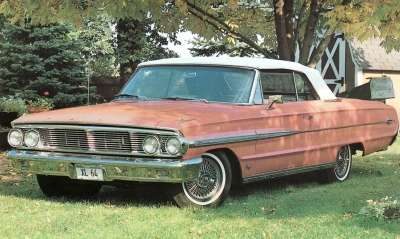
The 1964 Ford Galaxie: A Styling Shift and the End of an Era
The 1964 Ford Galaxie arrived with a silhouette that finally caught up to the wind. It was cleaner, sleeker, and borrowed heavily from the aerodynamic show cars dominating the era’s auto shows. The Torino concept was the obvious ancestor here, a design that would eventually evolve into its own model line by 1968. There is a lingering, unresolved mystery in the Ford design archives regarding exactly who got what. Joe Oros, the chief stylist for Ford during this turbulent period, recalls a year when Ford and Mercury essentially swapped hats. The design meant for the Ford became the Mercury, and vice versa. He isn’t certain which year that happened, but 1964 looks like the prime suspect.
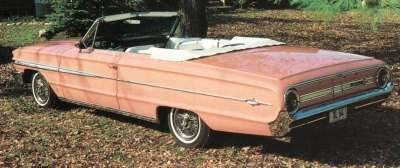
The visual changes were subtle but significant. The taillights stayed round, but they were pushed back into a sharp, recessed cove at the rear. Oros and his colleague John Foster admitted it was a headache to keep those round lenses looking fresh every single year. They couldn’t sustain it. By 1965, Ford gave up the ghost, switching to rectangular units for all full-sized cars, except for the entry-level Customs which kept a round lens inside a rectangular housing. That move ended a styling tradition that had anchored Fords since 1952.
Lineup Adjustments and Mechanical Tweaks
Inside the badge hierarchy, the 1963 “low-rent” 300 series was rebranded as the Custom. The base Galaxie, a nameplate used for years, was retired in favor of the Custom 500. The lineup was trimmed. The Galaxie 500 and XL notchback two-door hardtops vanished from the catalog entirely. Instead, four-door hardtops adopted the roofline of the highly successful Sports Hardtop. Even the sedans got a makeover. The two-door Galaxie 500, which made its final appearance in the model year, featured a back window with a much raker, more aggressive rake.
Under the hood, the engine range was mostly static, with one major exception. The 352 cubic-inch V8 received a four-barrel carburetor, pushing an extra 30 horsepower out of the block. Transmission logic also shifted. The Cruise-O-Matic became the standard automatic for XL models. The old Fordomatic was dropped completely; no full-sized Ford would offer it anymore.
On the Road: Motor Trend Tests
Motor Trend put two distinct setups through their paces. The first was a Galaxie 500/XL four-door hardtop powered by the 390 cubic-inch V8. The second was a two-door hardtop equipped with the massive 427. The 390-powered four-door handled tight, twisting mountain roads with surprising agility. It maintained high speeds without the four-barrel carburetor ever coughing or flooding, even when the driver was pushing hard through corners.
Acceleration was consistent throughout the rev range, leading to a top speed of 108 mph. There were no flat spots in the power delivery. The 0-to-60 mph time sat at a respectable 9.3 seconds. Fuel economy was not a strong suit, averaging 11.4 mpg on premium gasoline over 1,500 miles of mixed driving.
The 427-powered two-door was a different beast entirely. Stripped of many power options to save weight, it tore to 60 mph in just 7.4 seconds.
NASCAR and the Hemi Problem
Racing in 1964 started with familiar faces. A.J. Foyt repeated as the Riverside 500 champion, and Fords filled the second, third, and fifth spots. But the momentum shifted quickly. The clean sweep of the top five in the 1963 Daytona 500 was reversed in 1964 due to a combination of bad luck and the arrival of Chrysler’s controversial 426-cubic-inch Hemi.
Plymouths took the first three slots at Daytona. Ford’s racing brass balked at the situation. They asked NASCAR for permission to run an experimental overhead-camshaft engine to compete with the Hemi’s power. Officials said no. However, they did grant a concession: Fords and Mercurys could run a cut-down version of the high-riser 427 engine originally built for drag racing.
The intake manifold on that drag-specific 427 was so massive that lightweight Galaxies and Fairlane Thunderbolts built for the strip required a teardrop-shaped hood bubble just to clear the air cleaner.
The Last of the Traditional Fords
The 1964 Ford Galaxie marked the end of an era. It was the final year for this specific generation of large, body-on-frame Ford. Ford had a strong run on the track, bouncing back from early setbacks to dominate the season. Fred Lorenzen took the checkered flag at the Atlanta 500. He followed that up with a win at the Rebel 300 in Darlington. Lorenzen took home eight race victories that year.
The World 600 at Charlotte was a different story. It was a disaster for Ford. Early in the race, Junior Johnson and Ned Jarrett tangled on the backstretch. Their collision sent both cars spinning. Fireball Roberts swerved to avoid them. He lost control and slammed into the wall. His lavender No. 22 Ford flipped into flames.
Jarrett climbed out of his burning car. He rushed to help his rival. Roberts struggled free from the inferno. The burns were severe. One of NASCAR’s greatest drivers died six weeks later.
Despite the tragedy, the season ended on a high note for the brand. Ford won 30 Grand Nationals. That was more than double the second-place Dodge. It was also more wins than Ford had ever achieved before. Jarrett alone stood in the winner’s circle 15 times. He did most of that work on short tracks.
Production numbers reflected the car’s enduring appeal. Total Galaxie and Custom production hit 923,232 units in 1964. That was a sharp increase from 1963. The most popular Ford of any kind was the Galaxie 500 two-door hardtop. Ford built 206,998 of them.
It seemed Ford had saved the best for last. These cars, which debuted in 1960, were iconic. The 1965 and 1966 Fords were faster on the track. They were not better cars overall. Aside from engines, the 1965 models were as similar to the 1964s as a Hitchcock thriller is to a Bond fantasy. Times change. Tastes shift. The mid-Sixties were changing fast.
1962 Ford Models, Prices, and Production
The full-sized 1962-1964 Fords were overshadowed by the Mustang in their own time. Today, these “forgotten” Fords are collector items. Here is how the 1962 lineup stacked up.
Galaxie 100
* 2d sedan: 3,554 lbs, $2,453, 54,930 produced
* 4d sedan: 3,636 lbs, $2,507, 115,594 produced
* Total Galaxie 100: 170,524 units
Galaxie 500
* 2d sedan: 3,568 lbs, $2,613, 27,824 produced
* 4d sedan: 3,650 lbs, $2,667, 174,195 produced
* Victoria hardtop coupe: 3,568 lbs, $2,674, 87,562 produced
* Victoria hardtop sedan: 3,640 lbs, $2,739, 30,778 produced
* Sunliner convertible coupe: 3,730 lbs, $2,924, 42,646 produced
* XL Victoria hardtop coupe: 3,672 lbs, $3,268, 28,412 produced
* XL Sunliner convertible coupe: 3,831 lbs, $3,518, 13,183 produced
* Total Galaxie 500: 404,600 units
Station Wagon
* Ranch wagon 4d, 6P: 3,968 lbs, $2,733, 33,674 produced
* Country Sedan 4d, 6P: 3,992 lbs, $2,829, 47,635 produced
* Country Sedan 4d, 9P: 4,010 lbs, $2,933, 16,562 produced
* Country Squire 4d, 6P: 4,006 lbs, $3,018, 16,114 produced
* Country Squire 4d, 9P: 4,022 lbs, $3,088, 15,666 produced
* Total Station Wagon: 129,651 units
Total 1962 Ford Production: 704,775 units
1963 Ford Models, Prices, and Production
The 1963 lineup saw a shift in naming and structure. The entry-level model was rebranded as the 300.
300
* 2d sedan: 3,547 lbs, $2,324, 26,010 produced
* 4d sedan: 3,627 lbs, $2,378, 44,142 produced
* Total 300: 70,152 units
Galaxie
* 2d sedan: 3,567 lbs, $2,453, 30,335 produced
* 4d sedan: 3,647 lbs, $2,507, 82,419 produced
* Total Galaxie: 112,754 units
Galaxie 500
* 2d sedan: 3,587 lbs, $2,613, 21,137 produced
* 4d sedan: 3,667 lbs, $2,667, 205,722 produced
* Hardtop coupe: 3,599 lbs, $2,674, 49,733 produced
* Hardtop coupe, fastback: 3,772 lbs, $2,674, 100,500 produced
* Hardtop sedan: 3,679 lbs, $2,739, 26,558 produced
* Sunliner convertible coupe: 3,757 lbs, $2,924, 36,876 produced
* XL hardtop coupe: 3,670 lbs, $3,268, 29,713 produced
* XL hardtop coupe, fastback: 3,670 lbs, $3,268, 33,870 produced
* XL hardtop sedan: 3,750 lbs, $3,333, 12,596 produced
* XL convertible coupe: 3,820 lbs, $3,518, 18,551 produced
* Total Galaxie 500: 535,256 units
Station Wagon
* Country Sedan 4d, 6P: 3,977 lbs, $2,829, 64,954 produced
* Country Sedan 4d, 9P: 3,989 lbs, $2,933, 22,250 produced
* Country Squire 4d, 6P: 3,991 lbs, $3,018, 20,359 produced
* Country Squire 4d, 9P: 4,003 lbs, $3,088, 19,567 produced
* Total Station Wagon: 127,130 units
Total 1963 Ford Production: