Mazda is undergoing a fundamental transformation in its most critical market. At the 2026 Beijing Auto Show, Senior Executive Director Toru Nakajima signaled a decisive shift in the company’s strategy: Mazda is committing fully to electrification in China without sacrificing the brand identity that has defined it for decades.
The company is currently on a trajectory to become the first automotive joint venture (JV) in China to sell more New Energy Vehicles (NEVs) —which include battery electric vehicles (BEVs) and extended-range electric vehicles (EREVs)—than traditional internal combustion engine (ICE) vehicles.
From “Compliance” to Competitiveness
Mazda’s journey toward electrification has been far from smooth. Historically celebrated for its mastery of piston and rotary engines, the brand was late to the EV movement. Early attempts, such as the CX-30 EV, were largely viewed as “compliance cars”—models built primarily to meet regulatory requirements rather than to satisfy consumer demand. These models struggled significantly, with only about 500 units sold between 2022 and 2024.
However, a strategic shift in partnership has changed the narrative. By leveraging its long-standing relationship with Changan Automobile, Mazda has moved away from standalone niche models toward mainstream, platform-sharing products:
- The EZ-6 (6e sedan): Utilizing Changan’s EPA architecture.
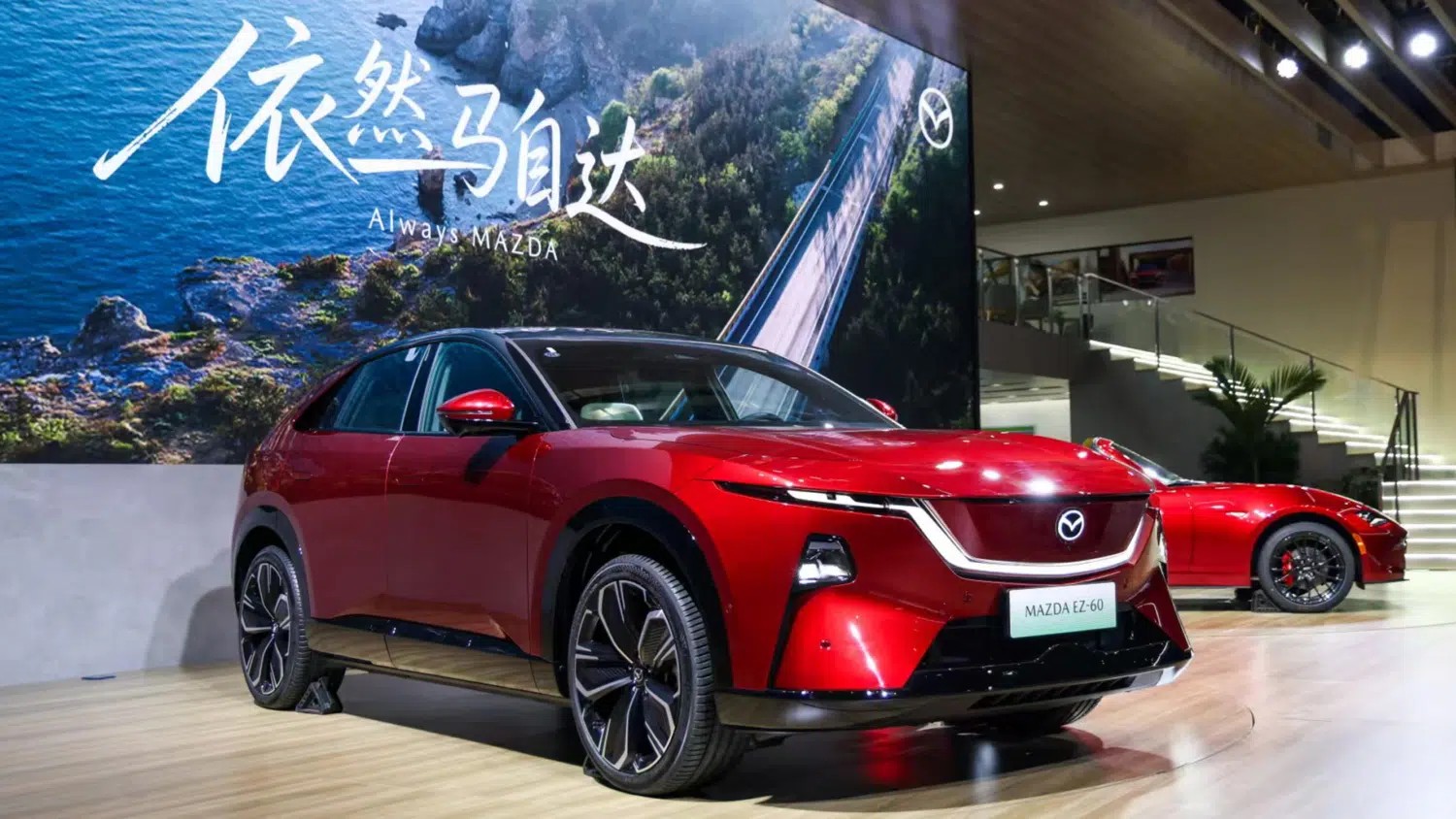
- The EZ-60 (CX-6e SUV): A midsize offering available in both pure EV and EREV formats.
These models are not just local successes; they are now being prepared for international markets, marking a transition from local adaptation to global electrification.
The Numbers Behind the Shift
Data from China EV DataTracker reveals that Mazda’s pivot is yielding measurable results. Between April 2025 and March 2026, Mazda delivered 91,061 units, outperforming its own internal sales estimates by nearly 20%.
The impact of the new electrified lineup is particularly evident in the first quarter of 2026:
– NEV Sales Share: New energy vehicles accounted for 47% of total Q1 sales.
– Model Impact: The EZ-6 and CX-6e combined represent more than 40% of Mazda’s monthly sales volume.
While these figures are impressive, analysts note a caveat: because Mazda’s total market share in China remains relatively small (21,619 units in Q1), achieving a high percentage of NEV sales is mathematically easier than it would be for high-volume brands. Nevertheless, the trend marks a historic departure from the traditional JV model in China, which has historically relied on aging, high-volume ICE models like the Nissan Sylphy.
Navigating a Competitive Landscape
Mazda’s success is not guaranteed. The Chinese automotive market is currently dominated by domestic brands that hold a significant advantage in infotainment technology and AI integration. While Japanese joint ventures like Dongfeng–Nissan and FAW–Toyota are all introducing NEV models, they face an uphill battle against local manufacturers who move faster on software and digital ecosystems.
To counter this, Mazda is leaning into its core philosophy. During his presentation, Nakajima stood between the high-tech CX-6e and the traditional MX-5 roadster—a symbolic gesture suggesting that while the “heart” of the car may change from gasoline to electricity, the focus on “Jinba-Ittai” (the oneness of rider and horse) remains unchanged.
Mazda is attempting a difficult balancing act: adopting the high-tech, electrified platforms required to survive in China, while maintaining the driver-centric emotional connection that distinguishes its brand.
Conclusion
Mazda’s transition from struggling “compliance” EVs to successful, platform-shared NEVs marks a turning point for the brand. If it can successfully marry Changan’s modern electric architecture with its own signature driving dynamics, it may provide a blueprint for how legacy automakers can survive the rapid electrification of the Chinese market.