


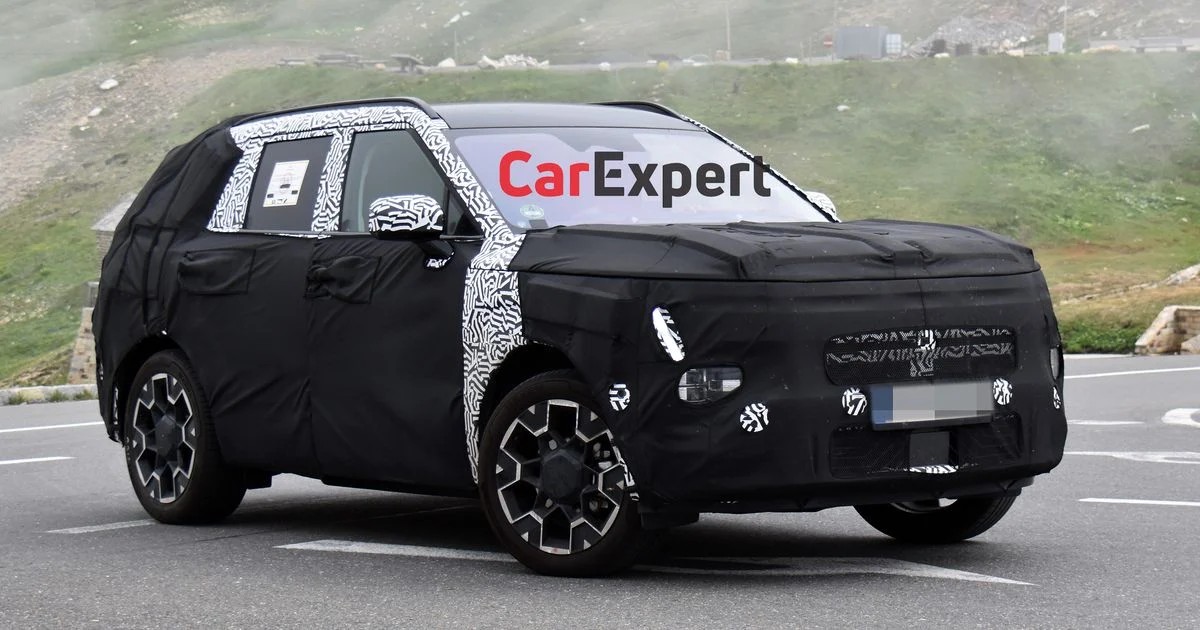
It is getting angular.
The new Hyundai Tucson was caught sneaking around the Austrian Alps this week. Spy photos. Real ones. Not just leaks from a tired insider.
This is the successor to the current model, the one competing against the Toyota RAV4 and the Mazda CX-5. And it is losing its curves. Good riddance?
The spy shots show a distinct shift away from the soft, rounded styling of the outgoing SUV. Think sharp lines. Boxy surfacing. A bluffer, squarer front end.
It looks meaner.
Underneath the thick camo wrap the engineers slapped on for secrecy, the nose hints at a specific design language. Vertically stacked LED headlights sit atop lower fog lamps. Spanning across that grille is likely a full-width light bar. And look closer at the hood.
It might be a clamshell. That means it opens from the side like a door, not upward from the front. Unusual. Practical, perhaps.
“The disguise also appears to reveal aclamshell bonnet.”
The rear? Still mostly hidden. But the vertical tail-lights are peeking out from the corners. Significant changes are lurking under there. We just can’t see them yet.
One tell, however. There is an exhaust pipe. Visible. This means the prototype running those Austrian passes is burning gas or using a hybrid setup. Electric-only isn’t this particular car. Though range-extenders might be part of the final plan, for now it breathes air.
Or emits exhaust.
We do not know if this sits on a fresh platform. Hyundai has kept that quiet.
Inside, things are familiar but updated.
The steering wheel has changed. It is the latest three-spoke design, with a square center boss featuring four dots. Morse code for ‘H’. Clever. Maybe too clever. But it has stalks for lights and wipers. No touch-pad chaos on the column this time. And yes, shift paddles are back.
The dashboard is a story in itself.
The center screen is taped over, but the driver display is clear. Digital. Slim. High-mounted. You might have seen it in the new i30 Sedan or the Ioniq 3. Hyundai is standardizing this tech across the board. Consistency sells cars.
Interestingly, the convoy was messy. The old Tucson was there, rolling on smaller wheels. A VW T-Roc was nearby. And a brand new Toyota RAV4 tagged along. Benchmarking in the mountains. It is all very transparent.
So what does this mean for Australia?
Arrival is slated for 2027. The global reveal is happening later this year, following the launch of the new Elantra (called the Avante or i30 elsewhere).
The Tucson is a heavy hitter here. It is Hyundai’s second best-seller in Australia. Right behind the tiny Kona.
It needs to fight. Hard.
The current RAV4 just switched to hybrid-only. The CX-5 is updating. The Honda CR-V is there. Even the Jaecoo J7 is in the ring.
Money talks, though.
Current Tucson prices start at $40,109 for the basic petrol model. Hybrids kick in at $42,859. If you want the top-end Premium Hybrid, you are looking at $59,859.
All prices are before on-road costs.
Compare that to the segment king. The Toyota RAV4 starts at $45,999. The flagship GR Sport hits $66,349.
The Hyundai undercuts the Toyota across the board. A significant gap.
Will that cheapness sell a boxy, angular new design? Or will customers miss the soft lines of the old model?
We will see in 2027


