


Headroom.
That’s what everyone screams about with the new Prius. Too cramped, they say. Tight back seat. I’m five-foot-ten. I put a six-foot-two mate in the rear bench once. He didn’t complain. If you’re six-foot-one or shorter, ignore the doom-mongering. Get the car.
The Early Honeymoon
Fuel costs are insane right now.
This is why the Prius suddenly feels like the answer to prayers. It’s not just cheap to run; it’s good to drive. It looks interesting. It feels built right. After two thousand miles, the average is sitting at a ridiculous 73 mpg.
I hit 87.9 mpg on a good run.
Think about that. When unleaded is £1.60 a liter, that number matters. It matters a lot.
The Nagging Noise
Mileage: 6,770.
Efficiency: 78.2 mpg.
The romance hasn’t faded completely, but irritation has set in.
Most of the ADAS tech works. Rear cross-traffic alert is genuinely useful in tight spots. Lane departure control? Too aggressive. But at least you can turn it off.
Then there is the Rear Vehicle Approaching Indication (RVAI).
It is, apparently, a UK-specific quirk.
The logic? Help prevent tailgating by alerting you if someone is behind you.
I was on the M25. Stuck in traffic. An Audi RS3 howling at my back. The dash lit up. WARNING. VEHICLE APPROACHING.
Stress spikes. Anger rises. Then I instinctively slowed down.
Who designed this? Seeing a “rear vehicle approaching” light while someone is tailgating you doesn’t make them drive better. It makes you panic. And slowing down while someone is charging at you? That’s dangerous. Counter-intuitive? Absolutely.
I dug into the menus. Found the switch. Turned it off. Permanently.
Suddenly, the car made sense again.
Why We Keep Driving It
Without that nuisance, the Prius is a delight.
Climbing in feels easy. The steering is light but direct. The hybrid powertrain glides along, silent and smooth. Even on our battered local roads, the ride is firm but not harsh. The seats support you. The position feels right.
And the efficiency keeps surprising me.
Back when this first arrived, I thought: Surely there are better £40k cars?
I was wrong.
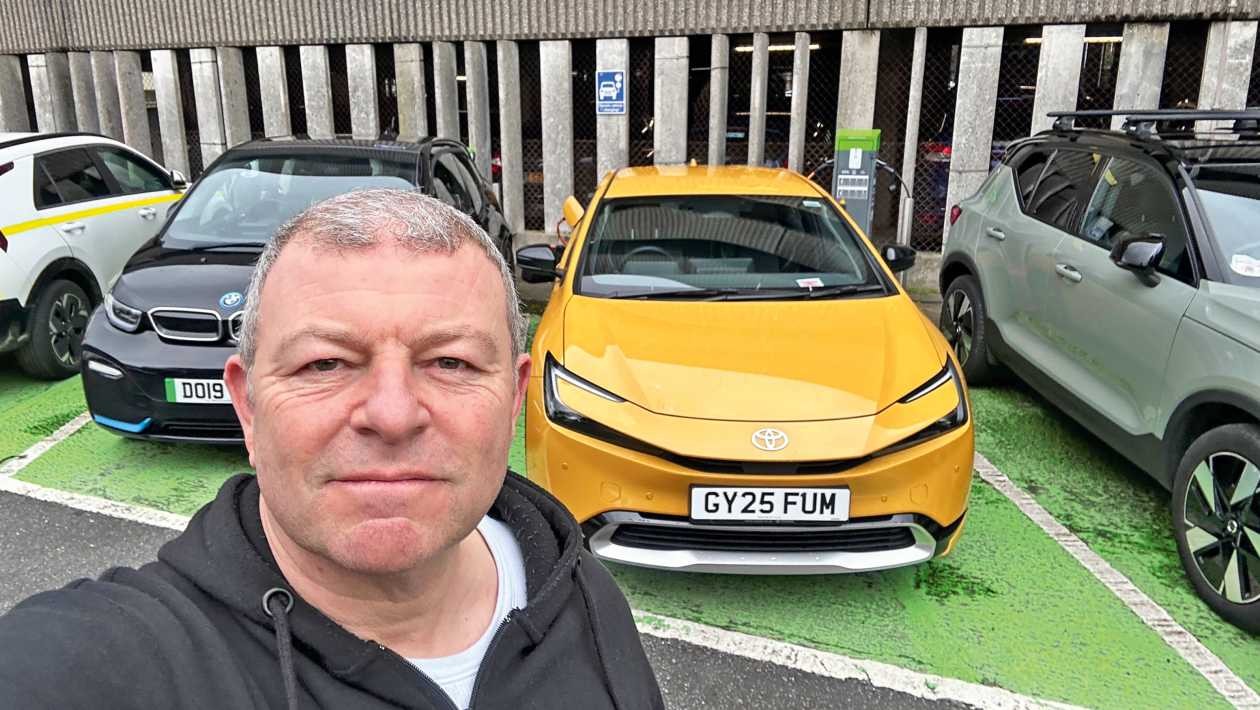
The top-spec Excel costs £40,54. It comes with Mustard Yellow paint if you pay extra £65. I do it.
It has a 2.0-liter petrol engine paired with a 13.6 kWh battery. That gives it 220 bhp.
Sixty-two miles per hour in 6.8 seconds? For a hybrid? Okay.
The real trick is the EV mode. I get around 40 to 45 miles on electric power alone. Charging at my nearest public point costs roughly £5 for that range.
Is that better than petrol?
Every single day.
The build quality shocks you. You expect Toyota. You don’t expect it to feel like a Lexus. The buttons click. The plastics don’t rattle. It sits up there with the Mercedes and the Audi in terms of cabin presence, but costs less than both.
There is a small screen behind the wheel that I wish was bigger. The central touchscreen works fine, though. Not confusing. Not bloated.
We’re not buying the Prius for the speed. We buy it because it makes sense. The tank holds 40 liters. A full tank gets you over 600 miles theoretically. In reality, I get closer to 500 before the computer gets scared I’m running empty.
Filling the tank costs about £30. Charging costs pennies.
It is a smart car. It is a calm car. And unless Toyota remembers that the RVAI system needs a factory kill-switch, it’s nearly perfect.


