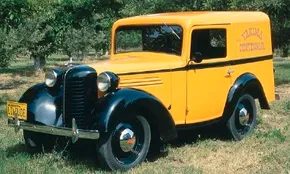
Small cars never really caught on in prewar America. Buyers wanted size, chrome, and presence. The American Bantam tried to survive that bias. Roy S. Evans took over the dying American Austin Car Company in 1935. He wanted to do what Sir Herbert Austin couldn’t. Sell tiny cars in the US.
The Depression made that hard. The debt was worse. American Austin owed $75,000 in back taxes and interest. Another $150,000 sat as a mortgage to the Pullman Standard Company. The federal bankruptcy court gave Evans the plant for $5,000. That was 1/2000th of the appraised value. He got a $250,000 loan from the Reconstruction Finance Corporation. Then he built the American Bantam.
How Alexis de Sakhnoffsky Styled the Bantam on a Shoestring Budget
Style mattered. Even for a budget car. Alexis de Sakhnoffsky designed the Bantam’s look. He gave it a smooth hood. A rounded grille. Reworked fenders. A new rear deck. His fee? $300. The cost to retool the entire line? $7,000. That is cheap. Even by 1930s standards.
Harry Miller built Indy race cars. He was hired to fix the mechanicals. Money was tight. He only redesigned the manifold. Butler’s engineers did the heavy lifting. They swapped expensive roller bearings for cheap babbitt bearings. They added full-pressure lubrication. A new three-speed transmission went in. Hotchkiss final drive. Ross cam-and-lever steering. The frame got heavier.
The engine size stayed the same. After 1939, they added a third main bearing. Wheels shrank. Down from 18 inches in 1937. To 15 inches in 1938. Smaller wheels meant lower centers of gravity. And cheaper tires.
American Bantam Models and Pricing from 1936 to 1941
The first Bantam line hit in 1936. One roadster. Five coupes. Prices ranged from $295 to $385. The 1937 lineup had two roadsters and three coupes. Prices jumped to $385-$492.
1938 brought new shapes. A Speedster with “Duesenberg sweep” side panels. A Boulevard Delivery with a rear half-roof. For 1939, Alex Tremulis designed a Riviera convertible. He claimed it could cruise at 75-80 mph. He said it averaged 42.5 mpg. That number feels optimistic. Maybe wrong.
Production didn’t boom. In 1938, they sold about 2,000 units. The next year? 1,229. Under 1,000 in 1940 and 1941. Then zero. Americans just didn’t want tiny cars. Evans couldn’t convince them.
The Jeep Contract That Saved Bantam (Briefly)
The firm found salvation in war. They won a contract to design what became the Army Jeep. Bantam built the first prototype. The Army worried about volume. Could Bantam build enough? Probably not.
Ford and Willys got the blueprints. They made their own versions. Bantam got a contract for 2,643 Jeeps. Ford and Willys built more than 600,000. Bantam did get a deal for two-wheel Jeep trailers. They made utility trailers until 1956.
It’s a strange end. A company that couldn’t sell cars to civilians saved the military with a prototype. The Bantam name vanished from passenger cars. But it lives in the Jeep. You just don’t see the badge anymore.