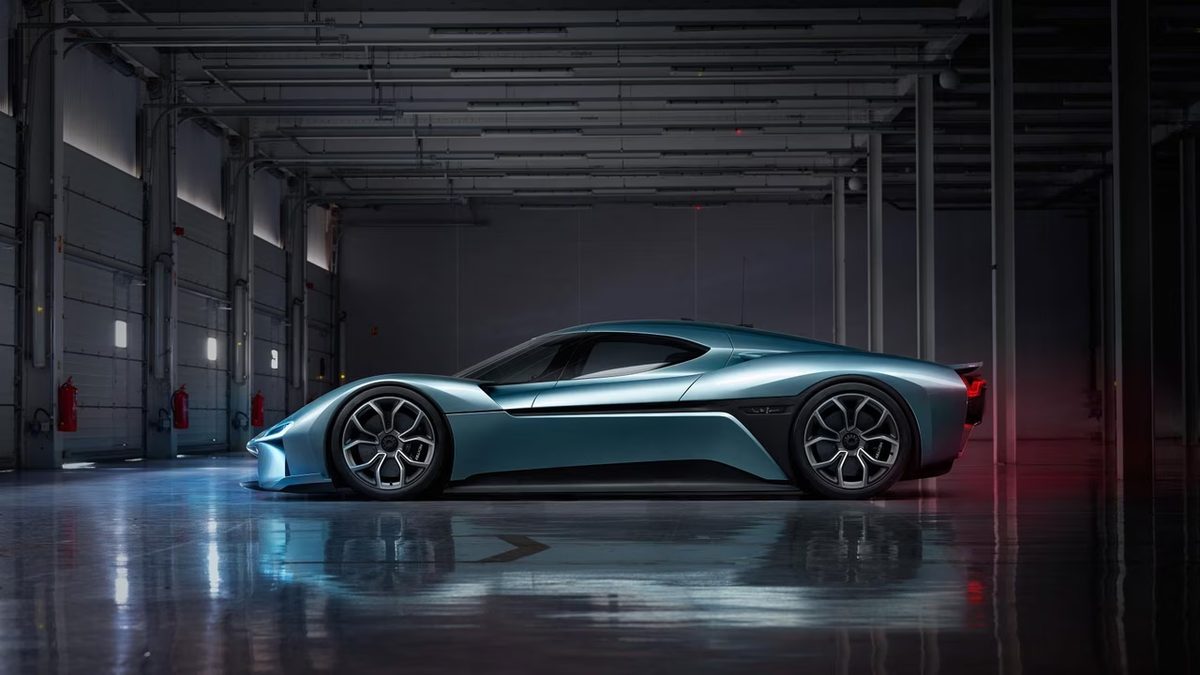
NextEV isn’t exactly a household name yet. The Chinese brand didn’t stumble into fame by accident. It won the very first Formula E championship in 2014. Nelson Piquet Jr. was behind the wheel of an electric monoposto that proved the concept worked. That victory wasn’t just for the trophy. It was proof of concept for high-performance electric vehicles.
So the company went bigger. They decided to build a road car. Not a commuter. Not a crossover. A hypercar. The goal was simple. Replicate track dominance on public roads. Beat Ferrari, Porsche, and Lamborghini on pure speed and engineering.
Enter the NIO EP9. The specs are intimidating. A monocoque chassis made entirely of carbon fiber. Top speed? 313 km/h. The 0-100 km/h sprint takes just 2.5 seconds. Zero to 200 km/h follows in 7.5 seconds.
Compare that to Porsche’s Mission E concept. The German electric sedan hits 0-100 km/h in under 3.5 seconds. The NIO is significantly faster off the line.
How the NIO EP9 Achieves 1,360 Horsepower
Power delivery is handled by four independent motors. Each motor has its own gearbox. The combined output equals 1,360 horsepower. That’s not a typo.
The energy comes from a unique powertrain. Swappable battery packs operating at 777 volts. The range sits at 427 kilometers. But the real trick is the swap.
NextEV claims you can replace the battery packs in eight minutes. A full recharge takes 45 minutes. This isn’t just charging speed. It’s a logistical advantage for track use.
Nürburgring and Paul Ricard Performance Records
To prove the numbers weren’t just lab tests, NextEV took the EP9 to the Nürburgring. The Nordschleife. The Green Hell.
The car completed a lap in 7 minutes, 5.12 seconds. That set a new record for electric vehicles. It beat the previous benchmark significantly.
Porsche’s Mission E concept later did the lap in just under eight minutes. The NIO held its ground. It wasn’t just fast. It was consistently faster than the established German rival.
The car also ran laps at France’s Paul Ricard circuit. There, it clocked 1 minute, 52.78 seconds. That shattered the old electric car record of 2 minutes, 40 seconds.
Why the NIO EP9 Generates 24,000 Newtons of Downforce
Inside the cockpit, the experience is visceral. Think fighter jet.
Deceleration hits 3.3 Gs under heavy braking. Cornering forces reach 2.5 Gs at 230 km/h. The aerodynamics are active and aggressive.
At 240 km/h, the car generates 24,000 Newtons of downforce. That’s massive. It pins the car to the track. Handling becomes less about grip and more about trusting the physics.
Who Owns the Six NIO EP9 Units?
Exclusivity is baked into the business model. Only six units were built. The price tag? $1.2 million per car. Total production cost is high.
But they aren’t sitting in a museum. All six were sold. The buyers? The investors who founded NextEV.
These aren’t collectors hiding them away. They are using the cars as rolling billboards. The EP9 is a flagship. It validates the brand’s engineering prowess.
The real test for NextEV is coming later. A more conventional production model is slated for release in 2017. The EP9 was never meant to be the volume seller. It was the proof that Chinese engineering could outpace the old guard.
Did they succeed? The lap