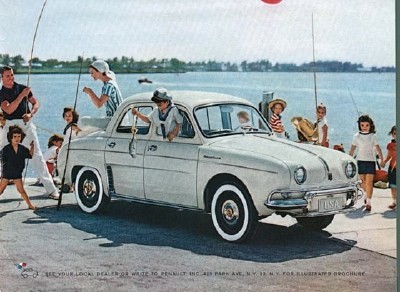
Renault didn’t just stumble into the rear-engine market by accident. The company had already chewed on the lessons provided by the tiny 4CV, a post-World War II car that forced engineers to rethink packaging and drivetrain layout. By the time the mid-1950s rolled around, those early experiments had coalesced into confidence. The result was the 1956-1958 Renault Dauphine, a vehicle that was physically larger than its predecessor and, for many buyers, significantly better. It wasn’t just a step up in size. It was a step up in competence. And that distinction was exactly what turned the Dauphine into a commercial success.
The Ghost of Porsche in a French Rear-Engine
Ferdinand Porsche holds the bag for an entire automotive era. If he hadn’t engineered the Volkswagen Type 1 Beetle, the trend of housing engines behind the rear axle might have never caught on. That ripple effect explains the existence of the Chevrolet Corvair, the Renault 4CV, and ultimately, the Renault Dauphine. It seems absurd that such a charming machine emerged from a company literally reduced to rubble just a decade prior. How does a nation, devastated by war as recently as 1945, build a car this appealing?
When General G. O. Barton’s 4th Infantry Division liberated Paris on August 25, 1944, France was broken. Four years of Nazi occupation had left scars deep into the industrial infrastructure. French resistance fighters had sabotaged what they could, and the Luftwaffe’s successors—the USAAF and the RAF—had pounded the rest into dust.
Louis Renault, the company’s founder, was locked up in prison for alleged collaboration and died shortly after. The company’s factories were flattened. A third of its machinery was gone. By all logic, Renault should have ceased to exist. Instead, the French state nationalized the ruins. Pierre Lefaucheux, the new chief executive, took the wreckage and started hammering.
The result was the 1955 Renault Dauphine. But before that, there was the 4CV.
1947
The 760cc Renault 4CV hit the market in 1947. It was a direct nod to Porsche’s “people’s car.” Renault had instructed his engineers in 1940 to build something similar. Development happened in secret while Nazi overlords demanded military trucks from the Paris plant. In a twist of historical irony, Porsche himself helped.
In 1946, French authorities sent him to review the 4CV drawings. He tweaked the weight distribution. He improved roadholding. He actually worked in Renault’s own engineering workshops for a time.
The 4CV was cute. Snub-nosed. Beetle-tailed. It had marginal performance and mediocre handling. But it was cheap. It was reliable. It was available. More importantly, it served as the blueprint. Every aspect of the 4CV would be reused, refined, and made better in the car that followed.
Project R1090
By 1951, the Régnie Nationale des Usines Renault decided it was time to try again. They called the project R1090. It took forever to get ready.
The first prototype rolled out in July 1952. Then came the testing. Over 2 million miles of data were logged. Renault put cars in extreme conditions to break them before the public could.
Arctic conditions were sampled in the North Cape area by one car, another car was sent to work in the Swiss mountains, and a third to the United States. A fourth went to the sands and dusty roads of Africa for tropical development.
This rigorous testing delayed production. The first assembly line at Flins didn’t start rolling out units until December 1955.
Why the Name?
Louis Renault originally wanted to call the new model the “Corvette.” General Motors beat him to the punch. So, the company looked to its royal heritage. France was a republic, but it remembered its monarchy. In the French hierarchy, a dauphin was the king’s eldest son. The dauphine was the feminine equivalent.
It fit. The car was pretty. It was appealing. It was small.
The 1955 Renault Dauphine finally arrived. Not as a rescue of a broken nation, but as its triumph. The ruins were gone. The engines were rear-engined. The style was distinct. And the ghost of Porsche? He was still in the chassis.
The Rear-Engine Gamble of the 1956 Renault Dauphine
Renault dropped the 1956 Renault Dauphine into the market in March, and France went crazy for it. They called it the “princess,” but under the skin, it was still carrying the torch for the old “Ventoux” engine. That conventional, water-cooled, overhead cam inline-four with removable cylinder sleeves lived right where it had always been: in the tail.
The bodywork was undeniably pretty. Curvaceous. Modern. It sat on a wheelbase of 89 inches—6.3 inches longer than the outgoing 4CV. The car itself stretched a full foot longer end-to-end. It was wider, slightly lower, and looked a tier above its predecessor, which limped along until 1961.
It worked as a people’s car because it looked classier than it was. You could shove people and luggage into it and hit 60 mph on France’s tree-lined Routes Nationales without breaking a sweat. But there was a catch. A big one.
Why the 1956 Renault Dauphine Handling Was Scary
Renault hadn’t figured out how to tame tail-heavy swing-axle dynamics. Neither had Dr. Porsche. When you put the heavy engine and gearbox in the back, and the front sheetmetal is just empty space for luggage, the weight distribution goes off a cliff.
Sixty-two percent of the Dauphine’s weight sat on the rear wheels. The suspension? Simple high-pivot swing axles. Those wheels struggled. Hard.
If you’ve ever read about the Dauphine nervousness, it’s all true. Passing a semi on the highway was a gamble. Crossing high, exposed bridges made the chassis skittish. You could try to fix it with weird tire pressures—15 psi in the front, 23 in the rear—but that never fully tamed the physics.
Early US reviews were forgiving. By 1960, Motor Trend stopped pulling punches. They noted that normal speeds hid the rear-engine layout, but push into a high-speed corner and the rear end becomes “quite skittish,” requiring skilled control of an oversteer condition that presents itself.
The Technical Oddities of the Dauphine
The unit-construction bodyshell was mostly conventional. Two perimeter-shaped longitudinal box sections with cross-bracing formed the backbone. The 845cc four-cylinder engine—a bored-out version of the 4CV’s powerplant—lived in the extreme tail. Cooling vents sat in the rear lid (not a trunk, since the trunk was in front). Air intakes in the rear passenger doors gave away the engine’s location instantly.
Power went to the rear wheels through a three-speed transaxle mounted ahead of the engine. Even back in 1956, Road & Track and Motor Trend wanted a fourth gear. They didn’t get one.
There was a Ferlec clutch option, too. Automatic electromagnetic operation. No separate clutch pedal. You just shifted.
The front-hinged lid flipped up to reveal a seven-cubic-foot cargo hold. The spare tire rode on its side under the front bumper, hidden behind a pivoting panel.
The suspension setup was a mix of sensible and bizarre. Up front, you got a conventional coil-spring wishbone layout with an antiroll bar. Rack-and-pinion steering. All neatly packaged on a detachable front cross-member.
Then, the rear. High-pivot swing axle. Simple. Concentric coil-spring and telescopic dampers sat atop the swing tubes—Renault called them “trumpet casings.”
Fore-and-aft location? There wasn’t any. Except for the trunnion arms in the transaxle housing, the whole pressed engine, transaxle, and suspension mounting member was detachable from the main body.
Flimsy Construction and Rust
The axle hubs at the front and rear were huge. Five very widely spaced bolt locations. The wheels were just sturdy rims with five mounting lugs. The space in the middle? Pure fresh air.
It might have looked elegant. It might have been cheap to build. But it wasn’t built to last decades.
The front end looked flimsy. In a head-on crash, that hollow nose would fold up to the windshield in seconds. Customers soon learned that body panels had an alarming tendency to rust away.
Commercially, none of that mattered. The timing was right. France’s economy was picking up. The world wanted modern-looking cars. The Dauphine became fashionable. Paris and other French cities teemed with these little four-seaters.
For more information on cars, see:
-
Classic Cars
-
Muscle Cars
-
Sports Cars
-
Consumer Guide New Car Search
-
Consumer Guide Used Car Search
The Dauphine’s American Wake-Up Call
Production hit a fever pitch by the late ‘50s. Seven hundred units rolled off the line daily. The 100,00th Dauphine left the factory in March 1957. Renault knew how to sell a fantasy. They had Brigitte Bardot photographed leaning against the curves. They sent a works team to the Mille Miglia. Five cars. Tweaked engines. Five-speed gearboxes. The result? A sweep of the first four spots in their class. The fourth-place car ended up in a ravine. It survived. It finished.
But the glamour didn’t translate to Main Street USA.
Renault tried. They assembled kits in England and Italy. They shipped the first ones to the New York Auto Show in April 1956. They hoped for volume sales. They were delusional.
Could they really think a 30-horsepower engine would dominate American roads? It took 31 seconds to hit 60 mph. It wheezed away from traffic lights. It couldn’t compete with a Checker cab in a drag race. The answer was no. They were swiftly proven wrong.
Drivers found the Dauphine sluggish. Second gear maxed out around 45 mph. You felt exposed. Unprotected. The only redeeming quality was efficiency. The base price was $1,645. That was $150 more than a VW Beetle, but the Dauphine drank less fuel. Magazine tests reported 39.1 mpg in mixed driving. It was cheap. It was thirsty for air, if not gasoline.
Gordini Steps In
Renault needed speed. They found it in Amedee Gordini. The French race-car builder had just walked away from Grand Prix racing. He was broke. He was looking for work. Renault hired him. They handed him a Dauphine and told him to make it faster.
The result arrived in September 1957. The Dauphine-Gordini. It had a new cylinder head. The engine pushed 38 hp. That’s a 27 percent jump. It came with a four-speed box. The top speed hit 74 mph. Suddenly, the car could talk to larger engines. It won the 1958 Monte Carlo Rally. The performance was no longer a joke.
The Floride Coup and Convertible
Less than a year later, Renault added style. The Floride. Called the Caravelle in the US. Styling by Frua. Bodywork by Brissonneau et Lotz. It sat on the Dauphine chassis. The engine was bigger.
You could buy it as a 2+2 coupe. Or a two-seat convertible. It became the status symbol in Paris. It was the car at the French seaside resorts. If you wanted to be seen, you drove a Floride.
The 1960s: Aerostable Suspension
The Sixties started with a technical twist. For the 1960 model year, Renault introduced the Aerostable suspension. Don’t expect a revolution. The swing-axle rear end stayed put. The change was additive.
Extra rubber springs went up front. Auxiliary air spring units mounted inboard of the rear coils. The setup softened the ride on smooth roads. It firmed up quickly under load.
For the driver who took corners hard, the benefit was geometry. With only two people in the car, the rear wheels gained negative camber. Grip improved. The Dauphine finally handled like something other than a grocery getter.
Up to 55 bhp in the Limited-Edition R1093
By the mid-60s, Renault had squeezed the last drops of performance from the small-block inline-four. The standard 845cc Dauphine churned out a respectable 32 bhp, while the Gordini variant, now utilizing the Caravelle’s engine block rather than its own specialized castings, pushed 40 bhp. The result? A 0-60 time of roughly 20 seconds and a top speed hovering around 80 mph. For a rear-engined economy car, that was decent. Not thrilling, but decent.
Production numbers tell a different story of volume than velocity. With over 200,000 units rolling off the line annually and the one-millionth car celebrating its milestone in 1960, you might expect a dip in engineering zeal. Complacency set in at some manufacturers. Not at the Régie.
The Ondine and DeLuxe Upgrades
In 1961, Renault tried to soften the Dauphine’s utilitarian edge. Enter the Ondine Dauphine. It wasn’t a new body style, just a standard model fitted with the Gordini’s four-speed gearbox. Later that year, the mid-cycle refresh brought the DeLuxe trim. You got reclining front seatbacks, a lined luggage compartment, upgraded interior trim, and standard whitewall tires. It was a bid for comfort in a class that rarely prioritized it.
Then came 1962. Renault finally gave the base Dauphine an all-synchromesh three-speed gearbox, fixing a long-standing grievance for drivers who hated grinding gears. But the real headline was the Dauphine R1093.
The R1093: A Rally-Bred Rare Bird
The R1093, where the “R” stood for Rally, was a limited-edition beast. Renault tuned the engine to produce 55 bhp. It could crack 90 mph. It was fierce. It was fast.
The catch? Almost all of them stayed in France. Export markets got the shaft. Enthusiasts abroad missed out on a car that outperformed many of its contemporaries in both speed and handling potential. It remained a domestic secret, a ghost car in the annals of French automotive history.
The R8 Influence and 1964 Updates
The Dauphine’s dominance was waning. The new Renault R8 sedan arrived with a square-rigged design, a larger engine, and updated suspension systems derived from the Dauphine’s own mid-1962 revisions. The R8 was the future. The Dauphine was the past, but a polished past.
For 1964, the Dauphine borrowed the R8’s four-wheel disc brakes. This was a significant safety upgrade. Stopping power finally matched the engine’s modest claims. New options included air conditioning and a three-speed automatic transmission with pushbutton controls on the dashboard.
Braking Performance and Handling Legacy
Here was a well-matured little car. It looked good. It was brisk enough for city commuting and highway merging
The End of the Road for the Dauphine
The slide-out rear window panels were a clever touch for airflow, but by the mid-Sixties, the 1964 Renault Dauphine was running on fumes. Nearly a decade had passed with zero style updates. Performance? Barely touched. As the paint aged, so did the metal. Serious rust issues were becoming a known quantity, and the chassis—light to the point of fragility—drawn constant criticism from drivers who demanded more substance.
Renault was its own worst enemy. The Dauphine was being squeezed. From below came the R4, a new front-wheel-drive compact that felt more modern. From above, the R8 offered more space and actual capability. The little Dauphine had nowhere left to hide.
The American Collapse
Sales in the U.S. tell the tragic story. Early in the Fifties, Renault moved only hundreds of units annually. Then, the small-car boom hit. Americans flocked to economical European imports. Led by the Dauphine, Renault hit a peak of 91,073 sales in 1959.
By 1966? Just 12,106.
The crash wasn’t just Renault’s fault. When Ford, Chrysler, and Chevrolet launched their domestic compacts in 1960, the entire import sector shuddered. Even Volkswagen took a hit. Renault tried a price cut in 1961. It didn’t matter.
But money wasn’t the only issue. Service support in America was a joke. You don’t have to take my word for it. Renault admitted it in their own ads when launching the R10 for 1967. They confessed that their earlier cars weren’t ready for American roads. “More than a fair share of things went wrong,” they wrote. “Less than a fair share of our dealers were equipped to deal with what went wrong.” They asked former customers—who had sworn off the brand—to give them another chance.
The brand would briefly surge again in the early Eighties, thanks to manufacturing at AMC plants and sales through AMC dealerships. But for the Dauphine, the party was over.
Fade to Black
The last base-model Dauphine rolled off the line in December 1966. The high-performance Gordini variants clung on until 1968. In total, about 2 million of these tiny sedans were built. By any metric, it was a commercial success.
Yet, no matter how hard Renault tried in the following years, nothing ever looked quite as charming. The Dauphine was unique. Its successor was competent. Its predecessor was historic. But nothing matched that specific, fragile cuteness.
1956-1968 Renault Dauphine Specifications
The Dauphine lived a long life for such a small machine. Here are the hard numbers for the 2 million units produced between 1956 and 1968.
General Dimensions
- Wheelbase: 89 inches
- Overall Length: 155 inches
- Overall Width: 60 inches
- Overall Height: 57 inches
- Front/Rear Tread: 49 / 48 inches
- Curb Weight: 1,324 lbs
- Weight Distribution: 39% Front / 61% Rear
- Cargo Space: 7 cubic feet
Construction
- Layout: Rear-engine, rear-wheel drive
- Body Type: Unitized
- Material: Steel
Engine Details
- Type: Inline OHV 4-cylinder
- Block/Head: Cast-iron block, aluminum head
- Bore x Stroke: 58mm (2.28 in) / 80mm (3.15 in)
- Displacement: 845 cc / 51.5 cid
- Horsepower: 30 hp @ 4250 rpm (U.S. spec; other markets varied)
- Torque: 48.5 lb-ft @ 2000 rpm
- Compression Ratio: 7.25:1
- Main Bearings: 3
- Valve Lifters: Mechanical
- Carburetor: 1-bbl Solex downdraft
- Electrical System: 6-volt
Drivetrain
- Transmission: 3-speed manual, synchromesh, floor-mounted
- Gear Ratios:
- 1st: 3.70:1
- 2nd: 1.81:1
- 3rd: 1.07:1
- Reverse: 3.70:1
- Axle Ratio: 4.37:1
Suspension & Brakes
- Front Suspension: Independent coil-spring-and-wishbone with antiroll bar and tubular shock absorbers
- Rear Suspension: Independent swing axle with coil springs and tubular shock absorbers
- Brake Type: 4-wheel hydraulic drum
- Brake Diameter: 8.9 inches (front and rear)
- Brake Swept Area: 133 sq in
- Tire Size: 5.00 x 15
Steering
- Type: Rack and pinion
- Turns, Lock to Lock: 4
- Turning Diameter: 29 feet