Plymouth handed over fifteen million bucks to make the Valiant look less like a taxi driver’s sedan and more like something you’d actually want to drive. The mandate was simple. Fix the styling. Modernize the interior. Stop making it look dowdy. The directive never once mentioned building a fastback. It certainly never authorized a new body style. But when you hand engineers a blank check and tell them to “freshen up” a car, they tend to get creative. They didn’t build the Duster. They stumbled into it.
The result was the 1970 Plymouth Duster. It wasn’t a planned halo car. It wasn’t a carefully studied market response to the Mustang or the Camaro. It was a byproduct of a makeover budget that got out of hand. And that accidental origin story is exactly why the car matters.
Why the 1970 Plymouth Duster Changed Everything
You have to understand the context of 1970. The muscle car boom was hitting a wall. Gas prices were creeping up. Emissions regulations were tightening. The big V8s were still around, but the free-wheeling days were ending. Plymouth needed a winner. The Valiant was already a solid seller, but it lacked punch. It was sensible. Safe. Boring.
Enter the Duster.
It started as a trim package. A sticker. A way to move metal. But somewhere between the design studio and the showroom floor, the lines blurred. The Duster wasn’t just a Valiant with a new coat of paint. It was a Valiant that looked faster. It sat lower. It had a more aggressive stance. It felt quicker, even if the engine bay hadn’t changed yet.
“The Duster was never meant to exist as a standalone model. It was a marketing experiment that accidentally became a cultural icon.”
This accidental status gave the Duster a unique charm. It wasn’t trying too hard. It didn’t have the polished corporate DNA of a Chrysler Imperial or the ruggedness of a Ford Bronco. It was just a cheap, fast-looking car that happened to be built on a reliable platform. That simplicity became its greatest strength.
How the 1970 Plymouth Duster Got Its Shape
The styling changes were subtle but effective. The front end got a new grille. Sharper. Angrier. The rear was cleaned up, losing some of the cluttered look of previous years. The most significant change? The roofline.
While the standard Valiant kept its notchback design, the Duster embraced a more sloped rear window. It wasn’t a true fastback in the purest sense, but it had the visual cues. It looked like it was moving even when it was parked. This visual trickery was cheap to produce but expensive to replicate in competitors’ showrooms.
The interior got a facelift too. Better materials. Better gauges. A sportier steering wheel. These weren’t huge changes, but they added up. They made the driver feel like they were in something special. Something exclusive. Even if it was built on the same assembly line as the boring sedans.
Which Engine Powered the 1970 Duster?
Plymouth had options
The Unlikely Rise of the Plymouth Duster
It was October 1959 in Detroit. Buyers were hunting for small cars to fight the Volkswagen Beetle and stop complaining about massive, heavy sedans. GM sent out the rear-engine Corvair. Ford rolled out the Falcon, a mini-Ford. Chrysler gave us the Valiant, with Virgil Exner’s European styling and the tagline “It’s nobody’s kid brother.”
Ten years later, in Fall 1969, the landscape had collapsed. The Corvair was dead. Ralph Nader’s safety crusade and the rise of the “pony car” killed it. Ford replaced the Falcon with the Maverick. The Valiant survived, barely.
And then there was the Duster.
A cute two-door fastback. An unlikely name. It wasn’t supposed to exist. Yet, by 1970, Plymouth Dusters were everywhere. More common than toast. You owned one. Your neighbor had one.
This isn’t a story about a planned victory lap. It’s about an accident that became an icon.
1970 Chrysler Compact Cars
By the late 60s, Chrysler dominated the compact segment. The 1970 lineup was the result of a decade of trial, error, and one very lucky break.
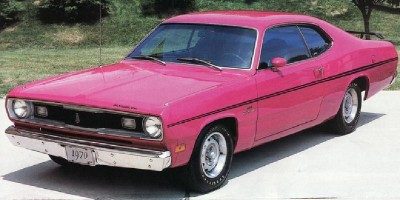
The 1970 Plymouth Duster 340 wasn’t just another compact. It was a mini-muscle car with a vibrant paint job and Rallye wheels. It was attractive. It was popular. It was fast.
Why did this specific model matter? Because it took the Valiant platform—a solid, economical compact—and injected it with high-performance DNA. The 340 cubic-inch V8 wasn’t the biggest engine Chrysler made. But in the Duster’s light body, it felt faster. Heavier. More aggressive.
The Duster 340 sold because it offered muscle car thrills without the muscle car price tag. Or the handling issues.
The Valiant remained. The Maverick replaced the Falcon. The Corvair vanished.
The Duster stayed.
It was ubiquitous. It was everywhere.
And it was never supposed to happen.
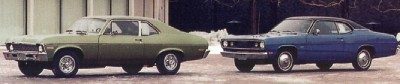
The Calculated Risk Behind the 1970 Plymouth Duster
Chrysler knew it was bleeding market share in the compact segment. The Plymouth Valiant and Dodge Dart duo controlled nearly 30 percent of that specific slice of the pie. That dominance dwarfed Chrysler’s overall 16-percent share of the total automotive market. But dominance isn’t static. It erodes if you don’t move.
The Valiant had been restyled in 1963 and again in 1967. That second overhaul stretched the wheelbase to 108 inches and stripped away the notchback hardtop and convertible. Those sexy bodies went to the Barracuda. By 1968 and 1969, the Valiant survived on minor grille and taillight tweaks. Bland. Predictable.
Then came 1970. Chrysler budgeted $30 million for facelifts on the A-body platform—the Valiant and Dart. Split evenly. $15 million each.
Dodge took its $15 million and applied it to new front and rear ends for the Dart sedan and hardtop. They ran an ad campaign calling it the “Dodge Rebellion.”
Plymouth did something entirely different.
Former compact-car planning executive Gene Weiss remembers the directive clearly. The team spent “nothing — zip, zero, nada” on the existing Valiant models. They kept the carryover body styles. Instead, they bet the entire $15 million allocation on a longshot. A product that didn’t exist in the corporate plan.
They created the Duster.
Why Lighter Was Faster
The motivation wasn’t just sales. It was speed.
Chrysler was simultaneously developing the all-new 1970 Barracuda and Dodge Challenger. These E-body pony cars had unique shells. They used heavier chassis components borrowed from Plymouth and Dodge intermediates. This made them robust. It also made them expensive to produce. That cost structure contributed to their premature end in April 1974.
But there was a performance problem.
The new E-bodies weren’t fast enough. Not without extreme powertrains.
“At the time the E-bodies were being planned, the relatively inexpensive 327 small-block Chevy Nova was the fastest car [in the quarter mile] right off the haulaway,” Weiss said.
The Barracuda was heavier. To beat a Chevy Nova off the line, you needed a big-bucks Hemi or a well-tuned 440. Most buyers wouldn’t spend that kind of money. A Barracuda without a Hemi couldn’t match the Nova’s quarter-mile times. The corporation needed a lighter car. One that could accommodate a new engine without the weight penalty of the E-body.
They needed to drop their new 340-cubic inch V-8 into a lighter chassis. The Valiant body fit the bill.
The 340 C.I. V-8 Package
Planners saw the Duster as an attractive package to deploy that 340 V-8. The goal was direct. Challenge the small-block Chevrolet Nova compact.
The Duster wasn’t just a Valiant with a different sticker. It was a calculated response to the Nova’s dominance in the street race arena. By keeping the car light and dropping in the 340, Plymouth created a competitor that could actually hang with the Chevy.
The decision to skip the facelift and build something new from scratch allowed them to target the muscle car buyers specifically. Not the families needing a hardtop. The guys who wanted quarter-mile times.
It was a gamble. Betting zero on the old cars and everything on a new one. But the math was simple. Lighter car. New V-8. Beat the Nova.
The rest, as they say, is history. But the engineering logic remains clear.
Building a Muscle Car Out of Scrap
Before the 1970 Plymouth Duster hit showrooms, the compact muscle segment was already fighting for space. The Barracuda handled the 340 engine for ’68 and ’69, while Dodge had the Swinger 340 hardtop. Nobody believed a square, valiant-based sedan with a V8 would move units. So Chrysler poured every spare cent of the tooling budget into making a new coupe.
It wasn’t supposed to happen. The 1970 Plymouth Duster wasn’t in Chrysler’s Long Range Plan. But executives were distracted by the E-body program. The Duster was small change by comparison. It flew under the radar. That gave the team freedom. It also gave them a nightmare constraint: a brutal tooling budget.
The Art of Junkyard Styling
The plan was simple on paper and impossible in practice. Every major structural element had to be carryover. Wheelbase stayed at 108 inches. Front sheet metal? Carryover. Cowl? Carryover. Bumpers? Carryover. Door lowers and quarter panel inner structures? All Valiant parts.
Stylist Milt Antonick had to make a close-coupled coupe look right while stuck with a floorpan designed for a four-door sedan. The overall length was locked at 188.4 inches to match the sedan exactly. Antonick called it “junkyard styling.” Making value out of scrap.
Working under Antonick was Neil Walling, then a junior stylist. He had been working on full-size Plymouths before getting pulled into this quick-hitter project. Lead time was non-existent. The task was to make five existing Valiant crease lines flow in a way that looked sporty.
Solving the Crease Line Puzzle
Walling succeeded by manipulating the existing lines. He swelled the quarter panel around the centerline of the rear wheel. The lower of the two top crease lines angled up sharply before dropping toward the rear. The lower pair of creases dipped off the door, then rose aft of the wheel opening.
This created a wedge shape. It added drama. It softened the car’s bulk. All five lines terminated in a peaked “V” at the end of the quarter panel.
Walling wasn’t happy with the proportions, though. The rear track was only 55.6 inches, compared to the front’s 58.2 inches. GM designers had swollen their quarter panels in plan view to hide narrow tracks. Chrysler couldn’t. The rear wheels looked tucked under.
“I always wished the car had a wider track,” Walling recalled. He later bought two-inch spacers for his own Duster on the company lease plan. Just to make it look right.
The Fastback That Broke the Rules
The roof was the secret weapon. Chrysler’s Bob Weiss knew the math: fastbacks were a “25-percenter.” Customers preferred notchbacks three to one. But the Duster was a fastback.
The sloping roofline made it instantly distinct from the nerdy notchback Valiant. It solved the styling problem. Walling wanted to push the base of the backlight as high as possible. The stylists created a steeply sloping backlight mated to a wedge-shaped C-pillar that angled forward. This reduced the apparent roof length. It created that close-coupled look.
The car lost an inch and a half in height compared to the sedan. In side profile, the beltline angled up behind the front door, then turned forward around the rear quarter window.
The resulting window was small. The drip rail arched. The front doors used frameless glass. It looked like a true hardtop. It wasn’t. The rear quarter windows flipped open. They didn’t retract.
The 1970 Plymouth Duster was attractive. It was sporty. It wasn’t perfect.
The Flaws Beneath the Steel
The design had cracks. Literal ones. And structural compromises that designers hated.
The carryover floorpan meant the interior was cramped. The rear seat was essentially a bench for luggage. The close-coupled exterior looked great, but the interior packaging suffered. The roofline sacrifice hurt headroom.
Then there were the body lines. The crease lines, while artistic, created stress points in the sheet metal. During development, engineers fought to maintain rigidity without adding weight. The “junkyard” approach meant weak points remained.
Walling’s desire for a wider track wasn’t just aesthetic. It was functional. The narrow rear track made the car twitchy at high speeds. The Duster could dance on the edge of traction if you pushed the 340 or 440 engines hard.
Weiss noted that the fastback roof, while beautiful, complicated the manufacturing process. The stamping dies were complex. The quality control issues were higher. More rejects meant higher costs. But the budget was fixed. So they cut corners elsewhere.
The result was a car that looked faster than it was. It handled better than its price suggested. But it was built on the bones of a family sedan. The compromises were baked into the steel.
Enthusiasts knew this. They bought them anyway. They fixed the spacers. They ignored the cramped back seat. They loved the way the lines flowed into the rear wheel arches.
It was a miracle of engineering constraints. A car that shouldn’t have worked. Did.
The flaws remained. The narrow track. The cramped interior. The complex body panels. But the 1970 Duster was born. And it changed how Plymouth viewed the compact market.
Not for the better. Not for the worse. Just different.
The $45-Inch Radius Gamble
The 1970 Plymouth Duster wasn’t just a Valiant with a better paint job. It was a calculated risk. The body was attractive. Sales were high. But the engineering team knew they had cut corners that would bite them later.
Take the windows. The non-retractable flip-open quarter glass was standard. The main side glass? A disaster waiting to happen.
Chrysler had pioneered curved glass back in 1957 with the Imperial. By 1967, the Valiant and Dart got curved panes. But those were gentle curves. A 90-inch radius. Standard. Safe.
For the Duster, the stylists wanted something sharper. They demanded a 45-inch radius.
“Nobody in the company quite believes a styling studio engineer,” Weiss recalls. “But when a car engineer says something can be done, he’s believed.”
John Worthy from Advanced Engineering took the hit. He had to take existing Valiant door panels—designed for that flat, 90-inch radius glass—and force a much rounder 45-inch pane into them. It should have failed. It should have jammed.
It didn’t. Worthy made it fit. It moved up and down. It worked.
Tumblehome and Rust
The result was dramatic. The glass curved inward so sharply above the beltline that it increased the “tumblehome.” Antonick hated it. He felt the glass was too close to the driver’s head. Too risky.
But the look sold cars. The rounder glass made the body below the beltline look rounder too. It hid the fact that the door was a carryover Valiant component.
Then there were the taillights. Tom Hale designed them. Horizontal. Twin slots. Recessed into the sheetmetal. No bright chrome bezels.
It looked sporty. It also invited rust.
Without those outer bezels, water and road salt had direct access to the seams. And the placement of the lamps meant the trunk lid sat high. A high liftover. You had to lift luggage up and over the lip to get it out. Annoying.
But the real headache was the decklid itself.
The Crease Problem
The Duster lacked a traditional handle. You shut the trunk by grabbing the sheetmetal lip.
If you did it wrong? You created a vertical crease. Or worse. A series of creases in the shallow lip.
Owners were denting their own cars. Daily.
Engineers panicked. They needed a fix. They proposed a vertical windsplit down the center of the decklid. It would add structural strength to the sheetmetal. It would stiffen the lip so it wouldn’t dent under pressure.
The revised decklids went into production in the summer of 1971. A running change. A patch.
The Duster was still popular. But the flaws remained. The glass was still tight. The rust was still waiting. The trunk lid was still fragile.
You bought the look. You got the flaws.
Plymouth didn’t skimp on the 1970 Duster. They threw money at it. The result was a car that looked expensive but carried a compact price tag. The styling update was the most obvious change. Chrysler designers carved out a new grille. It featured tight, recessed black bars. The center section jutted forward, flush with the frame. It was capped by the iconic “frog-legs” emblem.
Rectangular park and turn signals molded into these recesses gave the front end a serious edge. It looked like a “poor man’s Grand Prix.” This grille wasn’t exclusive to the Duster. The 1970 Valiant four-door sedan got it too. Inside, the dashboard borrowed heavily from the Valiant. But Plymouth added a fresh twist. A twin-circle gauge cluster dominated the view. Full instrumentation sat between two large dials. There was even room to slip in an optional tachometer.
Interior Options and Quick Development
Seat choices reflected the era’s mix of utility and sport. Standard was a vinyl front bench. Buyers could upgrade. Options included a cloth-and-vinyl bench, an all-vinyl split bench, or a split bench with a fold-down armrest. For the serious drivers, there were all-vinyl bucket seats. You could get them with or without a center console.
The development timeline was brutally short. John Antonick recalled the process vividly.
“The whole Duster program — sketches and modeling — took six weeks.”
Chrysler officials were impressed. Antonick wasn’t. He compared it to his time at Studebaker. The Avanti was designed in that same timeframe. The name came from outside. Ad agency executive Jim Weiss sourced it. “The Duster name came out of the advertising agency,” he said. It fit the aggressive naming trend of the day. Think “Judge.” Think “Boss.”
The Dust Devil Logo and Engineering
Early Dusters came with a mascot. A squat swirl of dust with angry eyes. It wasn’t scary. It was playful. A friendly little devil. Antonick admitted the design was basically the Tasmanian Devil. They wanted to use the Warner Bros. character directly. It cost too much. The Road Runner name was undervalued by Warner. They wanted ten times more money for the dust devil. So Chrysler made their own.
Underneath that playful exterior sat serious engineering. The Duster used Chrysler’s unibody construction. Front torsion bars provided the suspension. A TorqueFlite automatic transmission was available. It was solid. Reliable.
Slant Six and V-8 Powertrains
Engine options started with the legendary Slant Six. Chrysler had two versions for 1970. The first was a stroked 198-cubic-inch engine. It made 125 horsepower. That was an increase from the previous year’s 170-cube, 115-horsepower unit. The larger option was a 225-cubic-inch variant. It produced 145 horsepower.
For those who wanted more than economy, there was the 318-cubic-inch V-8. It was Chrysler’s workhorse engine. It delivered 230 horsepower. It was plenty for commuting. It wasn’t for the track.
That changed quickly. The 1970 Plymouth Duster 340 coupe arrived. It fulfilled the car’s true purpose.
The Duster 340 and the Clark Kent Code
The Duster 340 was the answer to the market’s demand for real muscle. It came with a 275-horsepower 340-cubic-inch V-8. The engineering code for this specific model was “CK.” It stood for Clark Kent. The Superman alter ego. It was a subtle nod. The Duster looked ordinary in daylight. Like a Kent. But pull the plug. Step on the gas. It transformed.
This model shifted the Duster from a cheap sports coupe to a legitimate competitor. It had the power to match the aggressive styling. It had the handling to back up the straight-line speed. The foundation was laid. The rest of the story follows.
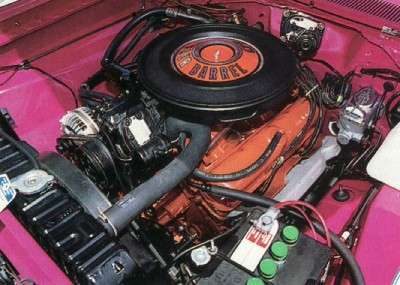
The Duster 340: Discreet Styling, Elite Performance
The heart of the deal was the 340-cubic inch small-block V-8. It pushed out a healthy 275 horsepower. The secret was the four-barrel carburetor and a compression ratio of 10.5:1. It wasn’t just about raw power though. Plymouth wanted this package to fit seamlessly into their Rapid Transit System ethos.
Identification was subtle. You wouldn’t immediately know what was under the hood. Dual black side stripes ran mid-body, thickening slightly to mimic the car’s swelled rear quarters. Two wide black stripes connected the tail lights at the back. It was understated. But underneath? It was a monster.
Spec Sheet: How the Duster 340 Was Built
To get that performance, Plymouth didn’t cut corners. They stuffed the 340 under the hood and backed it up with serious hardware. The cylinder heads were high-flow units. The camshaft had high lift, overlap, and long duration. A single Carter four-barrel carburetor fed the mix.
Suspension was dialed in for the track, not just the street.
- Front torsion bars: High-rate, .87-inch diameter.
- Anti-sway bar: Heavy-duty, .88-inch front.
- Shocks: Heavy-duty units.
- Rear springs: Heavy-duty, six-leaf setup.
- Brakes: Front disc brakes.
- Wheels/Tires: E70X14 raised white-letter tires on 5.5-inch Rallye road wheels with trim rings.
Transmission choices were all heavy-duty. You could pick a floor-mounted three-speed manual, a four-speed manual, or the Torque-Flite automatic.
Car and Driver Tests the Duster 340
Car and Driver put the coupe through its paces in their March 1970 issue. Their verdict? It was a “reroofed Valiant with a performance engine, priced to sell ($2,547).”
The numbers were impressive for the price point.
- 0-60 mph: 6.2 seconds.
- Top speed: 120 mph.
- Quarter-mile: 14.72 seconds ET.
That quarter-mile time was better than any stock ‘Cuda they had tested. It beat a swarm of bigger, more expensive cars too.
Handling was another story. The testers were not impressed. They reported severe understeer. The car plowed in turns. “With all that rear overhang and the narrow rear track, we were lucky it handled at all,” said Weiss. It was fast in a straight line, but the chassis struggled to put that power down effectively in corners.
Sales Dominance and Insurance Loopholes
The 1970 model year saw 24,817 Duster 340s built. That outsold the 19,155 ‘Cudas. In fact, the Duster 340 outsold the ‘Cuda 340/383 in each subsequent year. The margins were healthy. It proved the viability of the concept.
Annual volumes stayed high, between 13,000 and 16,000 units, right through 1973.
Why did young men buy these so aggressively? Insurance rates were a major factor. Premiums could hit $1,200 to $1,500 a year. That was a deal-killer. So, buyers used subterfuge. When asked about their new purchase, they truthfully told agents, “I’m buying a Valiant two-door sedan.”
Agents eventually caught on. They started asking follow-up questions. “A Duster?” Then, “Six-cylinder or V-8?” Finally, “Which V-8?” By then, the game was over. The insurance rates climbed, but the sales momentum had already been established.
The 1970 Valiant Duster Phenomenon
The 1970 Plymouth Valiant Duster (sold under all three names that year) hit showrooms on September 23, 1969. By the end of the model year, Plymouth had built 217,192 units. This was a stupendous increase over the 36,317 two-door sedans built the previous year.
It propelled Plymouth to third place in sales for the first time since 1959. When you added the 50,810 four-door sedans, the Valiant broke its previous decade-old sales record. The Duster’s popularity drove five consecutive sales records in its first five years.
Styling helped. But value sealed the deal. The Duster started at $2,172. Plymouth ads compared it to a Maverick. The Duster cost $90.75 more but offered:
- A five-inch longer wheelbase.
- 4.5 cubic feet of extra trunk space.
- Nearly 11 inches more rear-seat hip room.
- 3.5 inches more front hip room.
- Bigger brakes.
- More options, including the two V-8s.
- A better warranty.
Later ads targeted Chevy’s ill-fated Vega.
The Gold Duster and 1971 Updates
After selling 100,000 units, Plymouth celebrated with the Gold Duster option. It was the first in a series of trim packages designed to keep sales momentum alive. The package included:
- Gold side and rear tape stripes.
- Bright drip moldings.
- An argent grille.
- A 225- or 318-cubic inch engine.
- Whitewall tires.
- Deluxe wheel covers from the bigger Satellite.
It turned prospects into “prospectors.” Customers loved it.
Changes for the 1971 Duster were minor. It was no longer badged a Valiant. The grille lost its “frog legs” ornament. New wheel covers with “salt-and-pepper shaker” center holes were an improvement. These were later disfigured by black lines dividing the surface into wedges, a result of unfavorable consumer clinic feedback.
But the 340 remained the star.
For more information on cars, see:
- Muscle Cars
- Sports Cars
- Consumer Guide New Car Search
- Consumer Guide Used Car Search
What Changed in the 1971 Duster 340
The design tweaks continued in 1971. The focus remained on keeping the car relevant in a shifting market. The visual updates were small, but the mechanical heart of the Duster 340 stayed consistent. Enthusiasts kept buying it. The sales numbers proved that Plymouth had struck gold with the combination of affordable price and legitimate muscle car performance.
The road ahead would bring stricter emissions laws and rising insurance costs. But for now, the Duster 340 was king.
Plymouth wanted the 1971 Duster 340 to be a quiet threat. A sleeper. Instead, they painted a bullseye on its back. Stylists swapped subtlety for loudness, adding a full-length bodyside stripe that traced the upper body contour. It ended in massive “340” numerals on the rear quarter. If that wasn’t enough, the “True Extrovert” package added flat black paint across the hood, cowl, fender peaks, and beltline. Huge white-outline “340” numbers sat at a jaunty angle on the driver’s side. Orange “wedge” lettering ran down the vertical stroke of the four. Racing pins held the hood. It was the best-looking Duster of the seven-year run.
Visual Aggression and Exclusive Details
The 1971 Plymouth Duster 340 wasn’t just about looks. It came with specific hardware. A black-only decklid spoiler. A tachometer. A new “Tuff” steering wheel with a smaller diameter and thick rim. The front got an exclusive grille. It looked like a regular Duster from above but featured narrow, vertical, blacked-out rectangles with concealed park and turn lamps.
But the rear was where things got messy. Engineers planned vertical slotted tail-lamps to give the car a unique identity coming and going. They never made it to the production line. Corporate infighting killed them.
The Duster’s success pleased Plymouth. It did not please Bob McCurry, Dodge’s hard-charging general manager. He and his dealers hated that the Dart was being outsold by the Valiant-based Duster. McCurry demanded a variant for his boys. Quick.
The Dodge Demon and the Scamp Compromise
Management said yes. They took a stock 1971 Dart front clip and welded it to the Duster shell. This created the Dodge Duster, later renamed the Dodge Demon. It got its own fenders, hood, grille, and bumper. The wheel lip detail didn’t match the rest of the car. Nobody cared.
To solve the rear end problem, they stole the Duster 340’s vertical slotted taillights and lower deck panel. Plymouth stylists objected. They lost. The Dodge Demon never caught on. It wasn’t nearly as popular as the Duster.
But Plymouth didn’t leave empty-handed. In exchange for sacrificing their taillights, they got a copy of the Dart Swinger. Chrysler called it the Plymouth Scamp. It was Valiant’s first two-door hardtop since 1966.
The Scamp siphoned off buyers. Duster production dipped to 186,478 units in 1971. The Scamp moved more than 48,000 units. These were people who might have bought a Duster. Now they had a hardtop.
Maximizing Tooling with the Twister Package
Plymouth wanted to squeeze more value from the new tooling. They had spent most of their 1971 budget on parts for the limited-volume Duster 340. Sales and marketing needed volume. They created the Plymouth Duster Twister package. The name was a pun on “Duster.” They hoped it would broaden appeal without cannibalizing the main line.
The Twister package leaned on the existing infrastructure. It wasn’t a new car. It was a new way to sell the existing one.
Plymouth Duster Twister Package
The Twister package was the answer to low volume. The Duster 340 had consumed too many resources. The Twister package offered a different flavor. It kept the base costs down. It added visual flair. It targeted buyers who wanted style without the heavy performance specs.
The package included distinctive badging and optional stripes. It relied on the same platform. It used the same engine options as the standard Duster. It was a marketing play. A way to keep the lights on when the 340 wasn’t moving enough units.
Why the Twister Failed to Save the Day
The Twister package didn’t stop the decline. The Duster was aging. Competitors were entering the market. The muscle car era was winding down. Emissions regulations were tightening. The Twister was a stopgap. It bought time. It didn’t change the trajectory.
Plymouth kept producing the Duster through 1976. The Twister package was a small footnote. A reminder of what could have been. If they had invested differently. If they hadn’t lost the taillights. If they had kept the focus on performance.
The Duster survived. But it wasn’t the same. The Twister was just another option. Another way to sell the same old car.
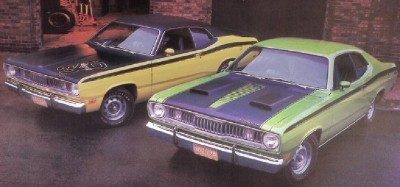
The 1971 Plymouth Duster Twister: A 340 Lookalike
The 1971 Plymouth Duster Twister package wasn’t just a sticker job. It was a deliberate attempt to make the economy coupe look meaner. Chrysler announced the option in February. It sat on the fence between six-cylinder and V8 models. But the visual language was pure muscle.
You got the distinctive 340 grille. That’s the high-performance part. The body got a special black “Duster twirl” side stripe. Twister decals went on the doors.
The hood was the main event. It was painted black. You could order twin flat black simulated hood scoops to go with it. The center plateau had a black-and-body-color strobe treatment.
It wasn’t just the hood.
– Lower deck stripes.
– Dual racing mirrors.
– Wheel lip and drip rail moldings.
– Deluxe seat trim inside.
– Whitewall tires.
– Rallye road wheels. No trim rings.
To hammer home the idea that the Twister was a 340 look-alike, a neat double-page ad showed a Duster 340 and a Twister parked side by side, both in identical Lime Light paint.
Chrysler spent money on tooling. They expected a redesign. The market-leading compacts hadn’t changed since 1967. The plan was simple. The 1972 models would be all-new.
The Plymouth and Dodge studios worked hard on this. They created softer lines. Rounder body sections. Attractive Darts. Valiants. Dusters. Demons.
They were ready.
Then the money ran out.
1970 brought financial uncertainty. The Duster was selling like crazy. Runaway success. It created a paradox. The product was too hot to touch. Planners cancelled the all-new cars. The stylish 1972 compacts stayed on the drawing board.
Chrysler stuck with what worked. The 1971 Twister remained the only way to get that specific aggressive stance without buying the actual V8. It was a compromise. A visual trick. But for the street racers who wanted the 340 aesthetic on a budget, it was exactly what they needed.
The rest of the lineup would have to wait. Or not. The crisis meant survival over style.
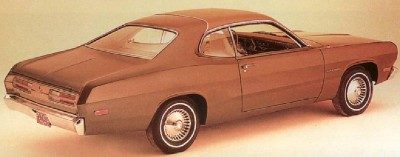
The Roof That Wasn’t Quite There
The 1972 Gold Duster package introduced a “canopy” vinyl roof. It didn’t wrap around. It covered only the forward section of the roofline. You could pick between two colors.
Designers hated it. They wanted a full wrap. They wanted drama. The planners didn’t care. The existing A-body platform was still moving units by the truckload. It commanded more than a third of the compact-car segment. Why fix what wasn’t broken? Why redesign a winning formula?
Stylists scrambled to inject some new flavor into the aging Duster. The changes weren’t everywhere. They were concentrated at the rear.
The taillights got wider. They were still split horizontally. But the split was different. It wasn’t cut through the sheetmetal anymore. It was defined by the argent plastic lens collar. A subtle shift. A hint of modernity in a boxy package.
Under the hood, the 340 cubic-inch V-8 remained the heart of the matter. But the numbers changed. Compression ratio dropped to 8.5:1. Net horsepower settled at 240. It was less aggressive than previous years, but still potent enough for enthusiasts who didn’t need to race in 1972.
You could add an electronic ignition system to any V-8. No more condenser. No more breaker points. Less maintenance. Fewer sparks in the wrong place.
And then there was the glove box.
Inside the door, attached to the inside panel, sat a two-quart plastic litter bag. Standard equipment. For the ecologically-minded buyer. Or perhaps just for the guy who wanted to keep his interior clean while smoking a cigarette or eating a greasy burger in his muscle car.
It’s strange to think about that plastic bag now. A small concession to a changing world. The roof was wrong. The taillights were slightly off. The horsepower was down. But the car still sold.
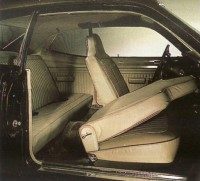
The front seats in the Gold Duster folded flat. This wasn’t just for style. It made getting into the rear bench significantly easier.
Plymouth kept the Twister Package alive. The Gold Duster returned for a second year. It wore a vinyl “canopy” roof over the front two-thirds of the car. Buyers could choose Gold Reptile or Black Boar grain vinyl. The texture added depth to the paint.
A full vinyl roof was still an option. But the styling had flaws. The vinyl stopped abruptly at the top of the rear quarter panels. The break looked unnatural. It looked ugly.
The look was finished with whitewall tires. Satellite wheel covers added chrome shine. Drip moldings protected the body. Special interior trim elevated the cabin. Gold lower deck panel tape stripes tied it all together. Total Duster production hit 228,012 units. That’s a lot of Valiant-based coupes.
1973 Space Duster Pak Strategy
There was no new Plymouth model launching in 1973. The company needed a reason to keep buyers interested. Planners focused on the existing Duster line. They created the 1973 Space Duster Pak. It was also called the Spacemaker Pak. The goal was simple. Improve the current car since a replacement wasn’t coming.
This package leaned into utility. It wasn’t about horsepower. It was about space. And packaging.
The 1973 Space Duster Pak was Plymouth’s answer to a stagnant model year.
Why the Space Duster Pak Mattered
Enthusiasts often forget the Duster started as a sporty compact. But by 1973, the market was shifting. Families needed practicality. The Space Duster Pak offered that. It retained the Duster’s reputation for handling. But it added versatility.
The interior layout was key. The folding seats were a direct response to buyer demand. Who wants a hard-to-reach rear seat in a sports car? Nobody. Plymouth listened.
Comparison to Previous Years
The Gold Duster’s canopy roof was a styling experiment. It worked for some. It failed for others. The full vinyl roof was a compromise. It covered more ground but looked disjointed. The Space Duster Pak dropped the fashion focus. It doubled down on function.
Which approach was better? The Gold Duster sold well because of its unique look. The Space Duster Pak kept sales steady when innovation stalled.
Details on the 1973 Package
The Spacemaker Pak wasn’t just a badge. It included specific options. The folding front seat was central. Rear seat access improved. Cargo space became more flexible. This made the Duster suitable for weekend trips. Not just drag strips.
Plymouth didn’t have a new model. So they tweaked what they had. It was a logical move. The Duster remained relevant. Even without a redesign.
For more information on cars, see:
-
Muscle Cars
-
Sports Cars
-
Consumer Guide New Car Search
-
Consumer Guide Used Car Search
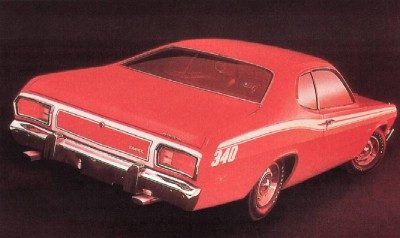
The 1973 Plymouth Duster didn’t just get a face lift. It got a complete overhaul of its utility and its street cred.
Engineers looked back at the 1964 Valiant Barracuda for inspiration. They reconfigured the body bracing to cut a hole in the firewall. This allowed the rear seatback to fold flat forward. A security panel behind it folded backward. The result was an opening 64 inches wide and 13.5 inches tall.
That created a fully carpeted cargo area. It stretched 6.5 feet long. Skis fit. Surfboards fit. You got 56 cubic feet of space.
Opt for the sunroof? It was metal in 1973, replacing the vinyl folding tops of 1971-1972. Taller objects slid right through the roof hole. The Space Duster option made the cargo capacity truly enormous. Plymouth Dusters had always swallowed loads, but this year they could haul serious gear.
The front end got a “freshening.” A new hood featured a raised “power dome” in the center. The grille shifted to argent rectangular horizontal boxes. These were eggcrate-filled and stacked three high. The center boxes matched the hood dome width. The outboard boxes were interrupted by parking lamps.
A bright molding ran along the top. It widened under the power dome to display the Plymouth name. New rectangular headlamp doors completed the look. The front bumper went deeper. Massive vertical guards fronted it to meet new federal bumper impact standards.
At the rear, the lamps moved to the outboard ends of the lower deck panel. They were framed in conventional bright bezels. The lenses remained split horizontally. These lamps were actually cheaper than the chromeless ones on the original Duster.
The combined changes added formality. They pushed the Plymouth Duster away from its hip, counter-culture roots. The Twister and Gold Duster packages continued with subtle tweaks. The Twister got a hood blackout treatment with smaller fake scoops. The Gold Duster offered side and deck panel striping in gold, black, or white.
The Plymouth Duster 340 received reworked body-side and rear striping. The front suspension saw updates. New upper and lower control arms joined improved upper ball joints and new knuckle arms.
V-8 equipped Dusters now came with front disc brakes standard. Power was included on the 340. All engines got electronic ignitions. Interior fabrics saw a considerable upgrade.
Production jumped. Plymouth Duster sales hit 264,974 cars.
Then came 1974.
The model year was largely a pass for standard changes. But Plymouth dropped the 360. This was a larger-displacement engine making 245 horsepower. It arrived in 1974 and stayed through 1975.
Most of the 1974-1975 Plymouth Duster 360 story is just about that engine. But the implications were huge.
Why did Plymouth add a 360 V8 to a compact coupe? The market was shifting. Safety standards were tightening. Emissions were choking performance. The Duster needed something special to keep up with the Challenger and the Camaro.
The 360 wasn’t a supercar. It was a stopgap. A final gasp of muscle car dominance in a shrinking segment.
It sat between the 340’s peak and the emissions-doomed 400. It was the last real chance to buy a cheap, heavy-hitting coupe from Plymouth.
But the Duster was never meant to last forever. The 360 arrived too late to save the genre. It arrived just in time to be its epitaph.
What happens when a muscle car gets too heavy? Too strict? The Duster knew.
It kept driving. Just a little slower.
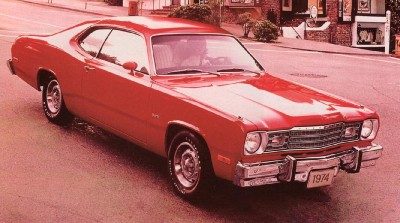
The 1974 Peak and the Death of Muscle
The Duster’s sales chart finally peaked in 1974. 281,378 units rolled off the line. That number is the highest it ever got for the model. The base model is the one pictured here.
But the marketing department tried to squeeze more life out of the dying embers. They kept the Twister and Gold Duster packages. You could even buy them as a combo. It was a gimmick. The real shift was mechanical. Plymouth slapped a larger-displacement engine into the lineup. They called it the Plymouth Duster 360.
It made 245 horsepower.
Buyers didn’t care. They built only 3,969 of these high-performance units. It was a paltry number. The muscle car era was officially dead. Chrysler marked the funeral by stopping Barracuda and Challenger production in April.
Why did sales tank? OPEC hit. The oil embargo started right as the 1974 model year kicked into gear. Gasoline became scarce in many areas. People got worried. They stopped buying big cars. Sales plummeted.
Chrysler had to pivot. In March, they introduced the Fuel Pacer System. It was an option. A small chrome casting sat on the left front fender. Inside was a light. It glowed when the carburetor enriched the fuel mixture.
The light signaled the driver to back off the accelerator.
It was a clever way to save gas. But it couldn’t save the performance image.
While the Duster hit that all-time high of 281,378 units, the parent brand was stronger. Valiant popularity reached its peak. All varieties counted, including the plush new Brougham line. Total production hit 476,818 units. This allowed Plymouth to capture third place in sales.
But the following year was a different story. The high mark was a plateau. Not a sustained rise. The market had shifted. Efficiency mattered more than power. And the Duster would have to adapt or fade.
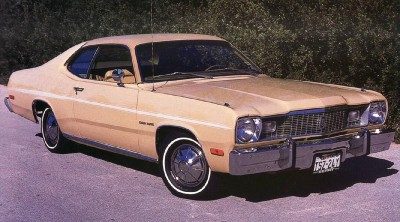
The 1975 Plymouth Duster: A Year of Struggle and Styling Shifts
Chrysler’s 1975 financial situation was dire. The company implemented a rotating three-month layoff for most engineering and styling staff. This cost-cutting move backfired. It delayed the launch of new F-body cars meant to replace the aging A-platform.
Despite the turmoil, the Plymouth Duster received significant updates. Studio manager Bob Eidschun designed a new grille. It featured a tight eggcrate texture. A center shadow box held the “frog legs” emblem. This was the first time the badge appeared since 1970.
The Duster Custom series also saw changes. The rear lower deck panel now had a bright applique panel running taillight to taillight. This “boiler plate” was standard on the Gold Duster too. Buyers could choose between a new bodyside tape stripe or protective molding. The tape stripe echoed the original Gold Duster’s design.
The Twister package was gone. But the Plymouth Duster 360 got gaudy new striping. It covered much of the upper quarter panels. This was the car’s final year. The 198-cubic inch Slant Six engine disappeared. The 225 became the base six.
Why the 1975 Changes Mattered
The 1975 Plymouth Duster wasn’t just a facelift. It was a response to financial pressure. The company was trying to save money. The rotating layoff hurt development. The F-body replacement for the A-body was delayed.
The new grille was a key visual change. The eggcrate texture looked sharp. The “frog legs” emblem returned. This badge had been absent since 1970. It signaled a return to form for Plymouth.
The Duster Custom series added a bright applique panel. It ran across the rear lower deck. This panel was also on the Gold Duster. Buyers could pick a bodyside tape stripe or protective molding. The tape stripe matched the original Gold Duster’s look.
The Twister package was discontinued. But the Duster 360 got new striping. It covered the upper quarter panels. This made the car stand out. The 198-cubic inch Slant Six engine was dropped. The 225 became the base engine.
The End of an Era for Plymouth Duster
1975 was a transitional year. The Duster was aging. The company was struggling. The new grille and badging offered a fresh look. But the underlying issues remained.
The F-body delay was a major setback. It meant the next generation was late. The Duster had to hold the line. The new styling helped. But the financial strain was real.
The Twister package was gone. The Duster 360 got a more aggressive look. The striping was bold. It covered the upper quarter panels. This was a final flourish for the performance-oriented Duster.
The engine lineup changed too. The 198-cubic inch Slant Six was gone. The 225 became the base. This simplified the options. But it also reduced variety.
What Remains of the 1975 Duster?
The 1975 Plymouth
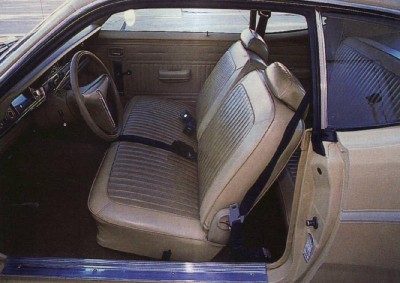
Standard Gold Duster seating consisted of a split-bench seat. High-back seats with integral headrests and a pulldown armrest could be ordered.
By now, the upcoming launch of the next-generation compacts occupied the corporation’s attention. Though the semi-fastback F-body coupes were clearly intended as Duster/Dart Sport replacements, management decided to call the new lines Plymouth Volare and Dodge Aspen.
There were a number of reasons for this decision. One of them, ironically, was the popularity of the Duster and Dart — they were common, perhaps too common. Another was their reputation as good basic transportation.
Chrysler, however, wanted a more upscale image for the forthcoming compacts to compete successfully with the new Ford Granada and Mercury Monarch. Hence, the new names, despite some last-minute experimentation with “Valiant Volare” name-plates.
With the corporation’s problems headlined in the media and word of the new compacts leaking out, Duster production dropped dramatically in 1975 to 120,131, barely ahead of the Valiant sedan.
The Plymouth Duster 360 had its final year of production in 1976 — a disappointing final year that attracted less than 35,000 buyers. Find out more about the 1976 Plymouth Duster 360 on the next page.
For more information on cars, see:
-
Muscle Cars
-
Sports Cars
-
Consumer Guide New Car Search
-
Consumer Guide Used Car Search
1976 Plymouth Duster 360
With all the hoopla surrounding the introduction of the 1976 Volare (it was Motor Trend Car of the Year), for the first time it was easy to forget there still was a 1976 Plymouth Duster 360.
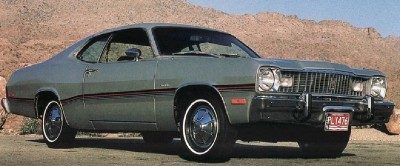
The Silver Duster: A Final, Striking Flourish
The 1976 Silver Duster wasn’t just another trim level. It was a final statement. Pared to the bone, this last-year model stripped away the fluff. Buyers chose between the base 225-cubic-inch six-cylinder or the 318-cubic-inch V-8. The 360? Still there if you had money to burn and lived outside California. But the Duster 360 badging was gone. So was the Duster Custom.
In its place came the one-time-only Silver Duster package. Think of it as the Gold Duster’s cooler, slightly more expensive cousin. The canopy vinyl roof remained, but the real show was the striping. Red and black graphics traced the lower body character lines, sweeping up to cross between the taillamps. Inside, Boca Raton cloth and vinyl spiced up the cabin. It was colorful. It was different.
The Feather Duster: Engineering for MPG, Not Ego
Chrysler engineers got weird with the 225 Slant Six. They wanted every drop of fuel economy out of it. The result was the “Feather Duster,” a $51 option package that sounds like a joke but wasn’t.
This wasn’t just a sticker. It involved serious weight reduction. Lightweight aluminum components replaced steel in the hood, decklid inner panels, bumper reinforcements, and intake manifold. The 225 was specially tuned with a single-throat carb. A specific 2.94:1 rear axle ratio was standard. You could even add a manual overdrive transmission with an aluminum case for extra weight savings. Total drop? 187 pounds.
“The Feather Duster came with a specially-tuned 225 Slant Six with a single-throat carb and an economy-minded 2.94:1 rear axle ratio.”
There was a catch, of course. To hit those promised gas mileage numbers, Chrysler severely restricted the list of available options. No power windows. No fancy radios. Just weight reduction and a single-barrel carburetor. The name “Feather Duster” was stamped on the front fenders, proudly declaring its efficiency mission.
Lean Manufacturing Before It Had a Name
Sales numbers tell the story of the end. In 1976, the Duster 360 (and the rest of the line) tempted 34,681 buyers. That’s nearly 6,000 fewer than the Valiant sedan sold. The era of massive muscle coupe dominance was fading.
Yet, look at the seven-year run. More than 1.3 million Plymouth Dusters rolled off the line. That is a staggering number for a compact coupe in the 70s. But it wasn’t just about volume.
According to Weiss, the Duster taught Chrysler lessons that wouldn’t be named until decades later.
“With the Duster, Chrysler learned a lot about line simplification, reducing part numbers, using less manpower, etc. It was our progenitor of ‘lean manufacturing.'”
By building essentially the same car year after year, manufacturing processes tightened. Quality improved. Costs were wrung out. It was efficiency disguised as a sporty coupe.
Why the Duster Mattered
People bought Dusters for fun. That was the point. It wasn’t just about horsepower or torque curves. It was about freedom. In a decade of unorthodox names like Road Runner, Judge, Boss, and Eliminator, the Duster fit right in. It had Mod Tops. Tuff wheels. Shaker hoods. Beep-beep horns. Wild colors. Outrageous graphics.
While performance justified its creation, the majority of buyers chose the six-cylinder models. They wanted the style. They wanted the practicality. They wanted something that looked hip and cool without breaking the bank.
Legacy and Collectibility
Did the Duster die in 1976? Not entirely. The name was “dusted off” later. The 1979-1980 Volare Duster Sunrise carried the torch. It appeared during the last few years of Sundance production too. Chrysler kept the name alive as a marketing tool.
But is it collectible now? Chrysler thinks so. They bought a Duster 340 to add to the collection at the Chrysler Historical Museum on the Auburn Hills campus. That’s not just nostalgia. That’s historical significance.
The data below covers the full run from 1970 to 1976. It shows how the Duster grew from a freshened-up Valiant into a million-plus seller. Then, slowly, it shrank back down.
1970-1976 Plymouth Duster Specifications and Sales Data
When product planners were handed $15 million to freshen the dowdy Valiant for 1970, nobody predicted the sporty, fastback coupe would become a phenomenon. Here is the raw data.
1970 Plymouth Duster
* Base Duster (226ci, 2-speed auto): 2,830 lbs | $2,172 | 192,375 units
* Duster 340 (340ci, 4-speed auto): 3,110 lbs | $2,547 | 24,817 units
* Total Production: 217,192
1971 Plymouth Duster
* Base Duster: 2,825 lbs | $2,313 | 173,592 units
* Duster 340: 3,140 lbs | $2,703 | 12,886 units
* Total Production: 186,478
1972 Plymouth Duster
* Base Duster: 2,780 lbs | $2,287 | 212,331 units
* Duster 340: 3,100 lbs | $2,742 | 15,681 units
* Total Production: 228,012
1973 Plymouth Duster
* Base Duster: 2,830 lbs | $2,376 | 249,243 units
* Duster 340: 3,175 lbs | $2,822 | 15,731 units
* Total Production: 264,974
1974 Plymouth Duster
* Base Duster: 2,975 lbs | $2,829 | 277,409 units
* Duster 360 (360ci, TorqueFlite): 3,315 lbs | $3,288 | 3,969 units
* Total Production: 281,378
1975 Plymouth Duster
* Base Duster: 2,970 lbs | $3,243 | 79,884 units
* Duster Custom: 2,970 lbs | $3,418 | 38,826 units
* Duster 360: 3,315 lbs | $3,979 | 1,421 units
* Total Production: 120,131
1976 Plymouth Duster
* Base Duster: 2,975 lbs | $3,241 | 34,681 units
* Silver Duster (Special Package): Included in base production
* Total Production: 34,681
The line ends here. The numbers drop off a cliff. But 1.3 million cars is a lot of rubber on the road. And a lot of memories left in the rearview mirror.